New walk dates, researching talks and return of The Hine Hike
Thanks to everyone who braved the weather for Deco in the Details Part 1 last weekend, and to everyone who came down to The Vat & Fiddle for my Watson Fothergill in the Park Estate talk. Your continued interest in Nottingham’s buildings and my own unique and “entertaining” take on them is much appreciated! Read to the end for new walking tour dates for April 2026.
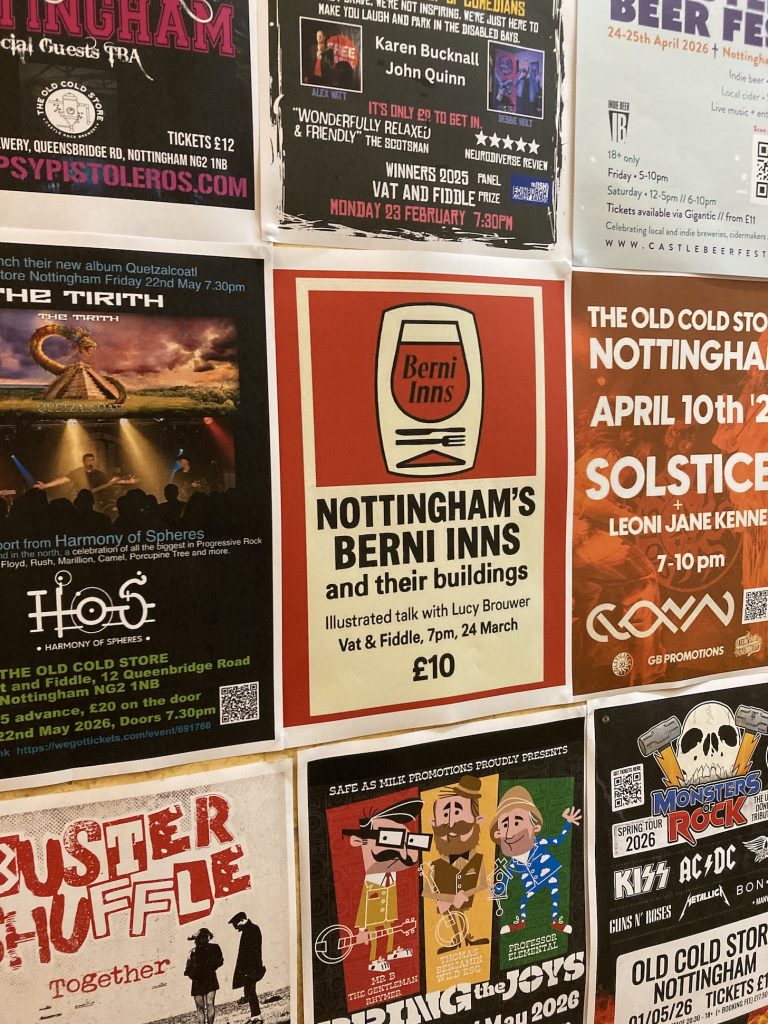
Poster at The Vat & Fiddle, February 2026
I’m deep into the research for my new Nottingham’s Berni Inns and their Buildings talk. Sometimes you just have to follow the idea and see where it leads… Expect tales of old buildings given new life, familiar menus, retro adverts and maybe a little misty-eyed nostalgia for nights out gone by!
There are still a few tickets remaining for the date at
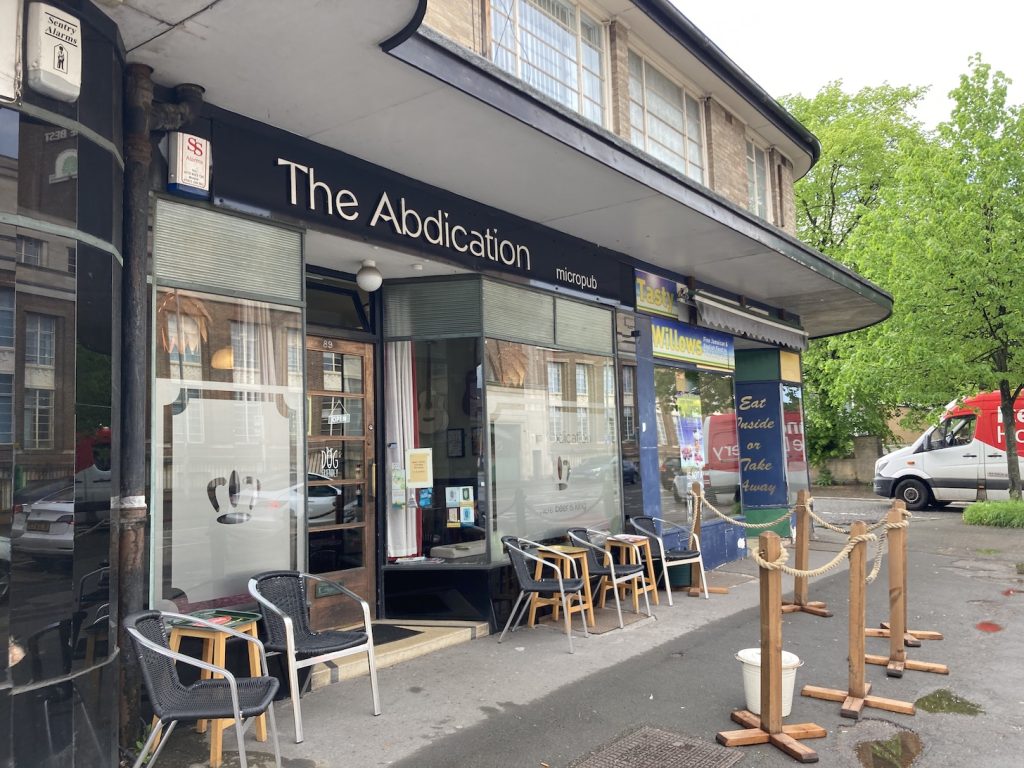
There will be another date for the Berni Inns talk at The Abdication Micropub, Daybrook, on Tuesday 21 April, 7 pm – email the pub for tickets or drop in to pay cash. All talk tickets are £10 each.
The Abdication, Coronation Buildings, Mansfield Road, Daybrook.
All walk tickets are £20 each. Click the links for full information.
A reminder: well-behaved dogs on leads are welcome on the walks.
I’m now taking bookings for private tours with availability on weekdays into the summer. Please drop me a line to organise a walk for your group of 6 or more (maximum group size: 20 people). Versions of all my tours are available for private bookings. If you’d like a personal tour for a smaller group these can be arranged to suit your requirements. Talks are also available for groups. Email me via my website.
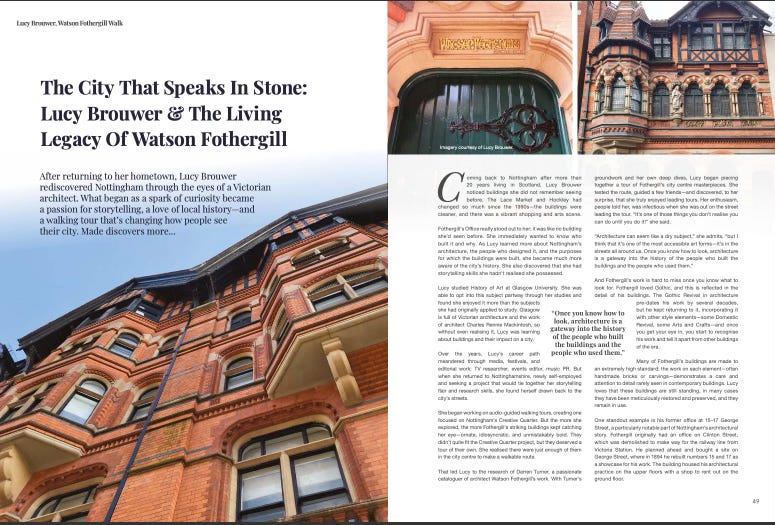
Keep looking up! Fothergill’s Office on George Street, Nottingham. Photo: Lucy Brouwer
Thanks for reading Watson Fothergill Walk – Lucy Brouwer! Subscribe for free to receive new posts and support my work.
Building histories… an occasional series. Plus a new talk at the Vat & Fiddle in March.
Deco in the Details Part 1 is now sold out, and there are 6 tickets remaining for Deco in the Details Part 2 on 29th March, 11 am. I will also hopefully be doing these walks again later in the year.
The Watson Fothergill Walks in February and March have tickets still available, if you haven’t joined me yet for a tour of my favourite Nottingham buildings, then make sure you don’t miss out this year. Read on to the end for news of a new illustrated talk at the Vat & Fiddle in March.
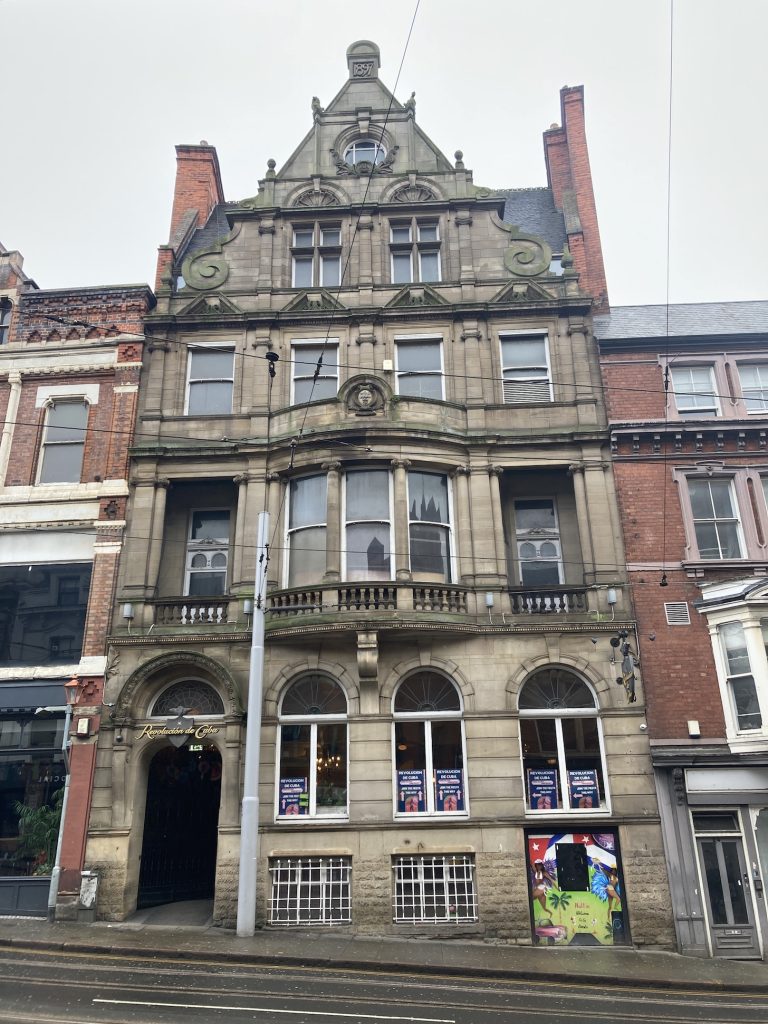
Thanks to my correspondent Hazel C for suggesting I look into the history of 26-28 Market Street, Nottingham. It has just been put onto the market for sale, with the present tenants Revolucion de Cuba, staying on inside.
This Flemish Renaissance-style grade II listing building, which was built from 1897 and opened in 1899, was designed by architect A.R.Calvert as The Nottingham and County Constitutional Club. At the time of his death in 1922, he was still the club’s secretary.
Alexandra House, Market Street, Nottingham. Photo: Lucy Brouwer.
It was originally built as the headquarters of The Nottingham and County Constitutional Club, one of several gentlemen’s clubs in the city in the late Victorian period. It was organised as a place for supporters of the Conservative and Unionist Party to meet and discuss the political events of the day, socialise and use the facilities. Their chairman at the time was the Solicitor James McCraith (coincidentally a colleague and client of Watson Fothergill).
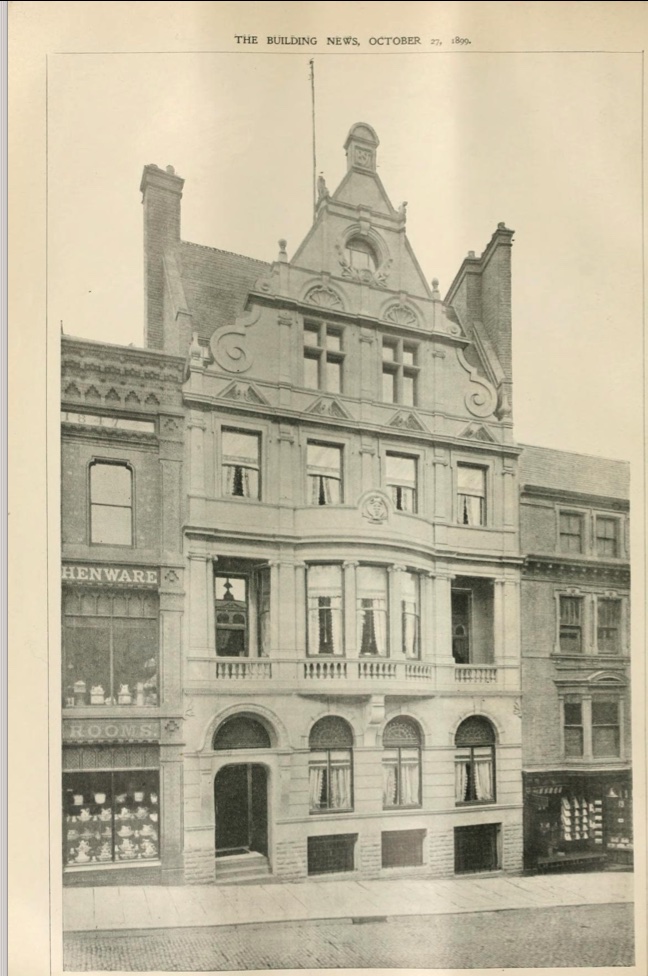
The newly completed Constitutional Club, 1899 (The Building News, Internet Archive).
When newly built, The Constitutional Club was considered “one of the most complete and well-equipped clubs outside London.” Inside were a smoking room, billiard room (three tables), and assembly hall on the ground floor. On the second floor, behind the balconies, were dining rooms, a committee room, reading, writing, and card rooms. At the top of the building were bedrooms for members, a bathroom and a steward’s room. Disconnected from these were a kitchen, scullery and servants’ bedrooms. There was a large skittle alley in the basement and a ladies’ room, decorated in peacock blues and white, “separate from the club proper”, (as not yet having the vote, the ladies were not allowed membership.)
The front of the building was constructed in Derbyshire stone, the entrance porch was panelled in Kilkenny and Languedoc marble, with a mahogany screen containing antique glass. A period photograph held by Historic England shows that the terrazzo floor, which can still be found in some places inside, is likely original.
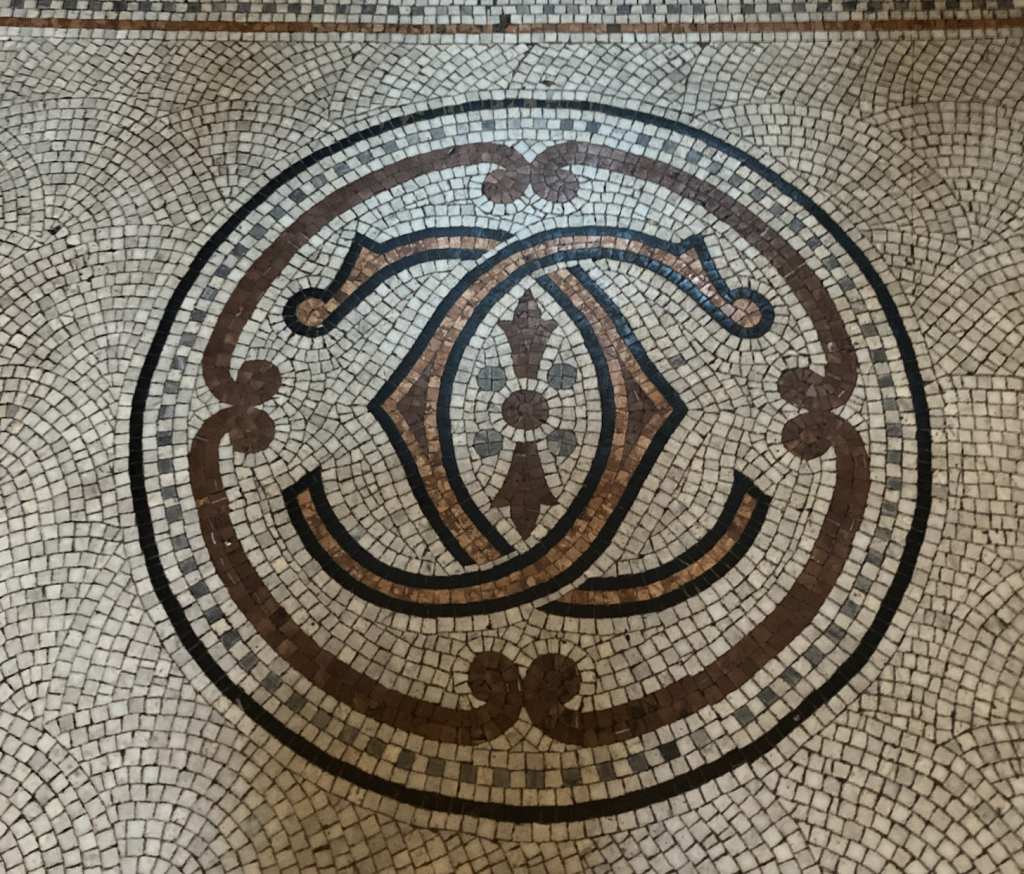
CC for the Constitutional Club, found at the entrance to the building. Photo: Lucy Brouwer.
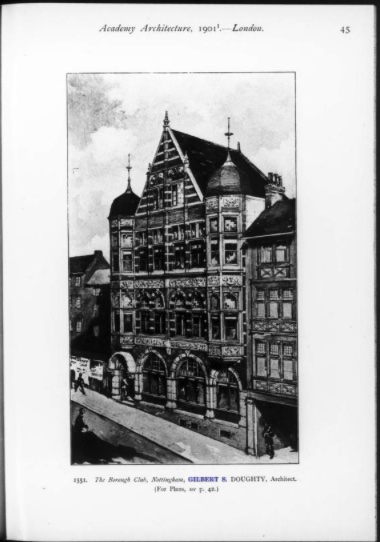
Over the years, these clubs and their lavish buildings fell out of fashion and became expensive to maintain. The Borough Club, which had a similarly decorative building on King Street, completed to designs by the architect Gilbert Smith Doughty, merged with the Constitutional Club in 1959. The building on King Street was sold to the Nottingham Corporation and subsequently demolished.
The Borough Club on King Street to a design from Academy Architect Magazine.
The Market Street Building and the organisation both took on the name “The Borough Club”. This building in turn, became too large and was sold off in 1968. The club had also merged with The Nottingham Reform Club (who themselves had sold off its Victoria Street building – Now The Cosy Club). In 1969, in an effort to bring themselves up to date, the merged clubs moved to the Midland Design & Building Centre, then a new modern building on Mansfield Road (and itself now demolished). The city’s politically-minded clubs now seem to have been absorbed by Conservative Party organisations, and the era of Gentlemen’s clubs is long gone – if you search for them now, you’re more likely to find listings for lap dancing establishments!
The next use for the Market Street building was as a Berni Inn. When The Black Boy Hotel on Long Row (whose many alterations and rebuilding works were carried out by Watson Fothergill) was demolished in 1970, the license was transferred to these premises, and it was refurbished with some of the hotel’s fixtures (including a small statue of an enslaved boy – which came up for auction a couple of years ago). It was renamed The Black Boy Inn, claims were made that the name and the history of the old hotel came from the time of King Charles II, whose nickname was apparently “Black Boy”, thanks to his dark hair. A likely story!
Berni Inns, a British restaurant chain whose accessible and straightforward Steak and Chips menu did much to democratise eating out in post-rationing Britain, had several establishments in Nottingham. In December 1971, The Black Boy Inn on Market Street opened. It eventually was home to four bars with seating for 330 people. As well as their trademark steaks, in the mid 1970s it served pizza and boasted a female DJ in its DiscoDine bar.
Berni traded here until 1988, when the building closed for refurbishment, reopening as Old Orleans, a Louisiana Jazz theme bar and restaurant, with the City Trading House bar in the basement.
In December 2015, Revolucion de Cuba took over the site from the relatively short-lived Long Island American Diner (Here from 2014. If anyone can remember the name of the nightclub on the upper floor, please let me know!)
Part of the Revolution chain of bars, it has recently been taken over by a new consortium and will be having a spruce up as the building goes on the market once again, valued at almost £2 million. (Check the listing for more pictures of the interior.)
All this has inspired me to dig deeper into the history of Nottingham’s many Berni Inns and their buildings, and I will be presenting my findings at The Vat & Fiddle on Tuesday 24th March, 7pm. Tickets are £10.
If you have any Nottingham Berni Inn memories to share or photos of the interiors of any of Nottingham’s many Berni Inns, I’d love to take a look. Drop me a line here.
My next Vat & Fiddle talk, on Watson Fothergill in the Park Estate, is now sold out. However, if you’d like to book me to give a talk to your group or club, please do not hesitate to contact me.
The weather has not been particularly conducive for tours this month, so I took a day off for a wander around Beeston. (This is not a guided tour, just something I do!)
Beeston’s history is well-documented, and the Beeston Civic Society have been doing great work. If you live there or visit, you’ll know that there are loads of cafes and bars, interesting shops and charity shops. A few buildings caught my eye…
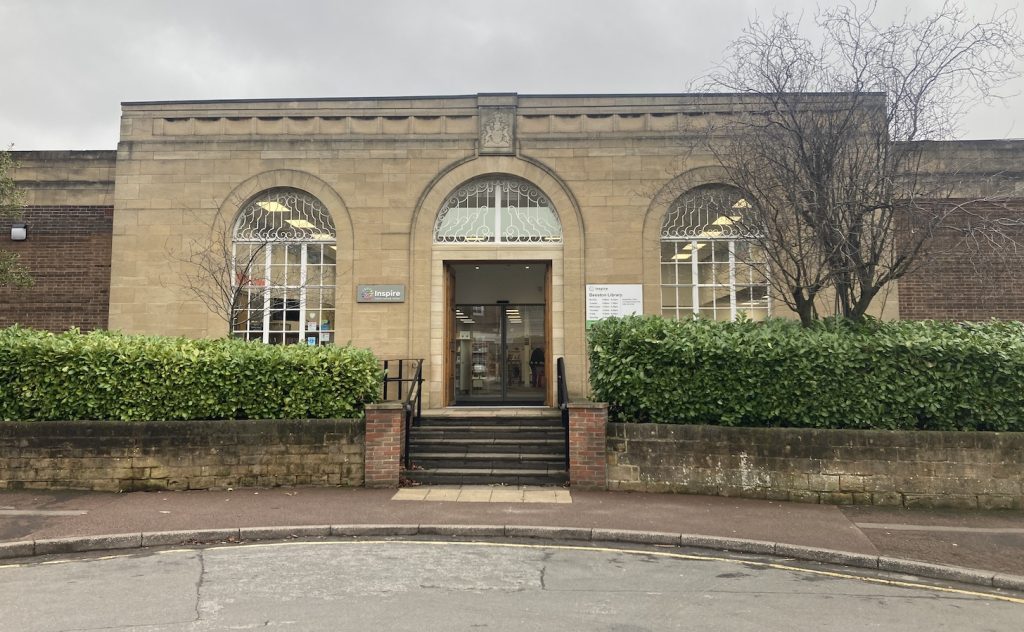
Beeston Library, Photo: Lucy Brouwer.
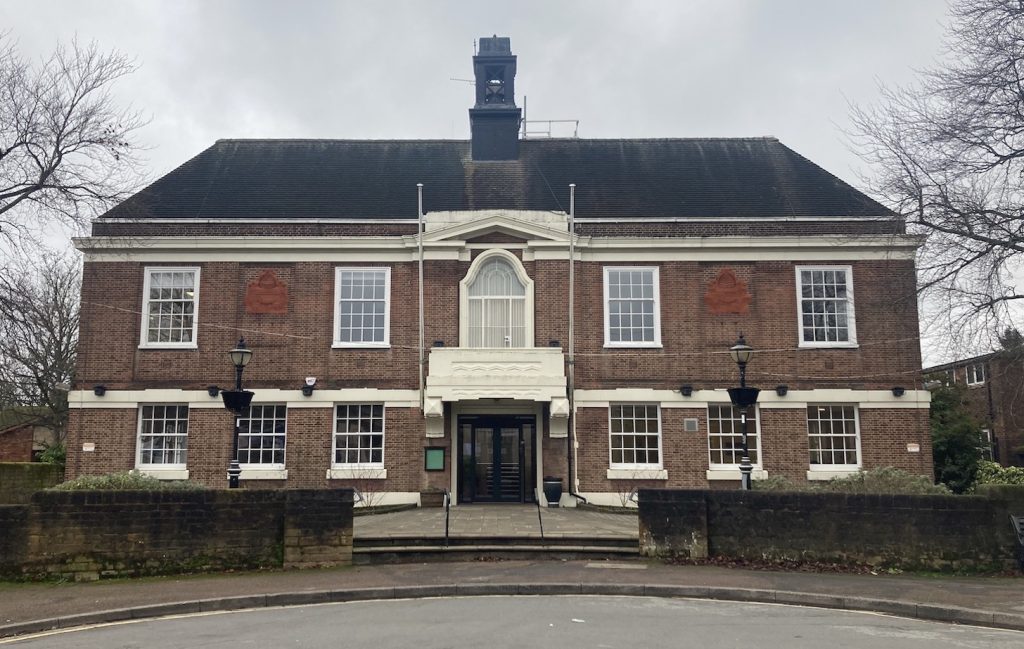
As a former Library Assistant and full-time bookworm, I made a beeline for Beeston Library. The building on Foster Avenue was designed by the County Architect E. W. Roberts in 1938. He was also responsible for West Bridgford Library. The builders of the Library, local firm Hofton & Son, also built Beeston Town Hall, which is now used as a church, and sits opposite. It opened in 1938 and was designed by the architects Evans, Clark & Wollatt with H.H. Goodall. It has a solid Neo-Georgian look with Art Deco details.
Former Town Hall, Beeston. Photo: Lucy Brouwer.
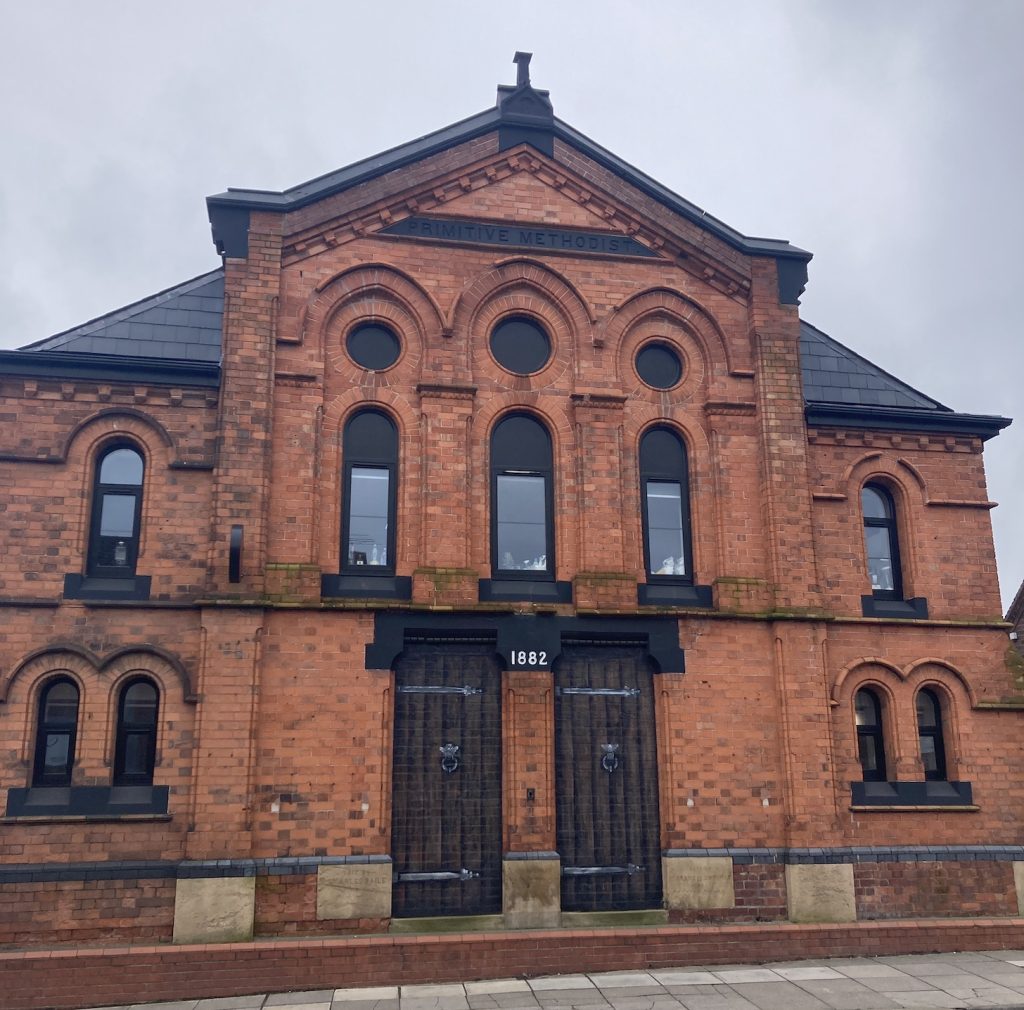
After a very nice coffee at Greenhood, itself in a former Birds the Confectioners shop on the High Road, our daunder** took us past the former Primitive Methodist Church on Wollaton Road. This 1882 building was one of many Victorian-era Methodist churches by Nottingham architect Richard Charles Sutton.
Former Primitive Methodist Church, Beeston. Photo: Lucy Brouwer.
R.C. Sutton was a very prolific architect in his day; his buildings can be found all over Nottingham and outlying areas. I’m hoping to explore his work and his connections to Bromley House Library, where he had his office, further this year.
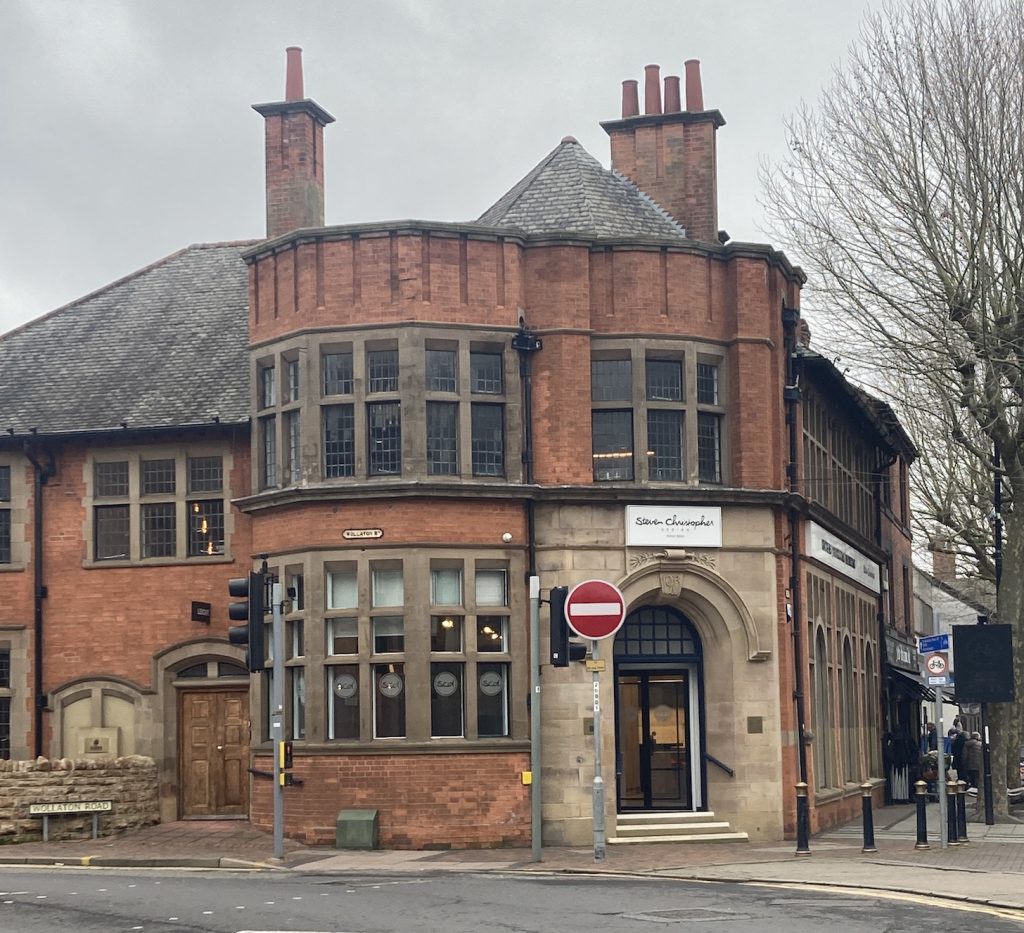
Back on the High Road, the former NatWest Bank stands out. It was originally built for the Nottingham and Notts bank, 1905-08, and was likely designed by the Coalville architect Thomas Ignatius McCarthy. The Pevsner guide describes it as “abstracted Neo-Tudor.” It ceased to be a bank in 2023 and is now a kitchen showroom.
Former Nottingham & Notts/ NatWest Bank, Beeston. Photo: Lucy Brouwer.
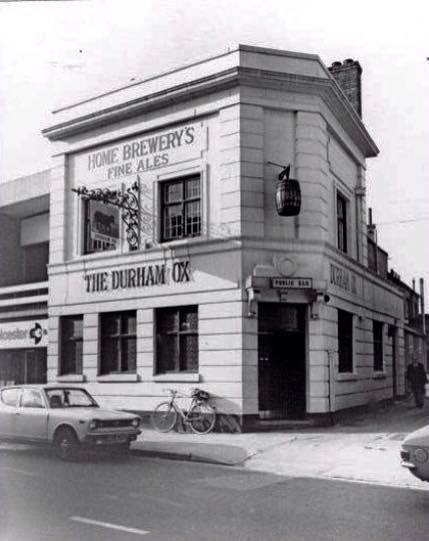
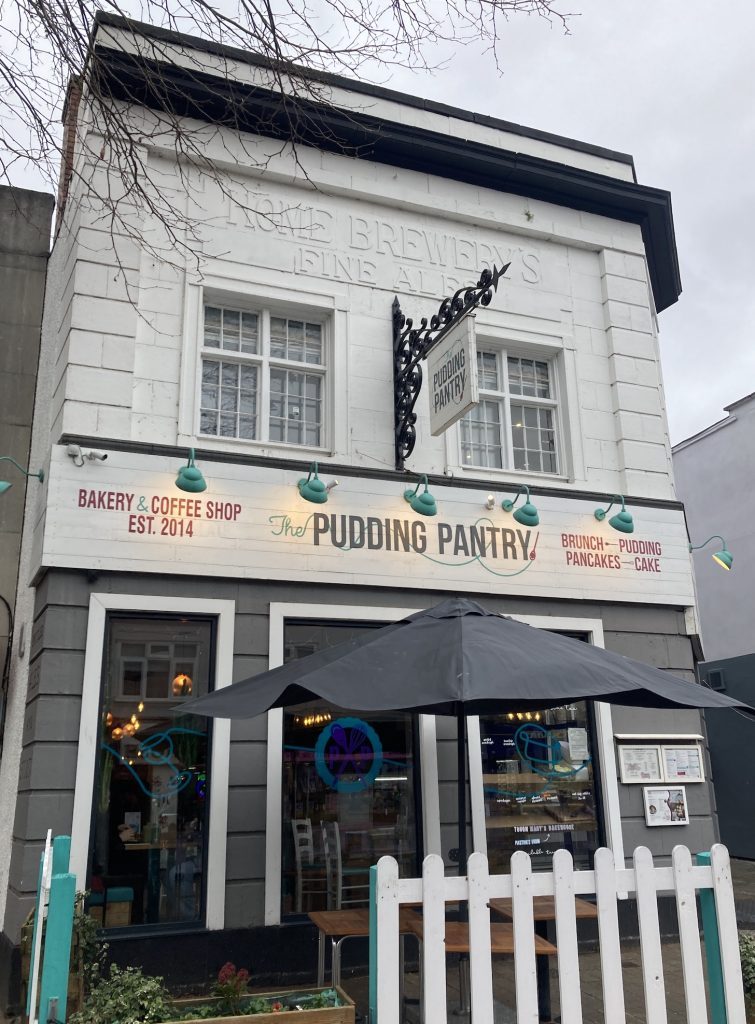
Further down the High Road, the familiar Home Brewery lettering on a white building caught my eye. The Pudding Pantry cafe was previously The Durham Ox pub.
A very detailed history of the pub can be found on David Hallam’s Beeston History website. The present building was built in 1925, and was one of many pubs rebuilt by the Nottingham architect Albert Edgar Eberlin, as mentioned in my Art Deco Pubs talk. Eberlin also worked on The Fox, The Royal Children, The Beechdale and many more pub buildings around Nottingham.
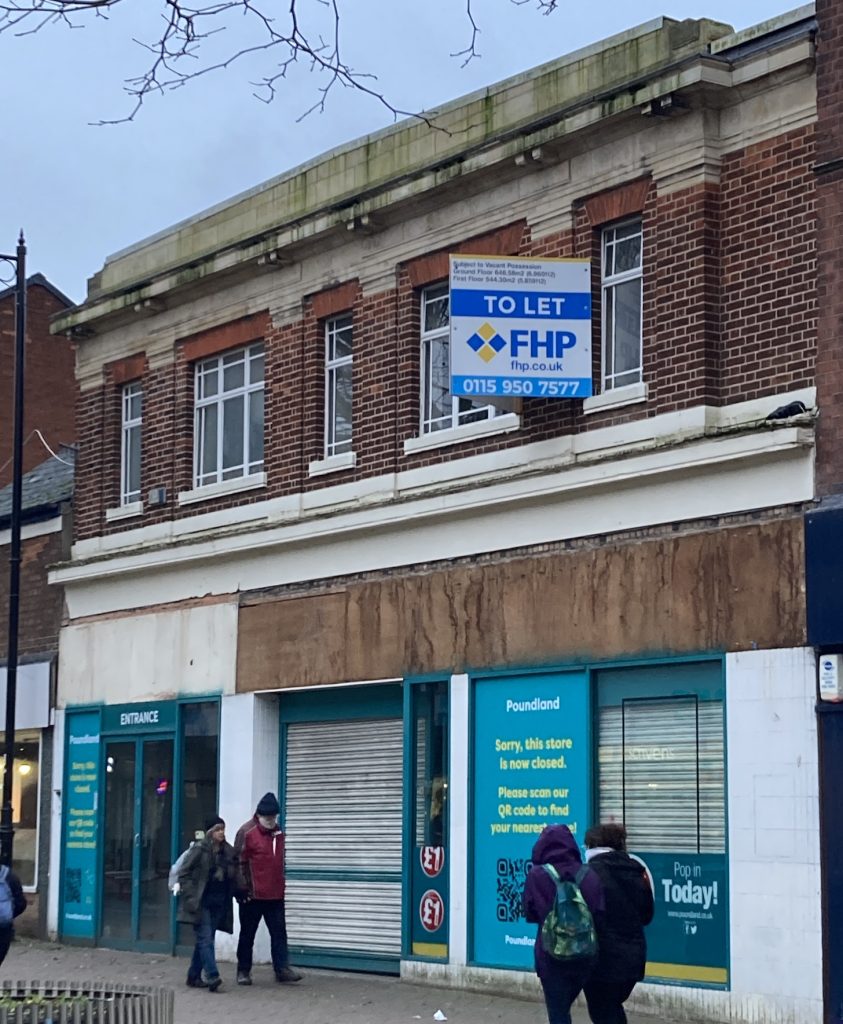
Another Deco-era building I noticed, the recently closed Poundland, was in fact a former Woolworths.
This was Woolworth’s store 578 and was completed in 1934 by their in-house architect, Harold Winbourne. I noticed the parapet and margin glazing in the metal-framed windows. Head over to the Woolies Buildings website for archive pictures of this one in its former glory and to Building Our Past for shop architecture historian Kathryn A. Morrison’s in-depth look at Woolworths and their architects.
Does your neighbourhood have any buildings that catch your eye? Look up and see what you can see next time you’re out. Or if you have a building you’d like me to research – get in touch.
* Bimble; English, informal: a leisurely walk or journey.
** Daunder; Scots: to stroll, saunter or wander aimlessly.
Thanks for reading Watson Fothergill Walk – Lucy Brouwer! Subscribe for free to receive new posts and support my work.
Thanks to Lamar Francois, Dan Simpkin, Louise Hunter & Lucy Simons for the photos.
Into the mix in 2026
Both my talks (Art Deco Pubs and Watson Fothergill in The Park Estate) at The Vat & Fiddle are now sold out, but I’m looking at doing some more later in the year.
Tickets are now available for my architecture tours Deco in the Details Parts 1 & 2 and Watson Fothergill Walk. I hope you can join me to explore the architecture of Nottingham city centre. My original tour looks at the work of Victorian architect Watson Fothergill. (Did I mention it has 5 star reviews on TripAdvisor?)
Deco in the Details is in two parts, each looking at a different side of Nottingham, exploring the history of the buildings of the 1920s & 1930s and looking at what makes the Art Deco style. (Do one, do both, it doesn’t matter in which order!)
The first tour dates of the year are as follows, with more info and ticket details via these links:
All tickets £20 each (plus relevant booking fees). There will be more tours coming up, including my other walks The Hine Hike, The Carrington Crawl, and hopefully some new ideas too.
If you have a gift voucher, please use the GIFT VOUCHERS ONLY section at checkout. Gift vouchers must be used one at a time – if you have any queries or would like to book directly, please drop me a message via my website and I can make the voucher booking for you.
I am also available for private tours. Any of my walks can be done for private groups and I’m often available on weekdays. Please send me a message to organise a tour for your group of up to 20 people.
Thanks for reading! Subscribe for free to receive new posts and support my work.
Book the newly renovated function room in a Fothergill building
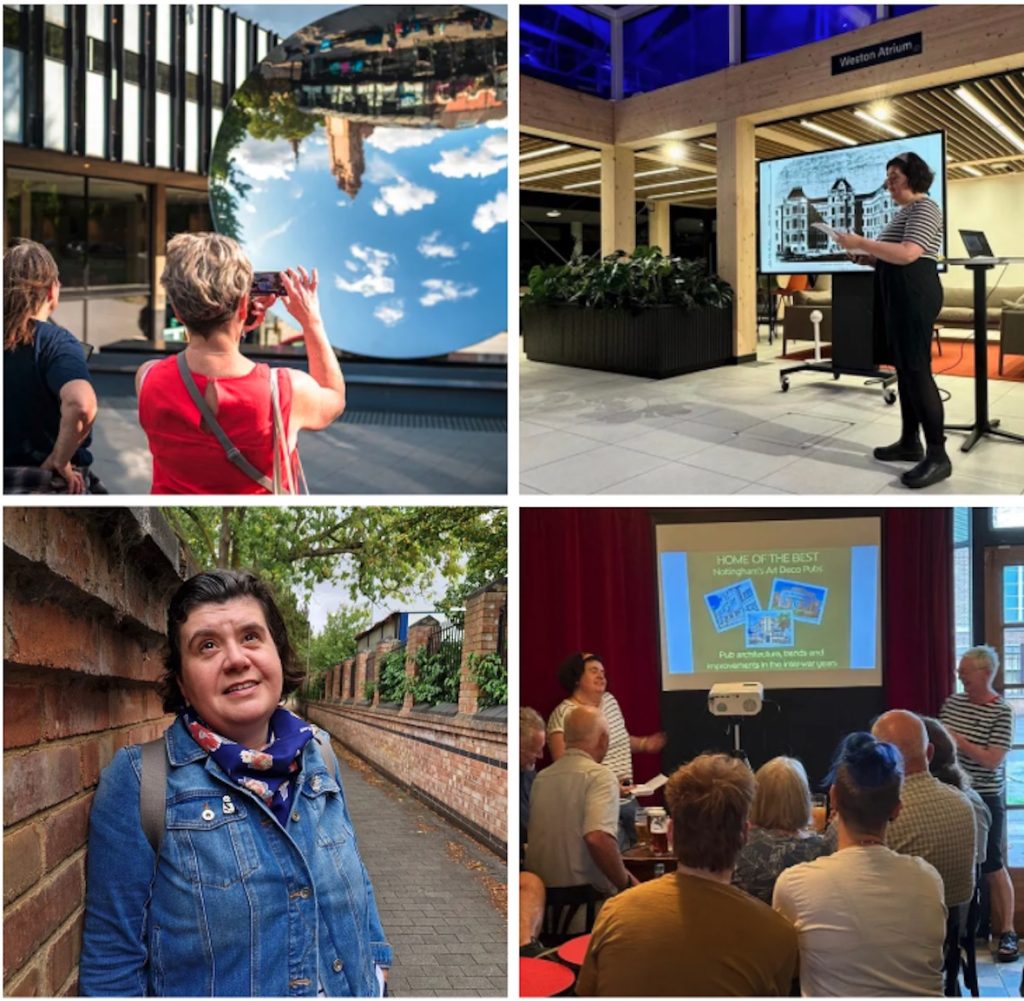
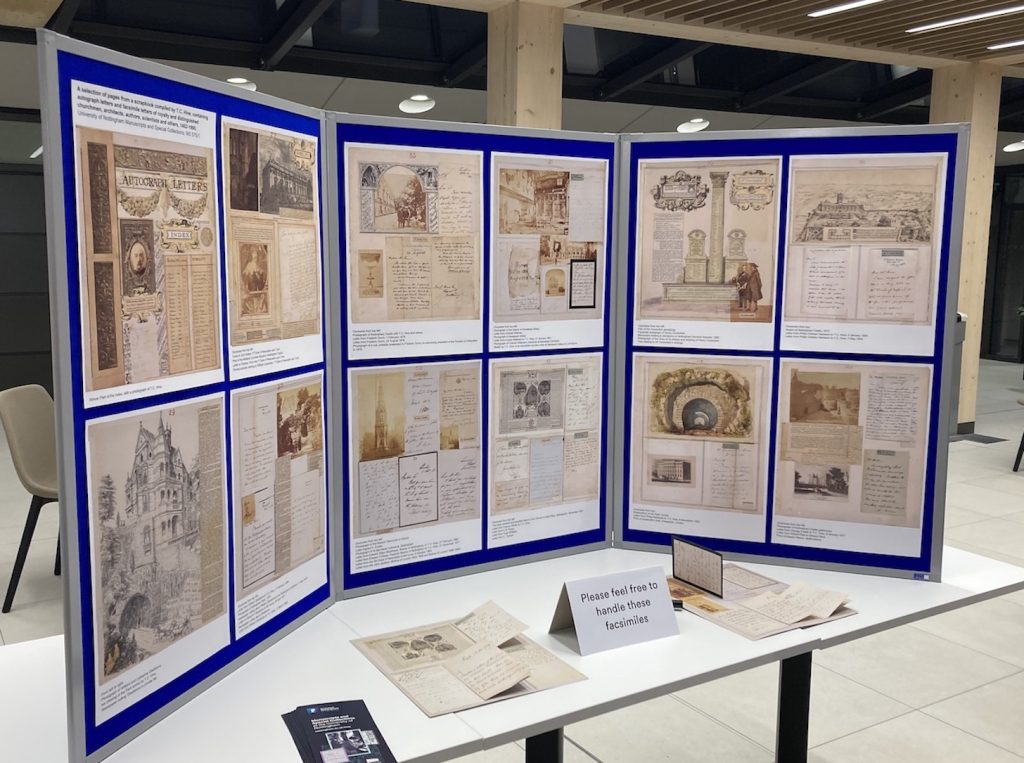
Thanks to everyone who came to the Introducing TC Hine event at the University of Nottingham. It was great to see some familiar faces and to explore the City as Lab project.
Some pages from the digitisation of TC Hine’s scrapbook. (Photo: Lucy Brouwer)
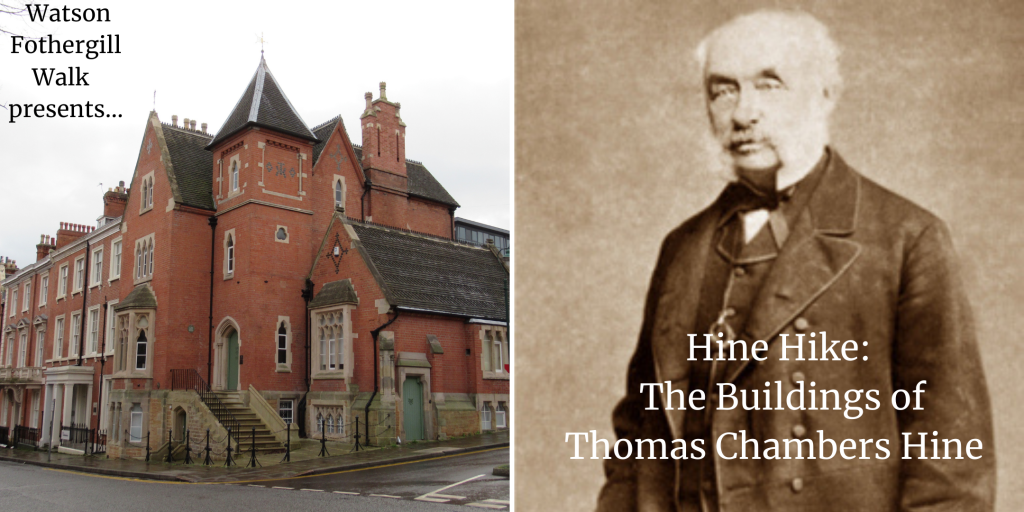
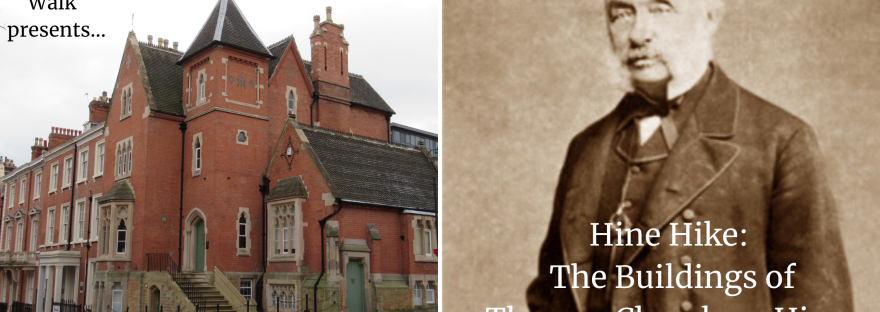
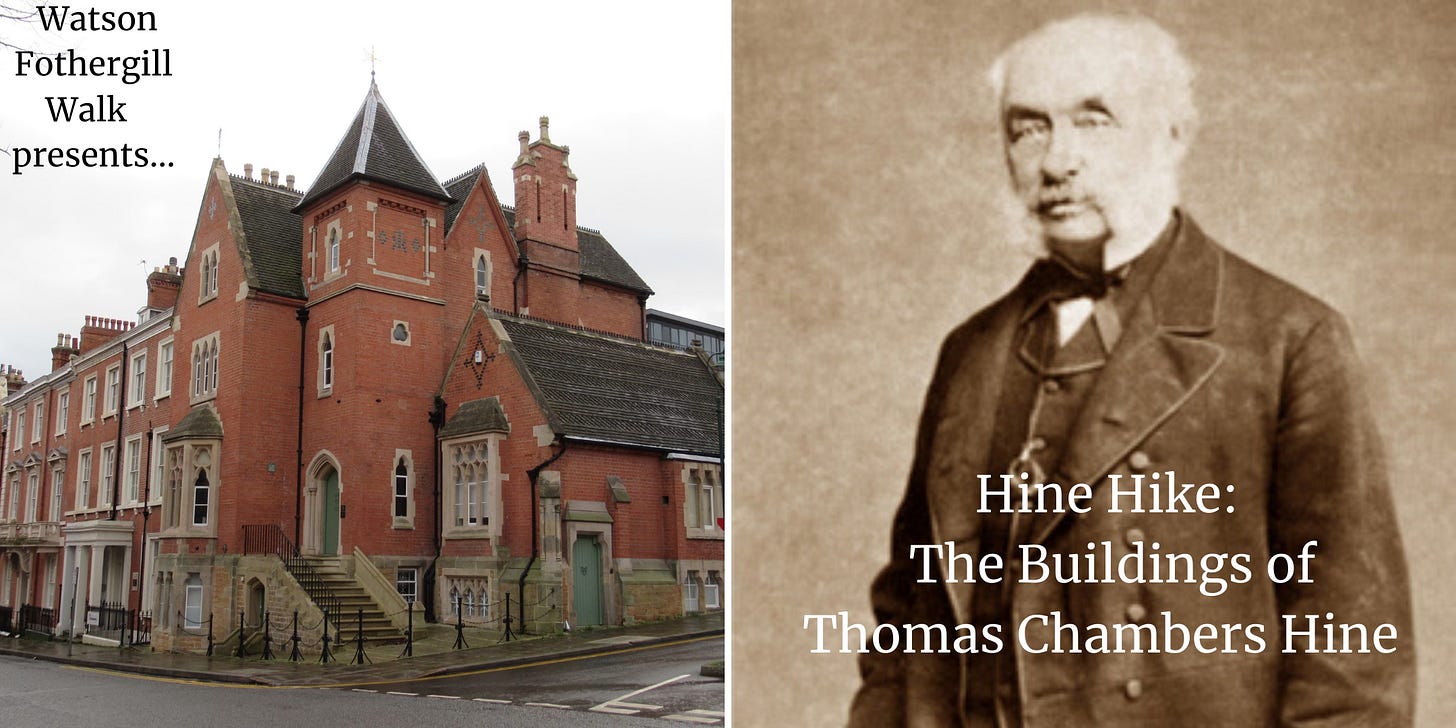
To continue the TC Hine theme, I’m offering my Hine Hike tour on Sunday 14 December, 11 am. This tour surveys the Nottingham city centre buildings of the Victorian architect Thomas Chambers Hine, from The Park Tunnel to The Lace Market and gives an introduction to his life and work.
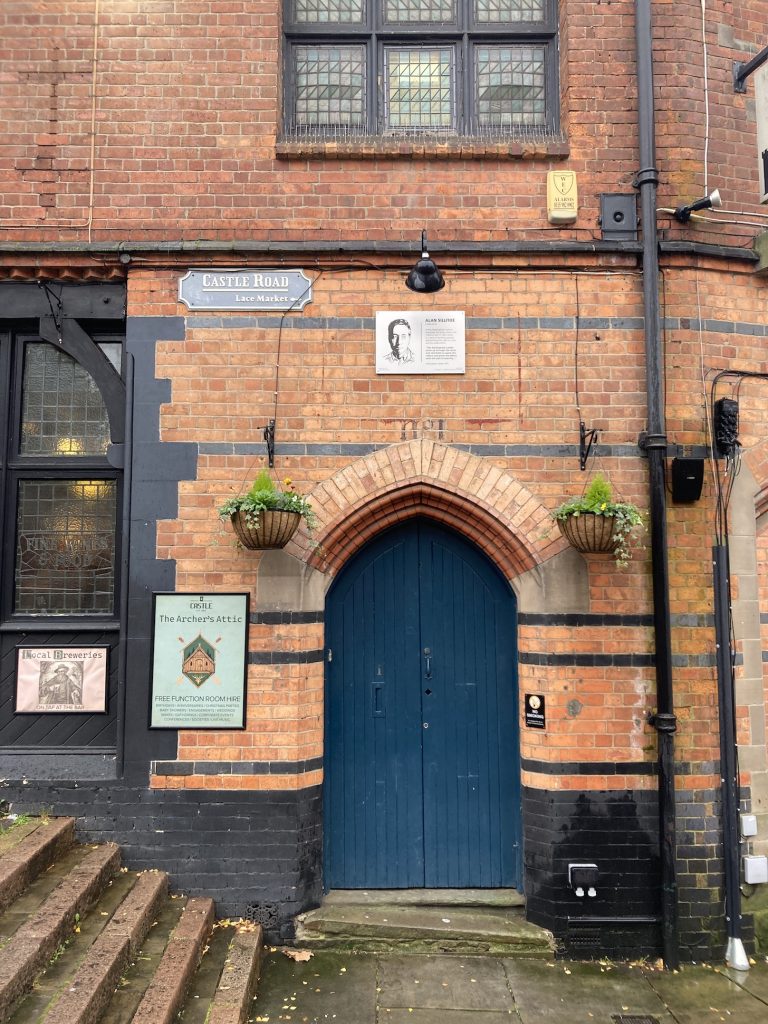
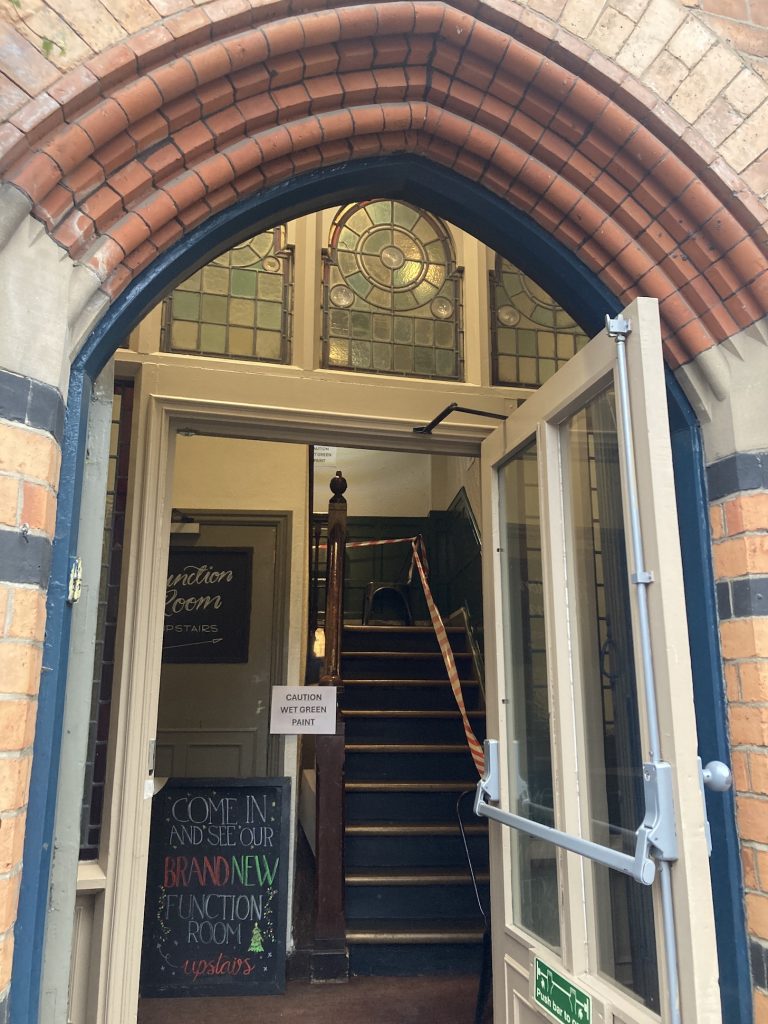
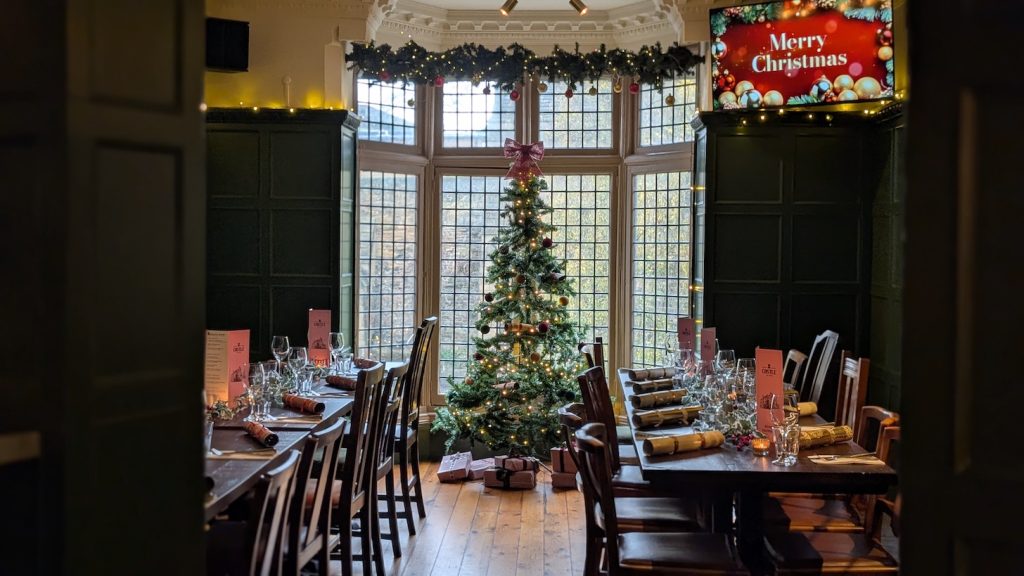
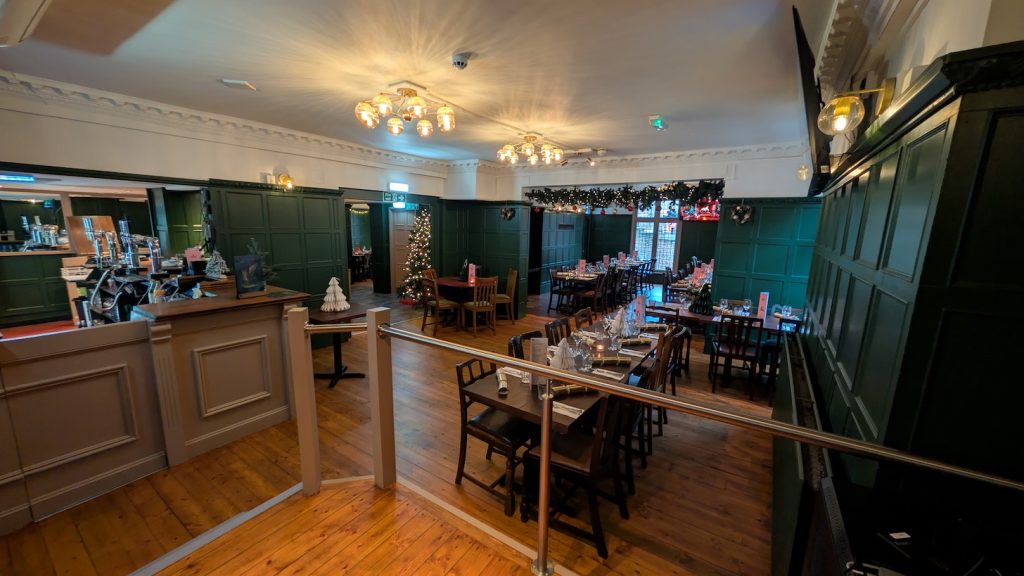
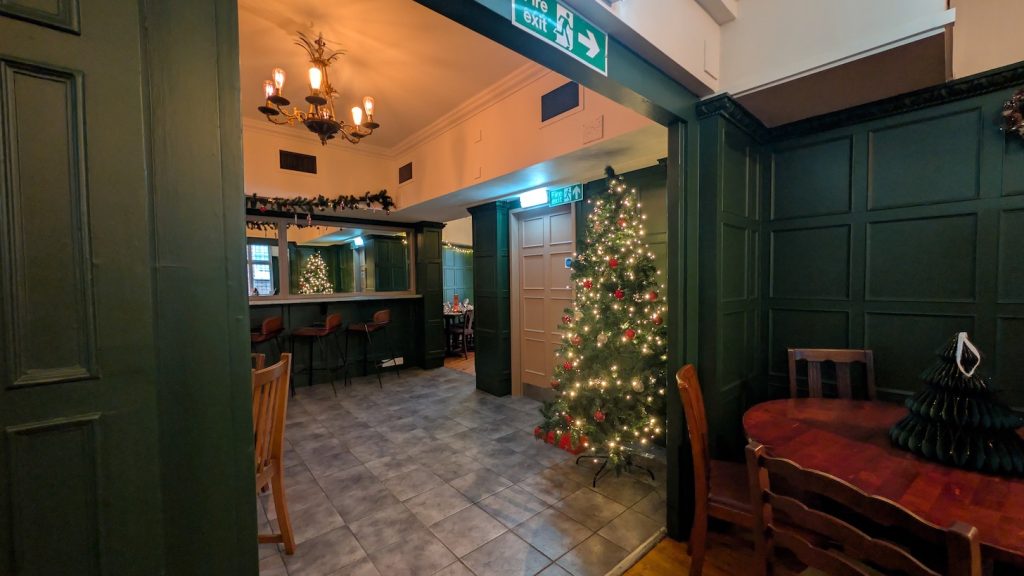
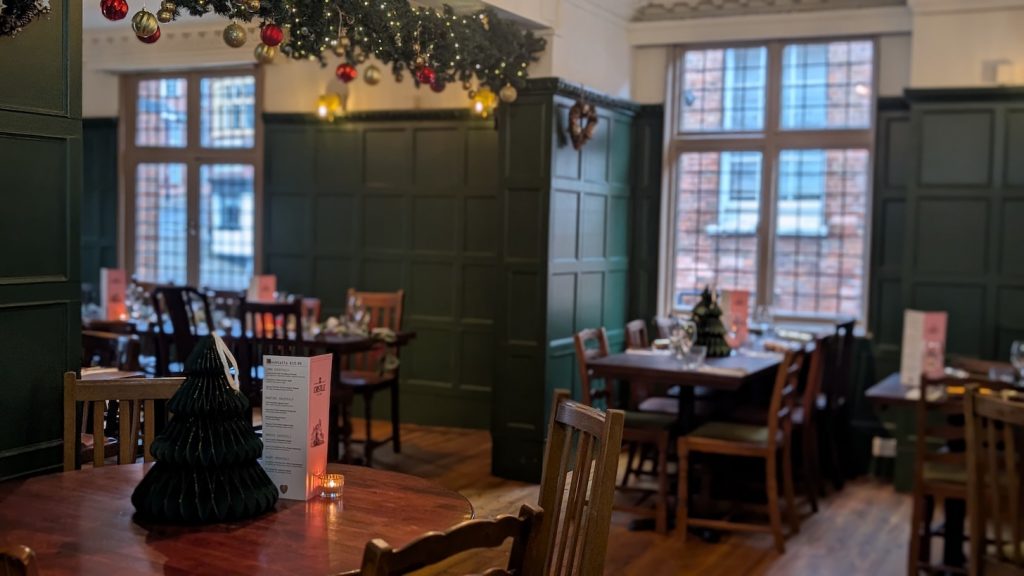
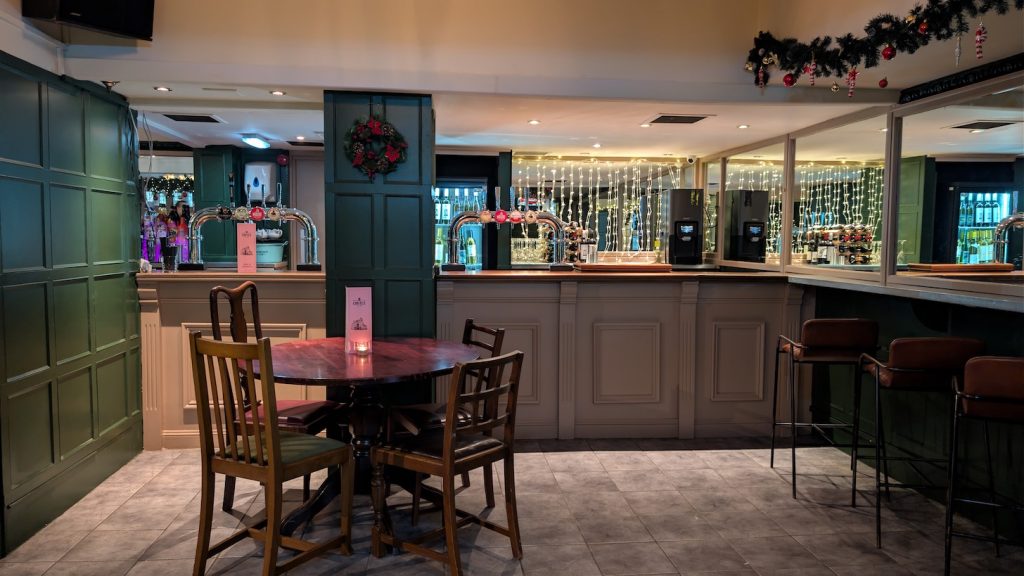
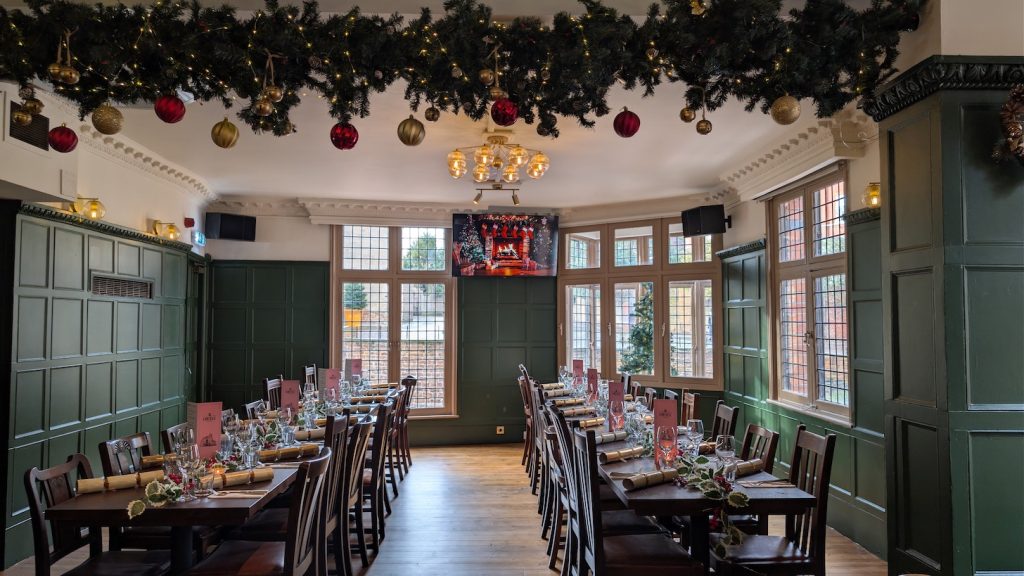
The upstairs function room of The Castle has been renovated and is ready for pre-Christmas bookings. I took a look around inside.
(Photos of the interior courtesy of Eversosensible/ The Castle Pub).
Upstairs in The Archer’s Attic (so called because there’s a great view of the Robin Hood statue), there is a bar, two dining areas with plenty of room for parties or group events, and even space for your own DJ. There’s info on capacity and more photos on the pub’s website. It’s free to hire the room, and they have some pre-Christmas availability so drop them a line if you’re interested in booking.
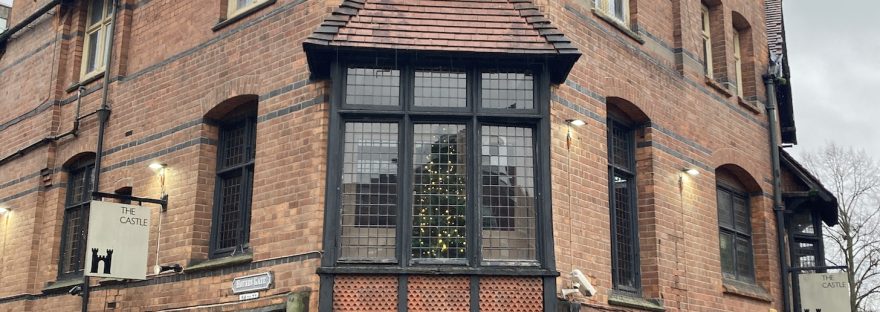
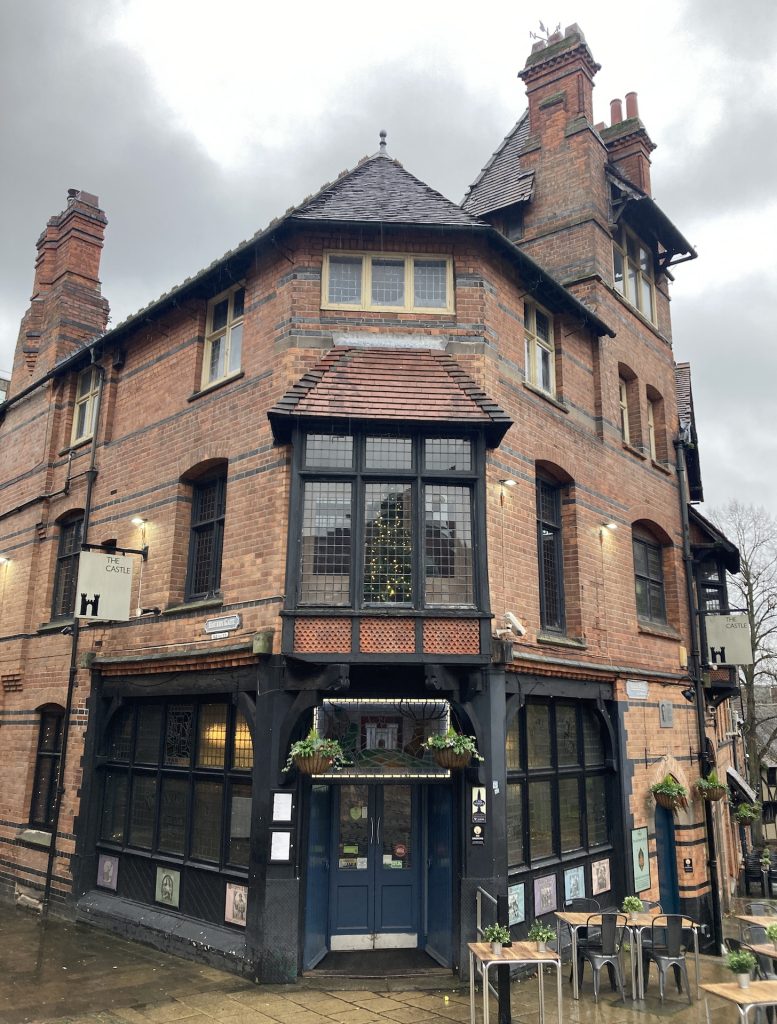
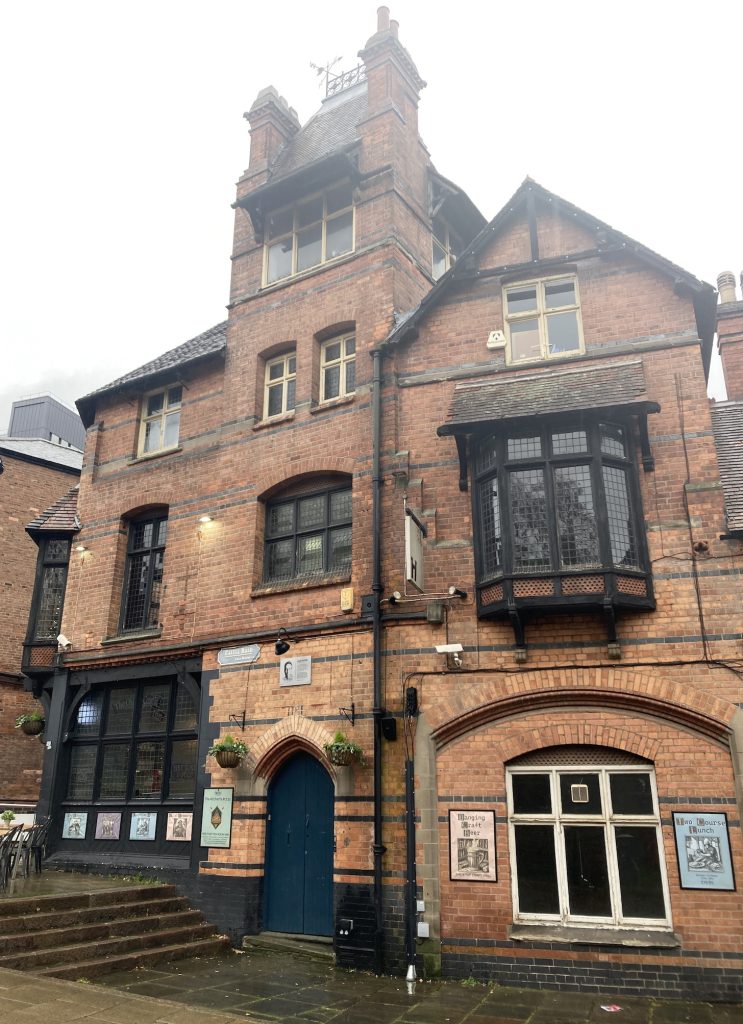
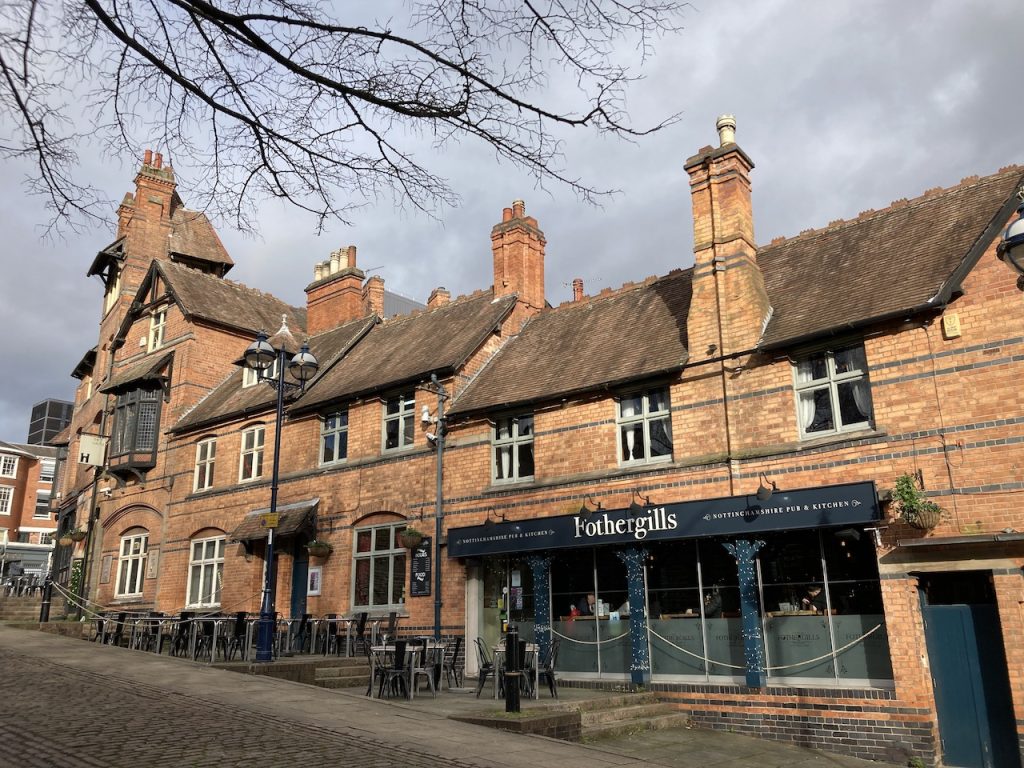
Mortimer House, which is also home to Fothergill’s Pub & Bistro, was built in 1882-83, and represents the Old English elements of Fothergill’s architectural style. Built for Clement Tate, a business man and surveyor, who was based in Nottingham at the time, the building was originally six houses with shops at either end. The Old Castle Inn, as it was then known, has been a public house since 1980, with a brief stint as The Fletcher and Firkin in the 1990s (look for the old Firkin doormat!) It had previously been a tea room, an antique shop and the office of a bankruptcy accountant! These days, it is a listed building and the final stop on my Watson Fothergill Walk guided tour.
Mortimer House, now The Castle and Fothergill’s (Photo: Lucy Brouwer)
The Watson Fothergill Walk will be back in 2026, so make sure you are subscribed to receive dates as they are announced. Gift Vouchers for my tours are available from Gift Up, or you can book a private walk for small groups by contacting me via my website.
Thanks for reading Watson Fothergill Walk – Lucy Brouwer! Subscribe for free to receive new posts and support my work.
An illustrated talk on houses by Fothergill and some of the people who lived in them
People often ask me about the houses in Nottingham’s Park Estate. So far, I have not presented a tour of The Park, mainly because it is so large, walking there involves climbing several steep hills, and there aren’t quite as many houses by architect Watson Fothergill as people might imagine …
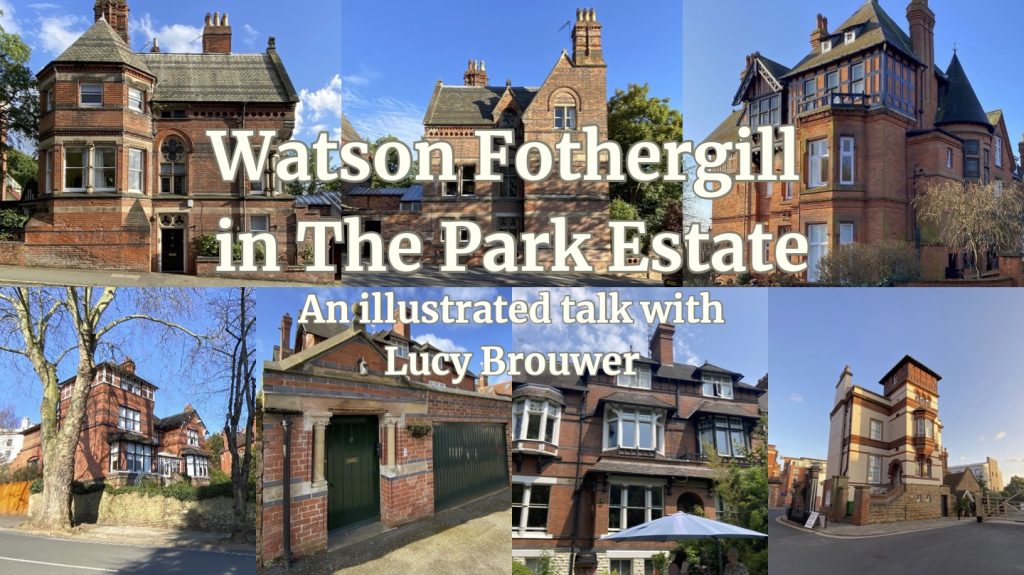
… However, I have put together an illustrated talk on houses in the Estate that Fothergill worked on, as well as stories of some of the characters who lived in them.
Join Lucy Brouwer, the creator of Watson Fothergill Walk, for a look at Fothergill’s houses in Nottingham’s Park Estate. Learn about the original owners and some of the residents of these distinctive Victorian buildings.
Nottingham’s Park Estate was home to some of Nottingham’s most illustrious Victorians and their families. The properties created by the architect Watson Fothergill represent some of the most outstanding houses in the development. Lucy, who is known for her popular Watson Fothergill Walk tour, has researched the histories of these houses and traced some of their original residents. Hear stories of some of Nottingham’s prominent Suffragists, Timber Merchants, Members of Parliament, and Scientists of the late Victorian era.
This is an illustrated talk with a duration of approximately 1 hour. Doors to the Golding’s Room open at 7 pm; the talk starts at 7:30 pm. The Vat & Fiddle will be open until 9 pm. Tickets £10 each
Another architect, Thomas Chambers Hine, was responsible for the layout and overall look of The Park Estate. I will be introducing Hine and his work for University of Nottingham Manuscripts and Special Collections on Thursday, 4 December. Details in the previous post.
To accompany this event, I am staging a Hine Hike walking tour on Sunday, 14 December, at 11 am. This tour offers an introduction to Thomas Chambers Hine and his buildings in Nottingham city centre. Duration approx. 2 hours. Tickets £20 each.
Thank you for all the interest in my Nottingham Art Deco Pubs talk. I am looking at staging it again, so make sure you’re subscribed to this mailing list for news of all future dates.
Thanks for reading Watson Fothergill Walk – Lucy Brouwer! Subscribe for free to receive new posts and support my work.
I’m working with U of N Manuscripts & Special Collections on something special
If you’ve been on my Hine Hike walking tour, you’ll know that architect Thomas Chambers Hine’s buildings are very important to Nottingham.
In researching the tour, I visited the University of Nottingham’s Manuscripts & Special Collections archives to look at Hine’s scrapbooks. Since then, the archivists have painstakingly digitised these documents, so it’s now possible to view them without handling the fragile pages.
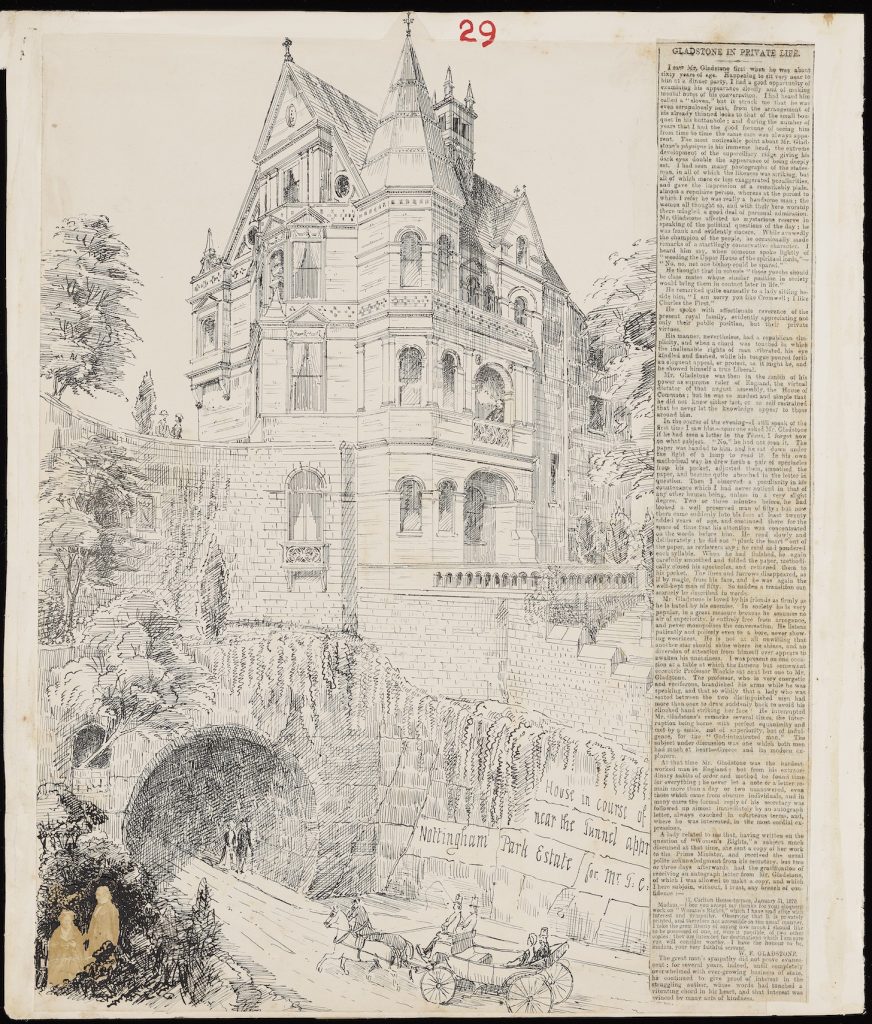
Article and image of The Park Tunnel from the Scrapbook of T. C. Hine, Manuscripts and Special Collections, MS 575/1/164. Please do not reproduce without permission.
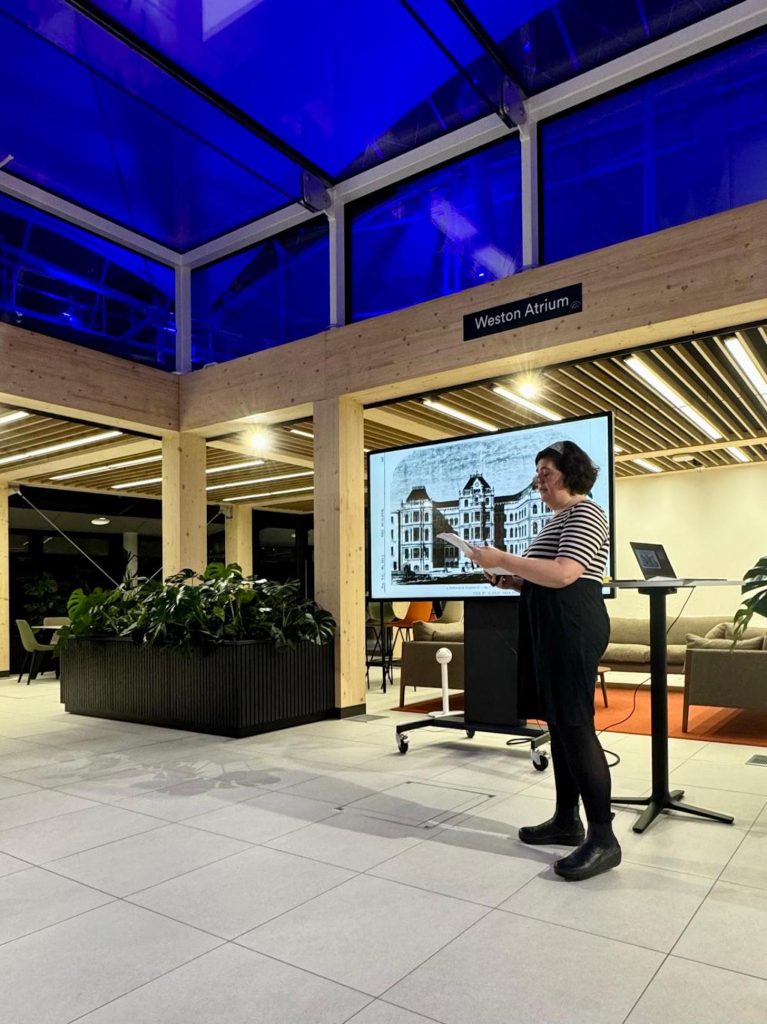
To celebrate, a special event will take place on Thursday, 4th December, 5 pm at the newly developed Weston Atrium, Castle Meadow Campus, NG2 1AB (formerly the HMRC building) – The event is free, but places are limited, so please email or phone Manuscripts & Special Collections to book. Keep reading for the contact details :
Introducing T. C. Hine – Manuscripts and Special Collections event at Castle Meadow Campus
Weston Atrium, Castle Meadow Campus, NG2 1AB
Thursday 4th December, 17.00 to 19.00
Manuscripts and Special Collections have recently completed a conservation and digitisation project on a beautifully unique item, the scrapbook of architect Thomas Chambers Hine (1813-1899). Hine designed some of the most iconic buildings in Nottingham including the current Nottingham Castle, Nottingham General Hospital, and The Park Estate. The scrapbook is an extraordinary item personally crafted by Hine himself and includes letters and signatures of royalty, churchmen, architects, authors and many others. As a keen autograph hunter, T.C. Hine collected letters which were signed by famous people and pasted them into a scrapbook, often accompanied by relevant illustrations and manuscript notes, photographs, cuttings from printed works, and engravings of architectural features and buildings that T.C. Hine perhaps admired.
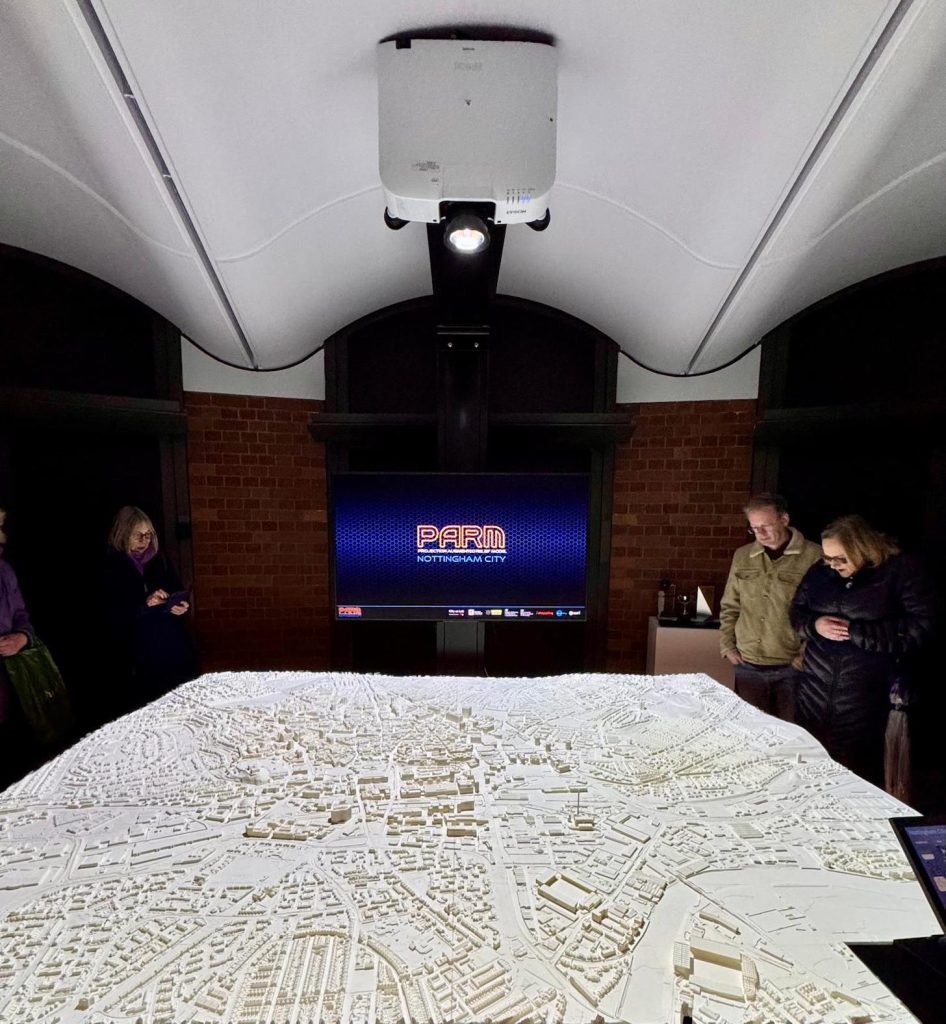
This event will include short talks from Lucy Brouwer, the historian and tour guide who has developed the Watson Fothergill Walk and Hine Hike in the city centre, and Gavin Kinsley (York Archaeology) who will discuss aspects of Hine’s work in Nottingham. After this, attendees will be invited to view an innovative three-dimensional model of the centre of Nottingham onto which is projected locations of Hine’s most notable architectural designs, facilitated by Dr Gary Priestnall (University of Nottingham) and hosted in the ‘City as Lab’ facility adjacent to the event space. Digital images of the scrapbook will also be available for attendees to explore in their own time with refreshments.
The event is free to attend but due to a limited number of places you will need to register in advance. We will also be operating a waiting list. To register, please email Manuscripts and Special Collections on mss-library@nottingham.ac.uk or call us on 0115 95 14565.
Places are limited, so please book in advance. Hope to see you there to talk about Why Hine Matters!
I will also be staging a Hine Hike on Sunday 14 December, 11 am, so wrap up warm and join me to discover the work of Thomas Chambers Hine in Nottingham.
On 7 November 1935, Nottingham’s Art Deco Savoy Cinema opened to the public.
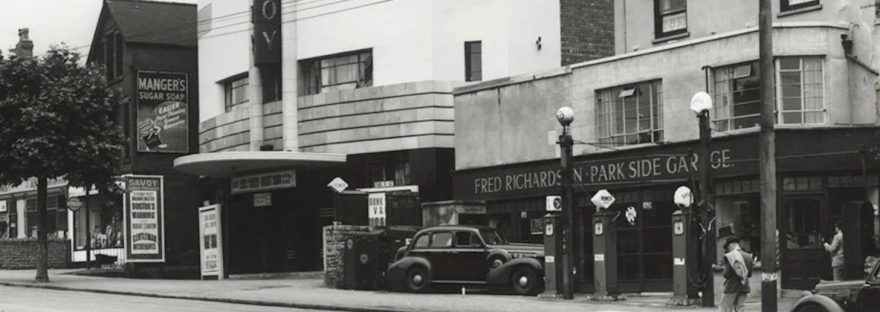
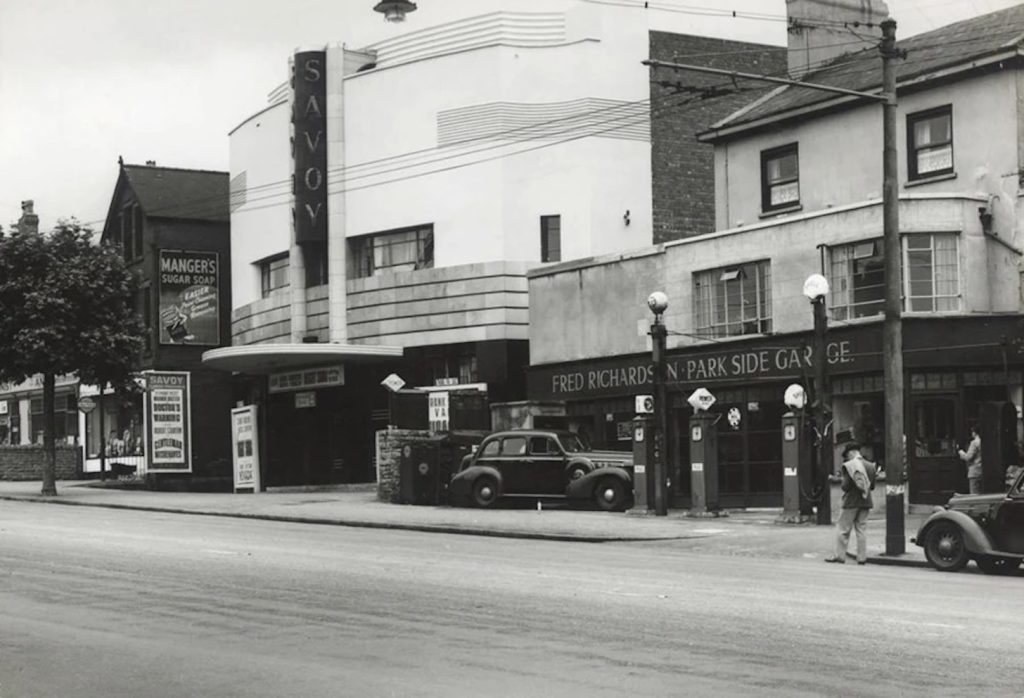
The Savoy Cinema, on Derby Road, Lenton, opened 90 years ago on 7 November 1935. It is the only surviving pre-WW2 cinema in Nottingham, although it has been much altered, it still has some original features surviving.
The cinema is celebrating this anniversary with newly refurbished seating and special prizes for cinema-goers, but what of the building’s beginnings and its architect?
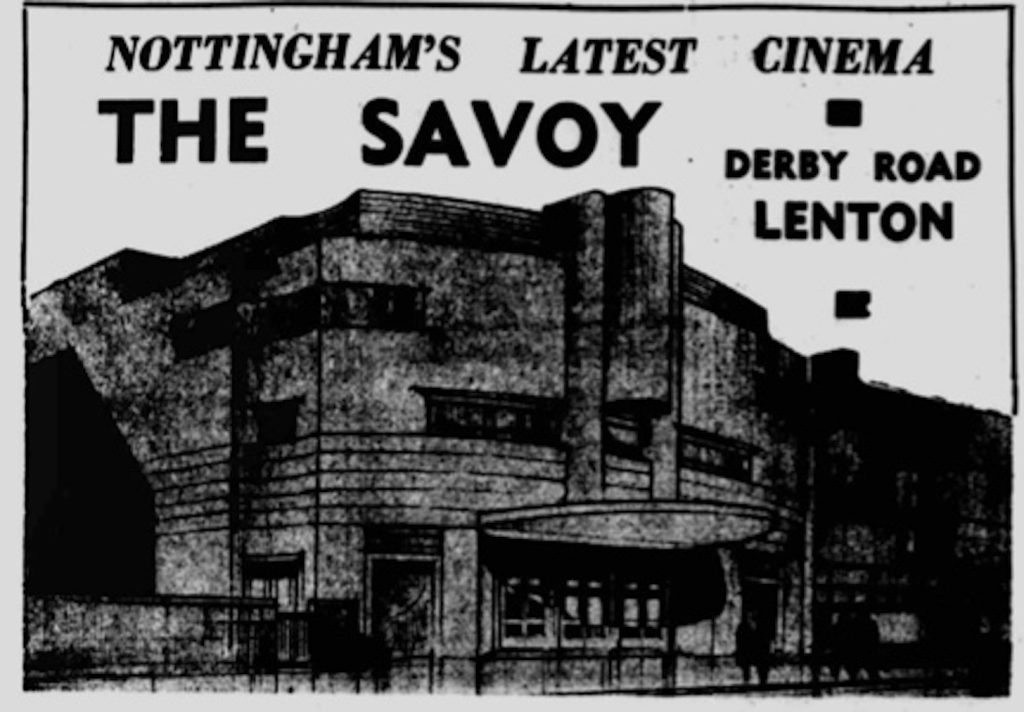
The Savoy as pictured in The Nottingham Journal, 7 November 1935. (BNA)
It was designed by architect Reginald W. Cooper (1902-1969), who had been an assistant to another Nottingham architect, Alfred J. Thraves, also known for his cinema designs and for his work on Nottingham’s Palais de Danse. (As covered on my Deco in the Details tour).
Reginald William Gaze Cooper was born in Long Eaton in 1902. By the age of 19, he was working as an architect. In January 1935, when plans for the Savoy were announced, his office was in Queen’s Chambers on King Street (a building familiar to anyone who has been on my Watson Fothergill Walk tour, as it was designed by Fothergill and completed in 1897).
The new Savoy cinema was described at its inception as being in the “Austrian style, with a frontage carried out in cream with stainless steel columns used to obtain decorative effect.” (Nottingham Journal, Wednesday 16 January 1935).
On the Derby Road trolley bus route, The Savoy was built to cater for the suburban populations of Lenton, Radford, and Wollaton Park. The “new picture house embodies every modern idea in cinema design”. It was planned to “provide accommodation for some 1,200 patrons”.
The frontage to Derby road was “striking in cream Cullamix (render) and green and black glass.”
The Savoy, as pictured in a Pilkington Glass Vitrolite Specifications catalogue (late 1930s). (Internet Archive).
In the Pilkington’s Vitrolite Specification catalogue, (pictured above) the canopy over the door of the cinema is highlighted. It describes black and green Agate Vitrolite bands with columns of green Agate and black. Vitrolite was a super-strength glass made by heating chemical compounds to extreme temperatures, it was often used on Art Deco buildings.
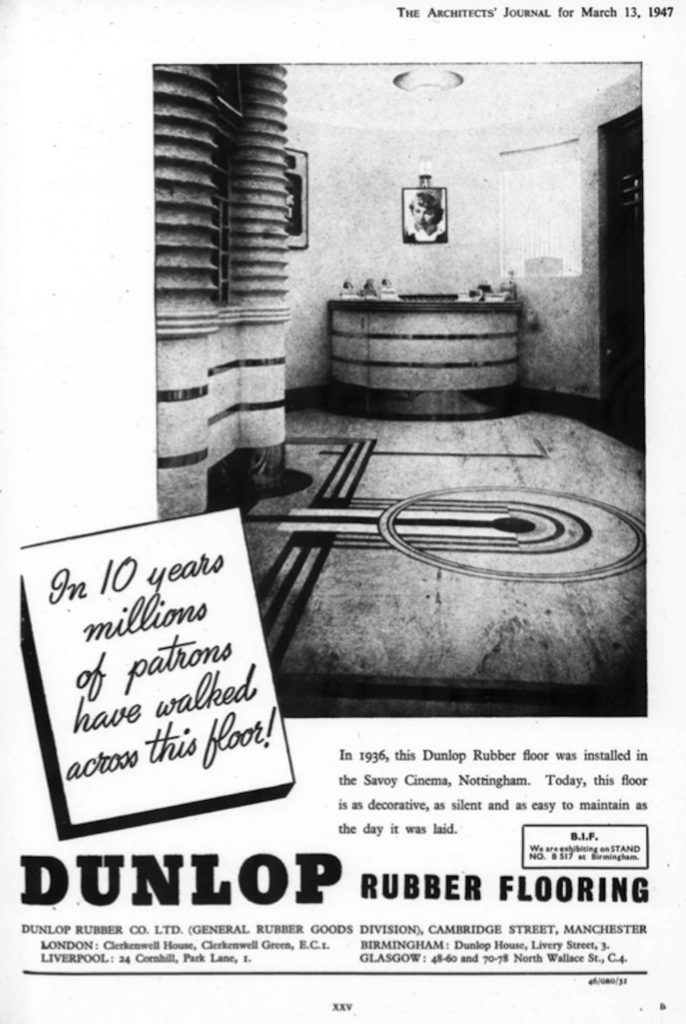
Inside the elliptical-shaped foyer, there was a central pay box and a chocolate counter. The flooring was made from Dunlop Rubber, as seen in this advertisement from The Architect’s Journal in 1947.
The Nottingham Journal described an interior colour scheme of pale green, deep cream, and silver. “No cinema in the city possesses such a perfect screen.” Seating, carpets, and curtains were all supplied by Griffin & Spalding (the local department store, eventually to become Debenhams).
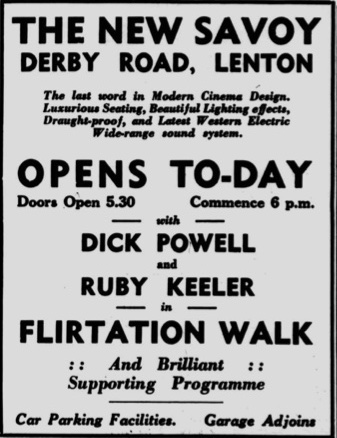
The opening film was Flirtation Walk, a musical of 1934 starring Dick Powell and Ruby Keeler.
Reginald W. Cooper was also the architect of many other Nottingham cinema buildings, including The Roxy, Daybrook, The Capitol, Radford (Still standing as a church and worth seeking out), The Ritz-Carlton (in Carlton!), The Adelphi, Bulwell, and The Metropole on Mansfield Road, Sherwood. He was also responsible for the typically Art Deco Ritz cinema in Ilkeston and the Nottingham Stadium Ice Rink.
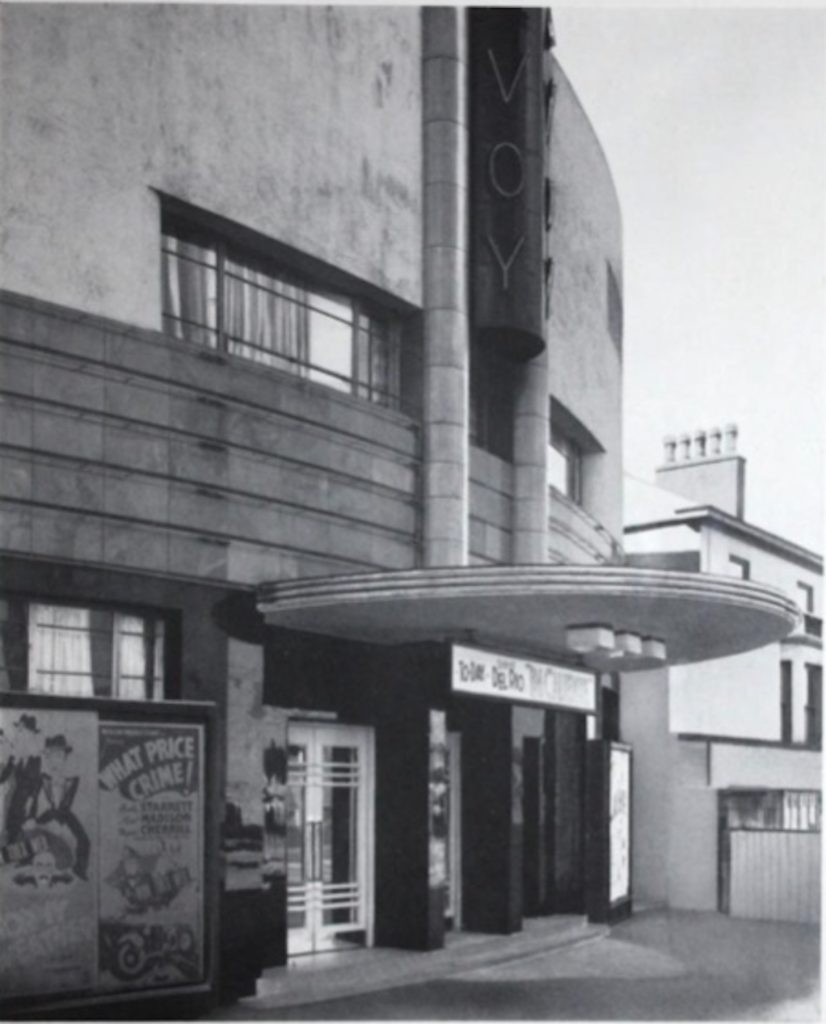
Read more about The Savoy in Left Lion, source of this 1940s photo.
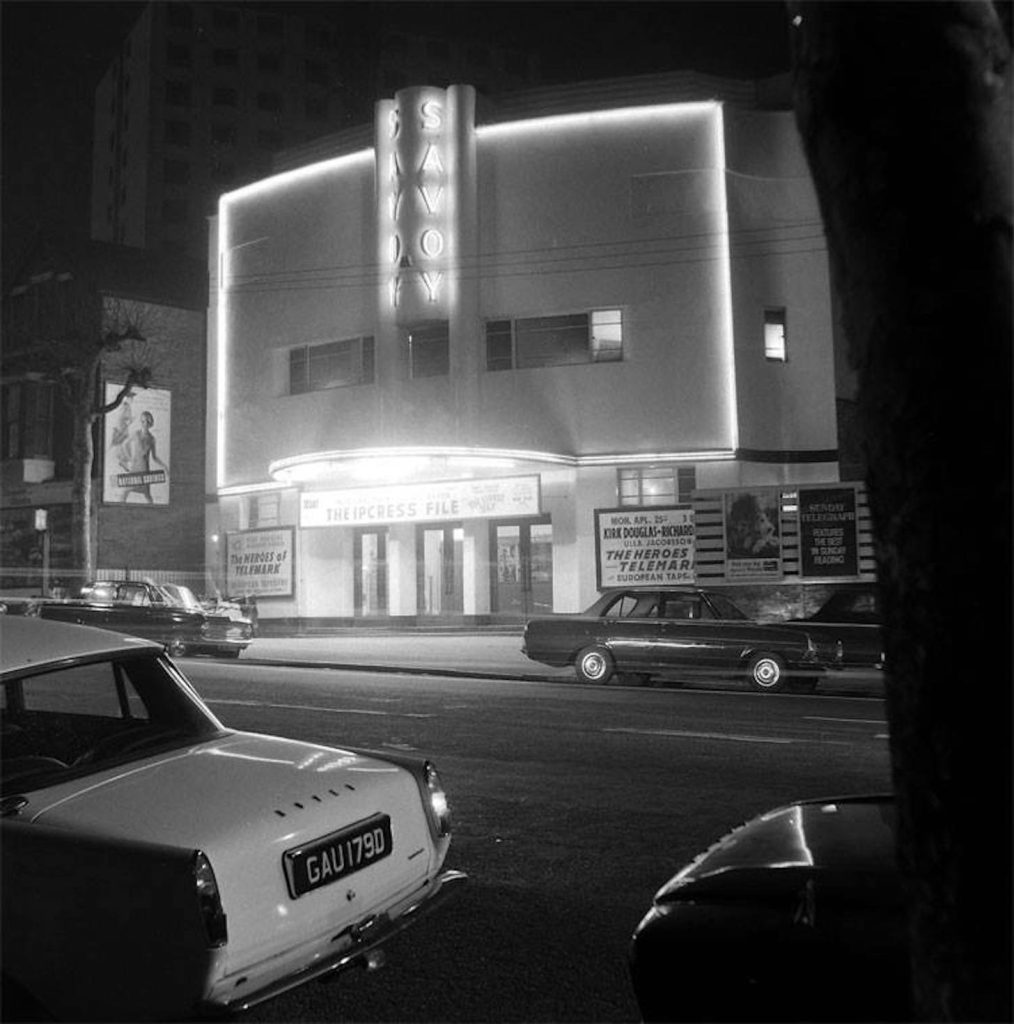
The Savoy circa 1965 (Found on Facebook).
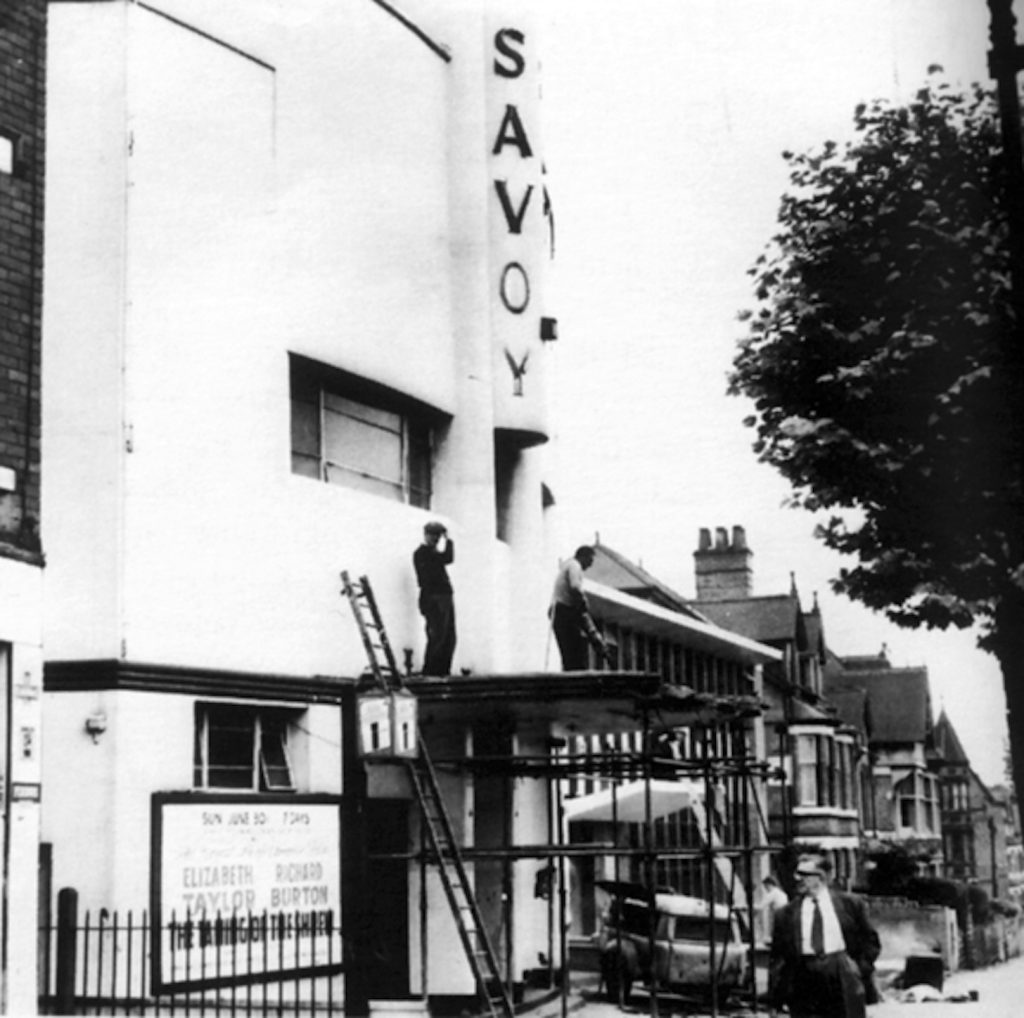
The front of the Savoy being altered circa 1968 (Read more about The Lenton Picture House Co and The Savoy in The Lenton Times, the source of this photo).
These days, The Savoy has an altered frontage, added in the late 1960s, and the interior has undergone an array of alterations. More about the ongoing history of The Savoy in West Bridgford Wire.
If you’re heading to The Savoy to see the films they’re showing this week – including The Choral and Bugonia – enjoy the movie and remember one of Nottingham’s great Art Deco-era buildings.
I’ll be repeating my talk on pubs of the 1920s & 30s in January 2026
There’s still time to join me for Nottingham Deco in the Details Part 2 on Thursday, 30 October at 11 am. It doesn’t matter if you’ve done Part 1 – the tour is self-contained! This time I’ll be looking at buildings including Notts Fire & Rescue, YMCA, The Palais de Danse, The Lord Roberts, Sneinton Market, and The Bath Inn.
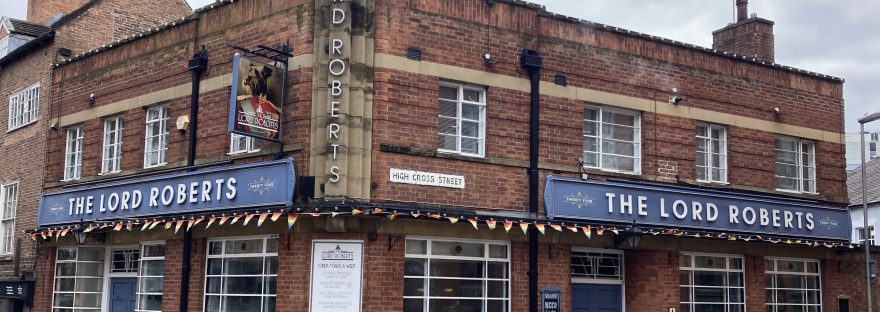
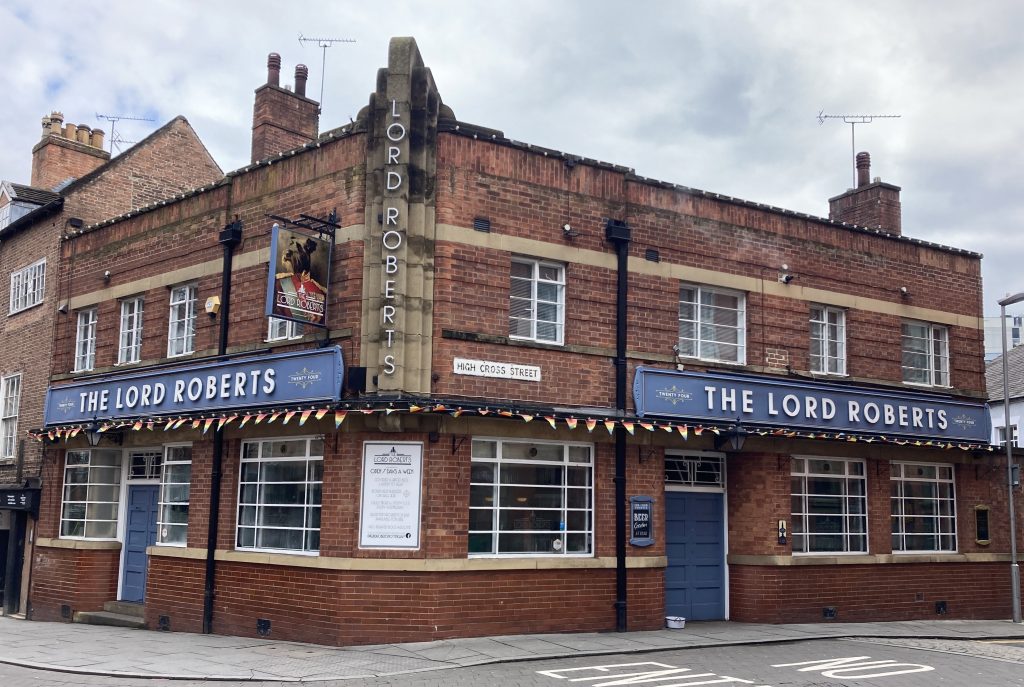
The Lord Roberts, corner of Broad Street and High Cross Street, Nottingham. (Photo: Lucy Brouwer)
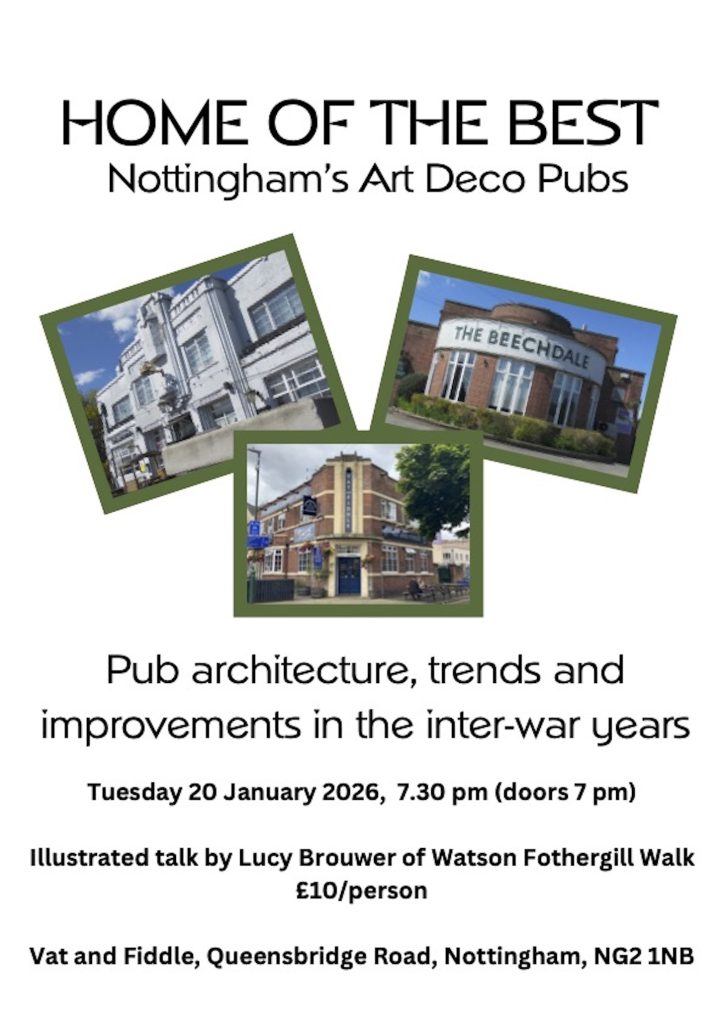
And speaking of Art Deco Pubs, I’ll be staging my illustrated talk on Nottingham’s Art Deco Pubs again in January at The Vat & Fiddle. Tickets via this link or from the bar at The Vat. The previous performances have all sold out so book ahead to avoid disappointment!
Nottingham’s Art Deco Pubs: Pub Architecture, Trends and Improvements in the Interwar Years, Tuesday 20 January 2026, Doors 7 pm. Tickets £10 each.
My walking season is almost over, but I am working on a few new ideas for next year. You can still book me to guide and of my tours as private walks for groups – fees starting at £100 for up to 5 people (maximum group size 20). Please drop me a line here to organise a tour.
Plus – look out for some Thomas Chambers Hine-related news coming soon…
Thanks for reading Watson Fothergill Walk – Lucy Brouwer! Subscribe for free to receive new posts and support my work.
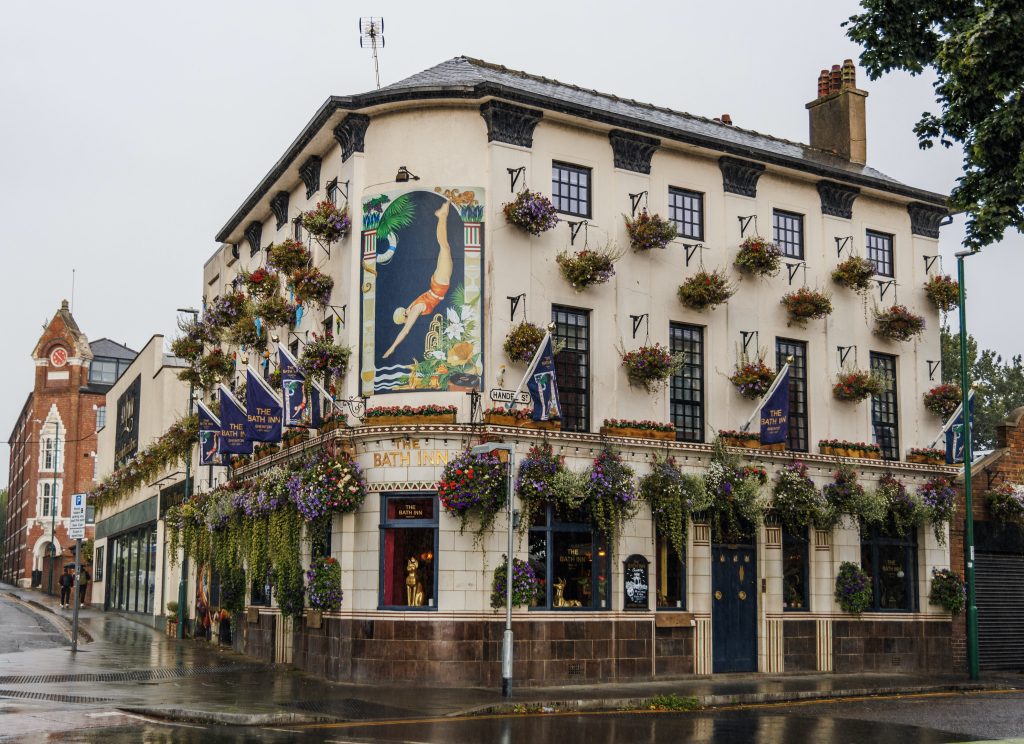
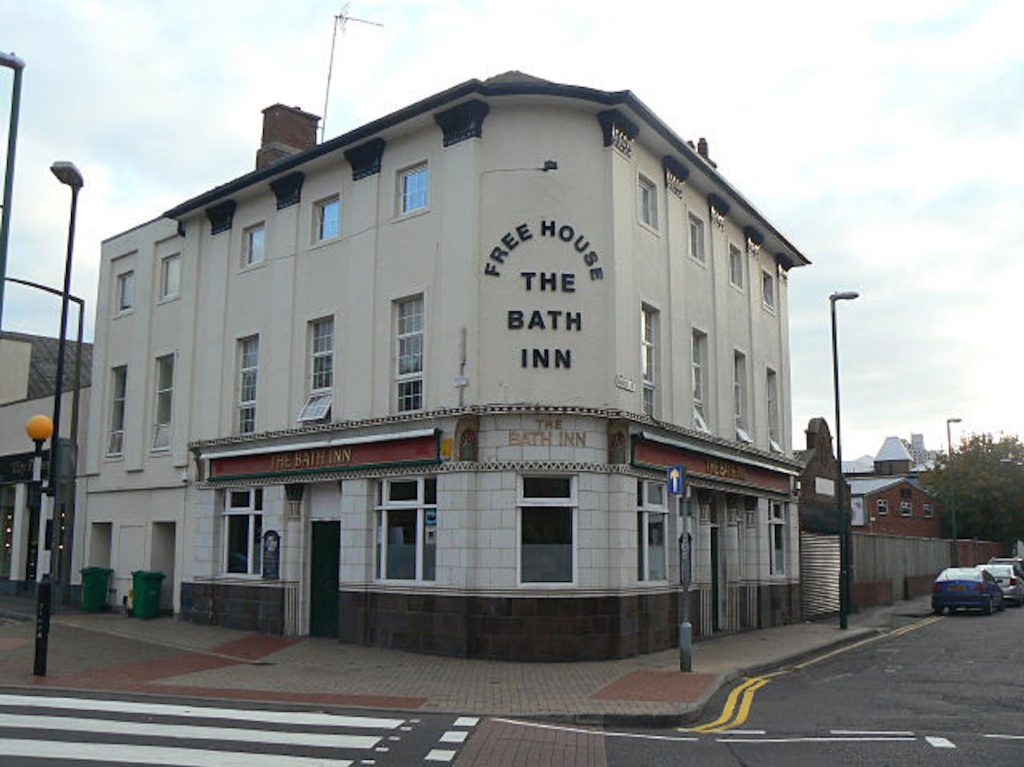
The Bath Inn, Handle Street, Sneinton Market. Photo: Louise Hunter
I touched on the history of The Bath Inn when I looked at Nottingham’s Art Deco Pubs, but since then I met a descendant of Thomas Losco Bradley (the owner of the Midland Brewery, originally responsible for refurbishing the pub in Egyptian style), so I thought I’d delve a little more deeply into the story.
There is an older building, originally built in the 1820s, beneath the 1928 refaced exterior of The Bath Inn, which itself has been restored and reinvigorated by the present publican, Piers Wheatcroft Baker.
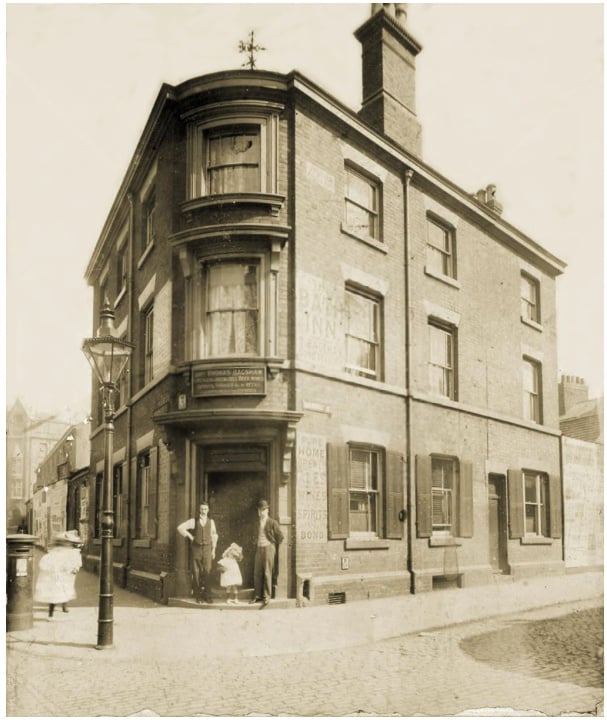
Before it was refurbished in the 1920s, the landlord was Frederick Knibb (possibly seen in the photo above). The name above the door is a previous landlord, Thomas Bagshaw (c.1885). By the time the work was done on the exterior, the landlord was Tom Hollingworth, who had previously been a tobacconist. His wife Annie carried on running the pub after his death in 1934 until at least 1939.
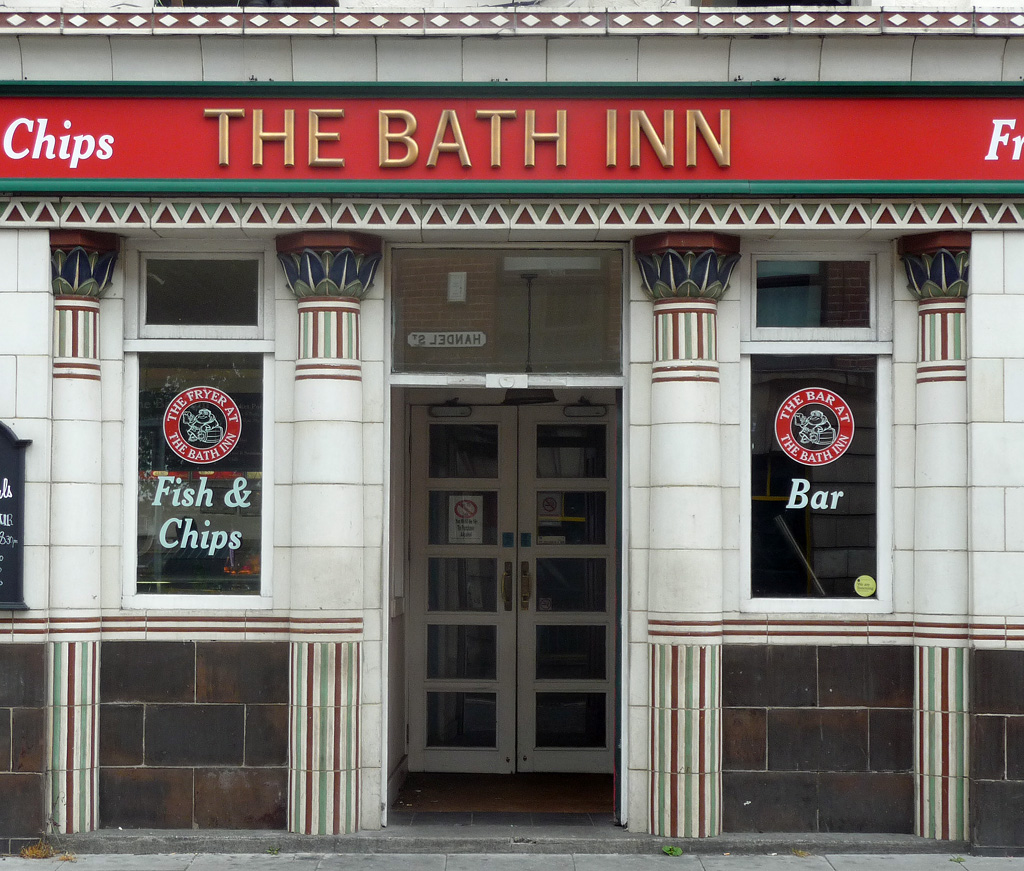
The pub is a Listed Building described as stucco with a faience pubfront (the glazed tiles are typical of those used in many 1920s and 1930s buildings). It has a rebated, rounded corner and on both sides, the now-rare Egyptian stylings are visible in the ornamented cornice and the columns with bunched reeds as capitals around the doors. There are giant Egyptian pilasters with decorated capitals down the length of the building, now partly hidden behind the hanging baskets.
Ancient Egypt was all the rage in the 1920s thanks to the discovery of Tutankhamun’s tomb in 1922. Read more about it on Historic England’s blog.
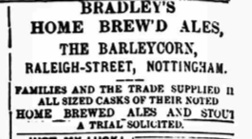
In the 1920s, The Bath Inn was one of the tied houses belonging to The Midland Brewery, owned by Thomas Losco Bradley. The Midland Brewery was then based at 119 Northgate, New Basford, but had begun in the late 1890s when Bradley started brewing ales at the pub he kept on Raleigh Street, The Barleycorn (now demolished).
Thomas Losco Bradley was the son of Thomas Bradley, who had run another pub in Radford, The Cricketers Arms on Alfreton Road. They were at the Cricketers in 1881 but by the time of the census in 1891, the Bradleys had moved to The Barleycorn.
Thomas Losco Bradley took over The Barleycorn from his father and began brewing his own beers. He lived at Second Avenue, Sherwood Rise, with his wife Alice and son Thomas Losco Bradley Jr.
Football News, 1892 (BNA)
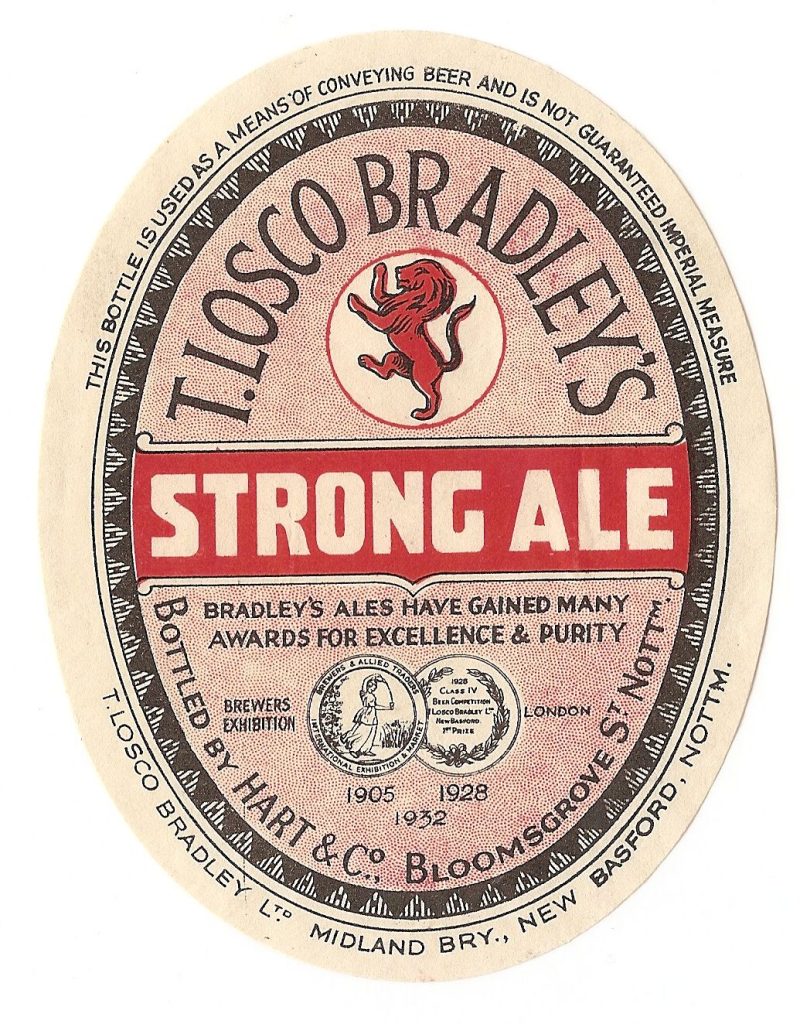
Around 1907 the business expanded and Thomas Losco Bradley purchased the brewery building on Northgate, New Basford from Madden & Dell. By now the company was called The Midland Brewery and their beers came to be known (in their advertising at least) as “Bradley’s Brilliant Ales.”
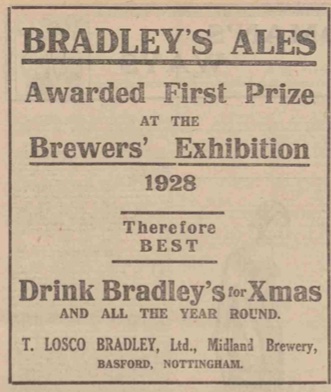
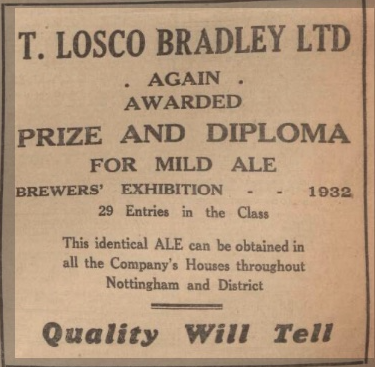
In 1928, Bradley’s Ales were awarded First Prize at the Brewers’ Exhibition in London. Perhaps The Bath Inn was refitted in celebration of this victory?
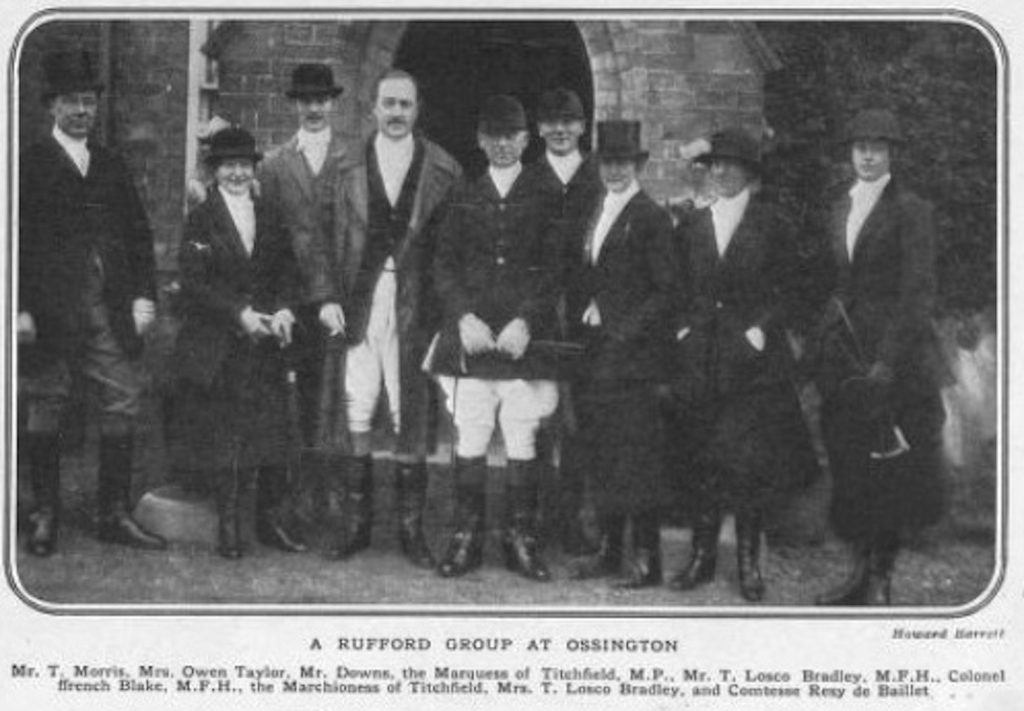
Thomas Losco Bradley was a well-known figure locally. He owned racehorses and as master of the Rufford Hunt, was often photographed in The Tatler mingling with the county set. His wife bred Fox Terriers at their home Munden House and was featured in The Ladies’ Field magazine in 1917 with her dogs, who all had the pedigree name ‘Cromwell’.
The Tatler 1928 (Archive.org)
At the time of his death in 1930, Thomas Losco Bradley Snr had moved to Holly Lodge, Oxton and he was buried in his pink hunting kit after a service at St Barnabas Cathedral. His ‘favourite lemon and white smooth haired Fox Terrier, “Nettle”, with a black bow round its neck attended the funeral’. (Granthan Journal, 5 April 1930).
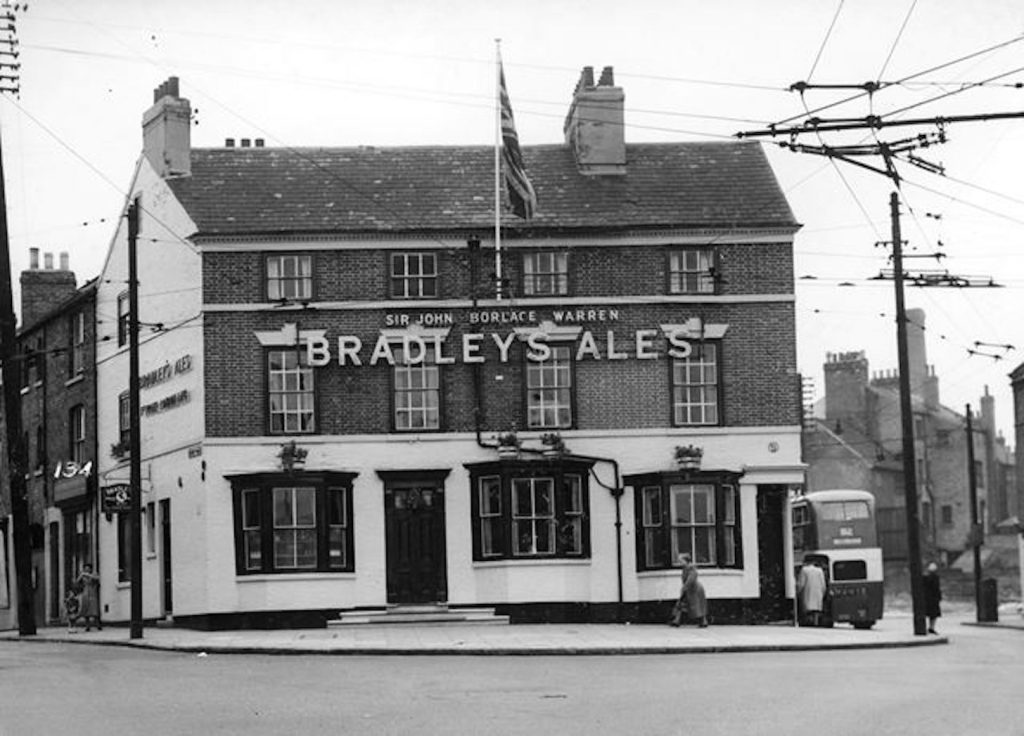
The Brewery continued to be run by his son Thomas Losco Bradley Jr, with several tied houses, many of which are still Nottingham pubs today, including The Sir John Borlase Warren, The King William (aka The Billy), The Hand in Heart, and The Foresters (New Foresters), along with several outside the city.
Sir John Borlase Warren, Canning Circus, Nottingham, as a Bradley’s pub. (Photo: Brewery History)
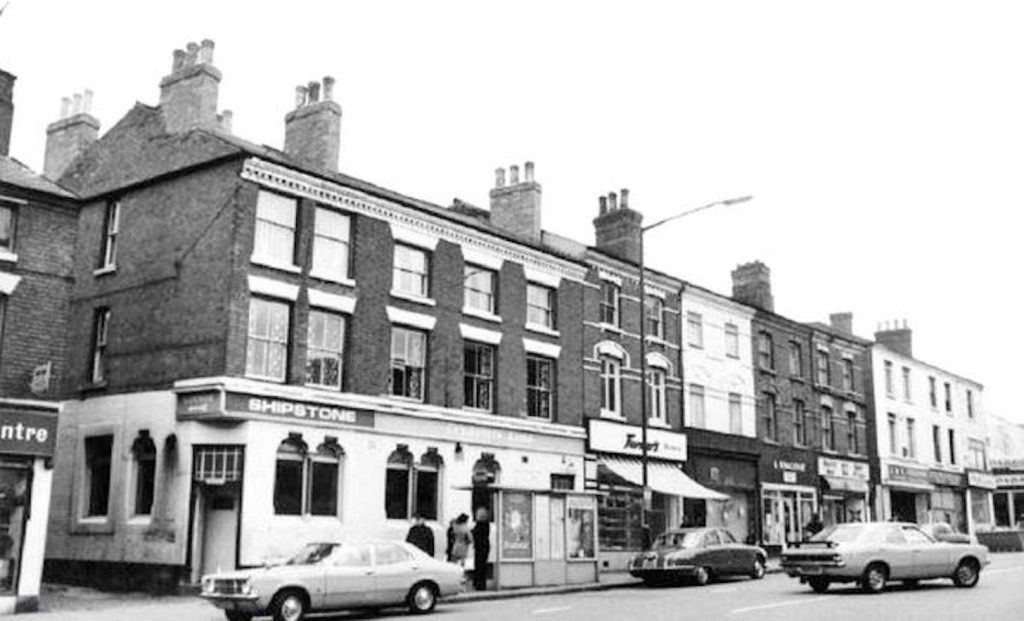
In 1954, Shipstones purchased the brewery and its pubs, The Bath Inn and the others became Shipstones houses. In the 1990s, it was briefly a Greenall’s pub, and for a while it was part-pub, part-fish and chip shop.
It closed down, but in 2021 was reopened by Piers Wheatcroft Baker, who has gone on to do great things. He has restored the exterior and added an Art Deco flavour to the inside of the pub, along with many characterful elements worthy of his pedigree – his father is Doctor Who actor Tom Baker and his mother was part of the Wheatcroft family of Sneinton rose growers, including her uncle, the flamboyant Harry Wheatcroft, who was born in Handel Street, just a stone’s throw from the pub. Read more about the regeneration of The Bath Inn in Nottingham’s own Left Lion or drop in for a pint (sadly not of Bradley’s Brilliant Ales).