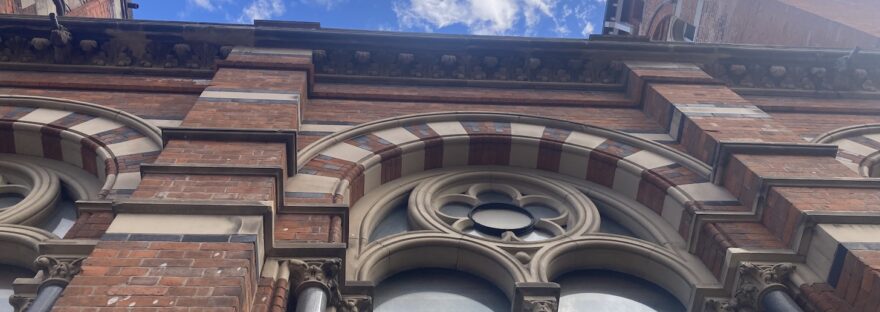
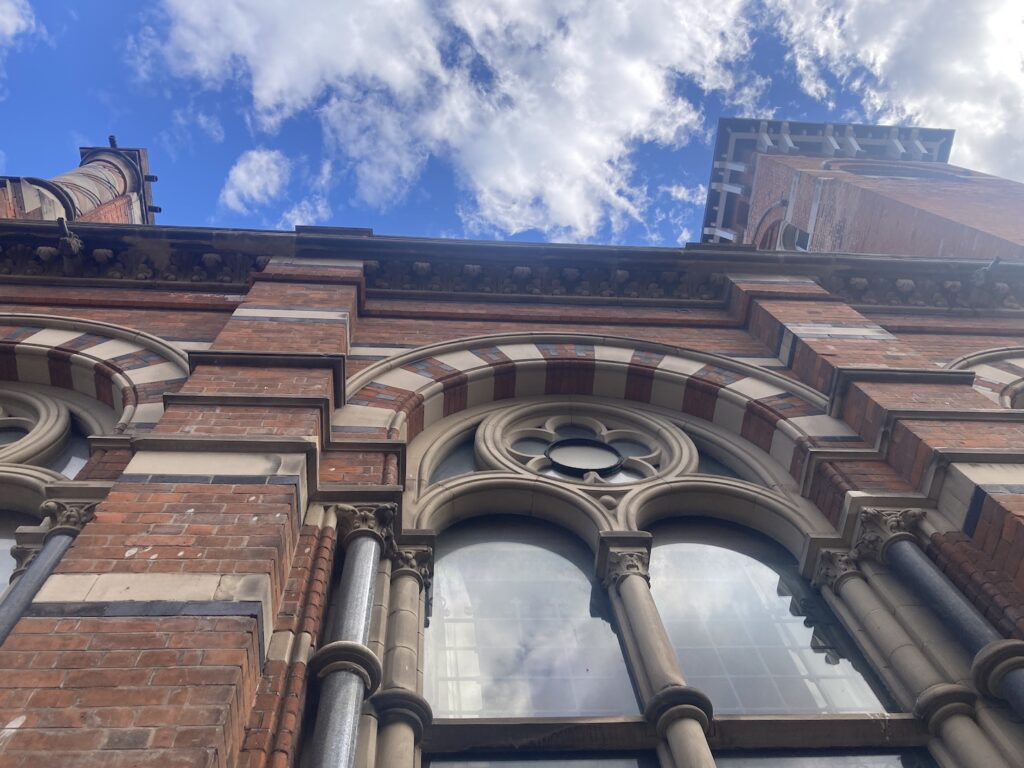
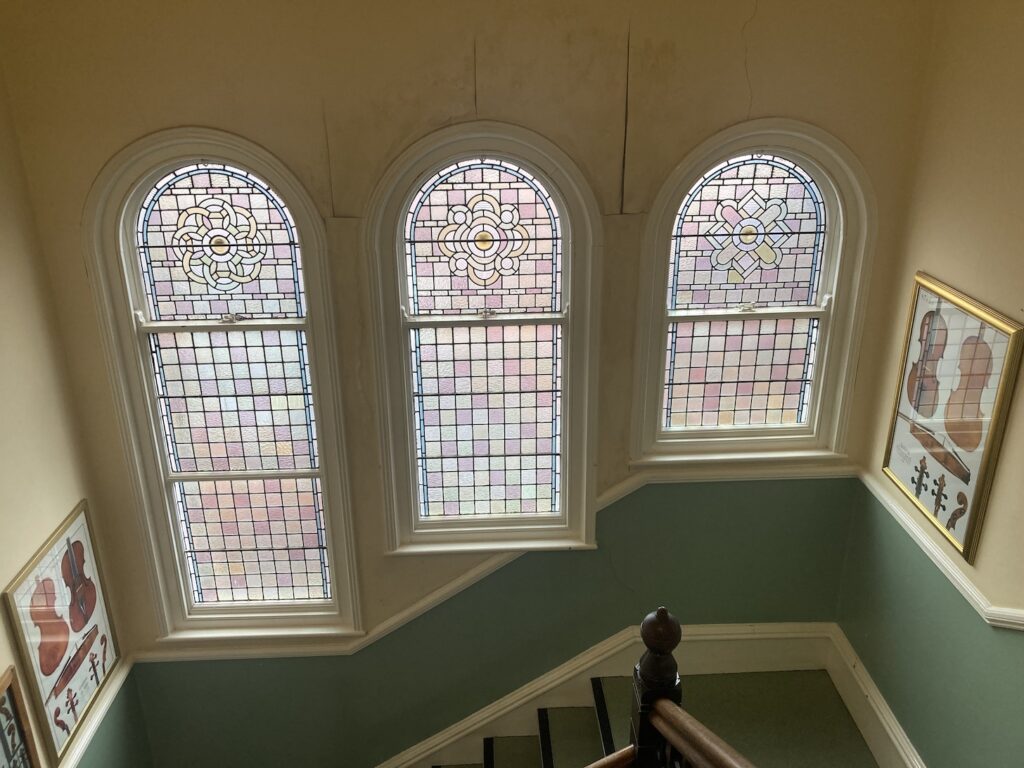
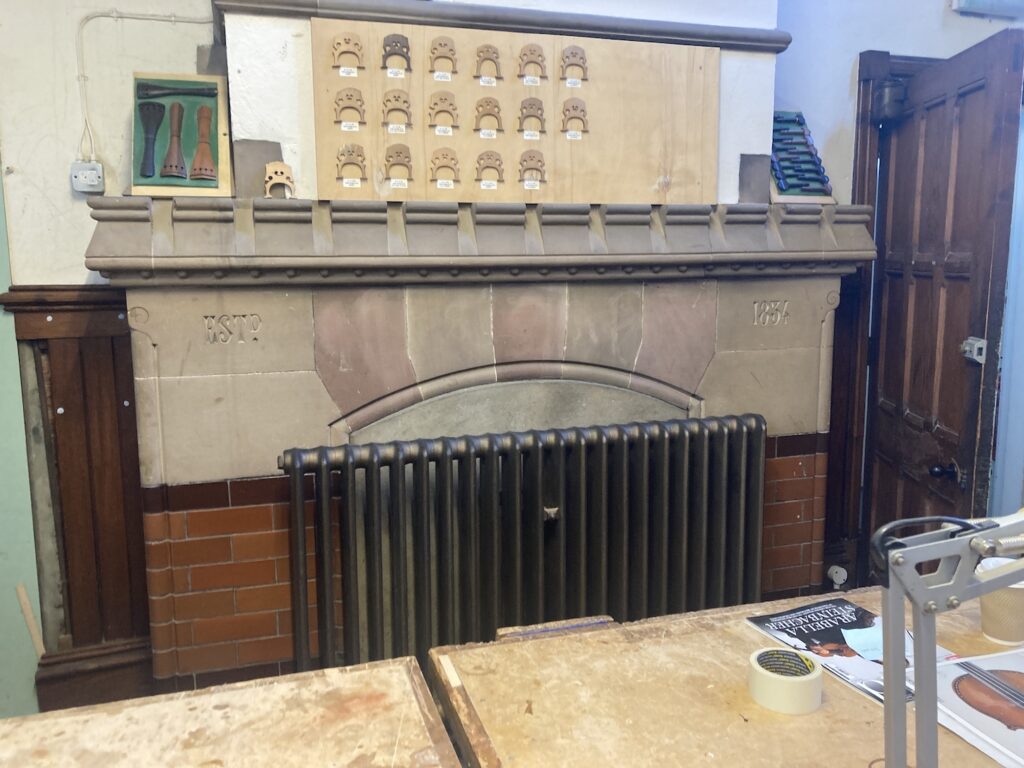
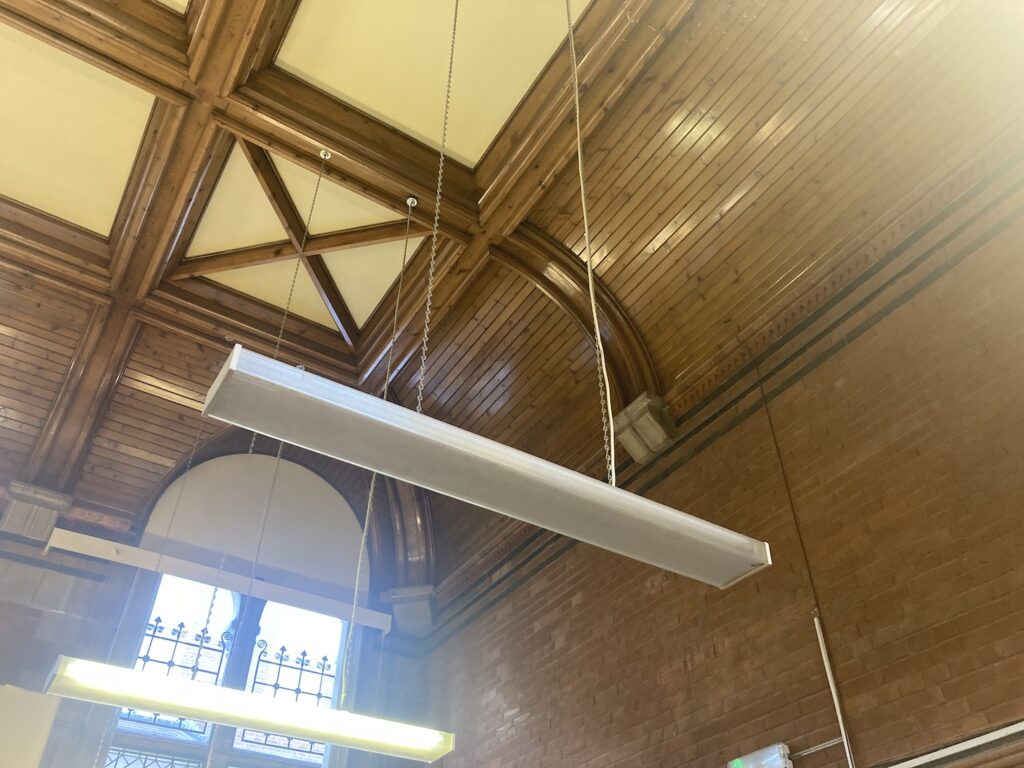
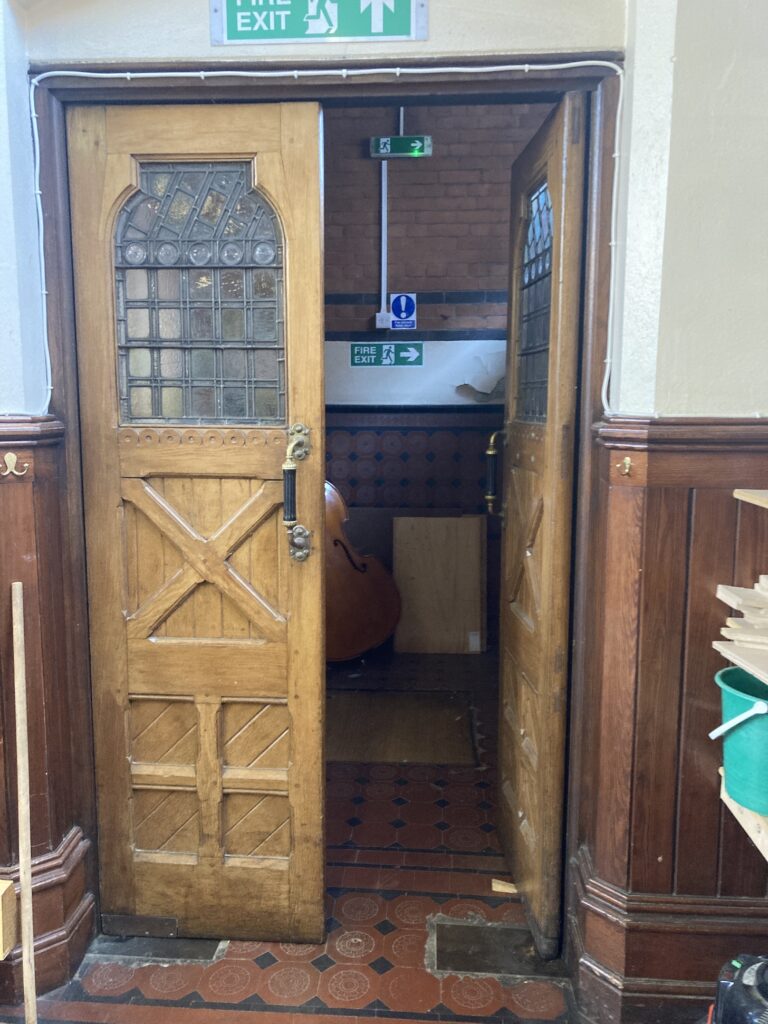
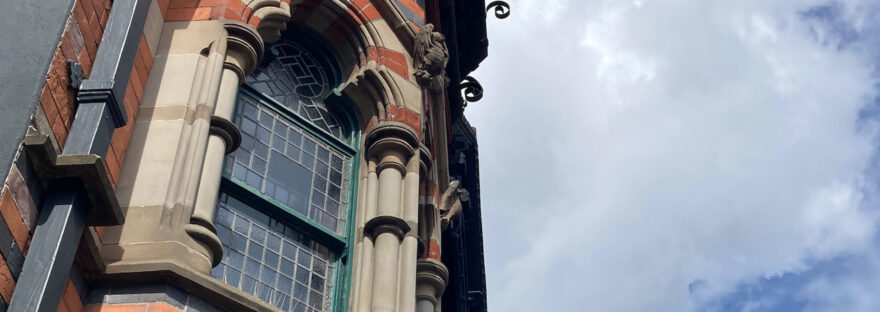
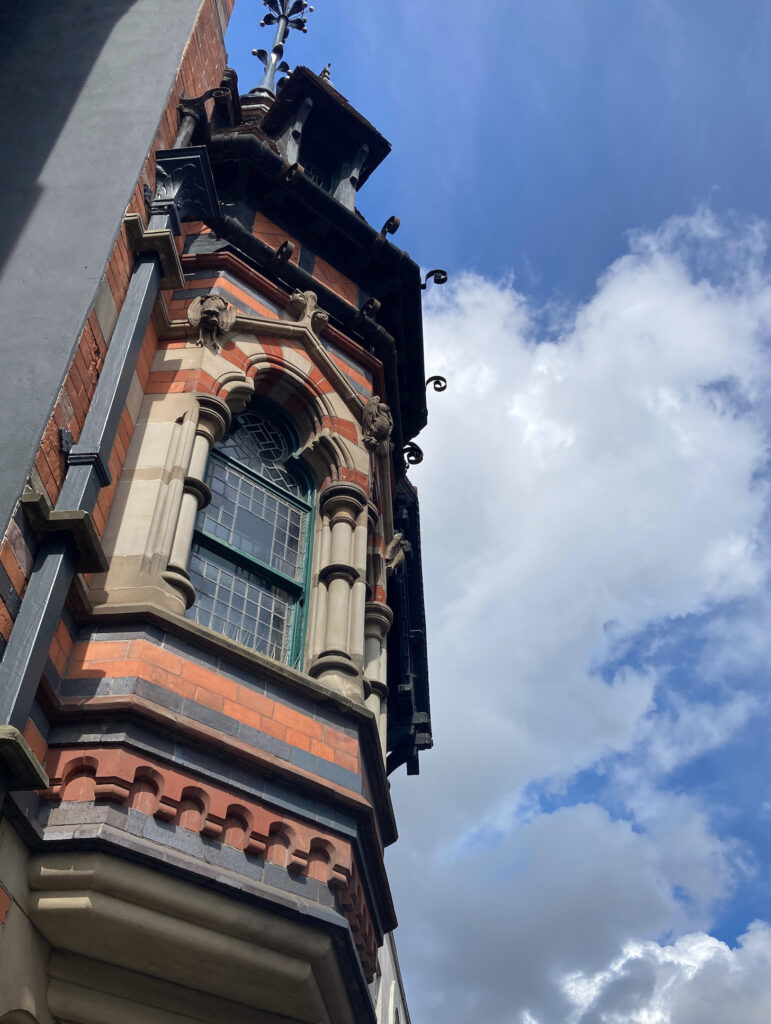
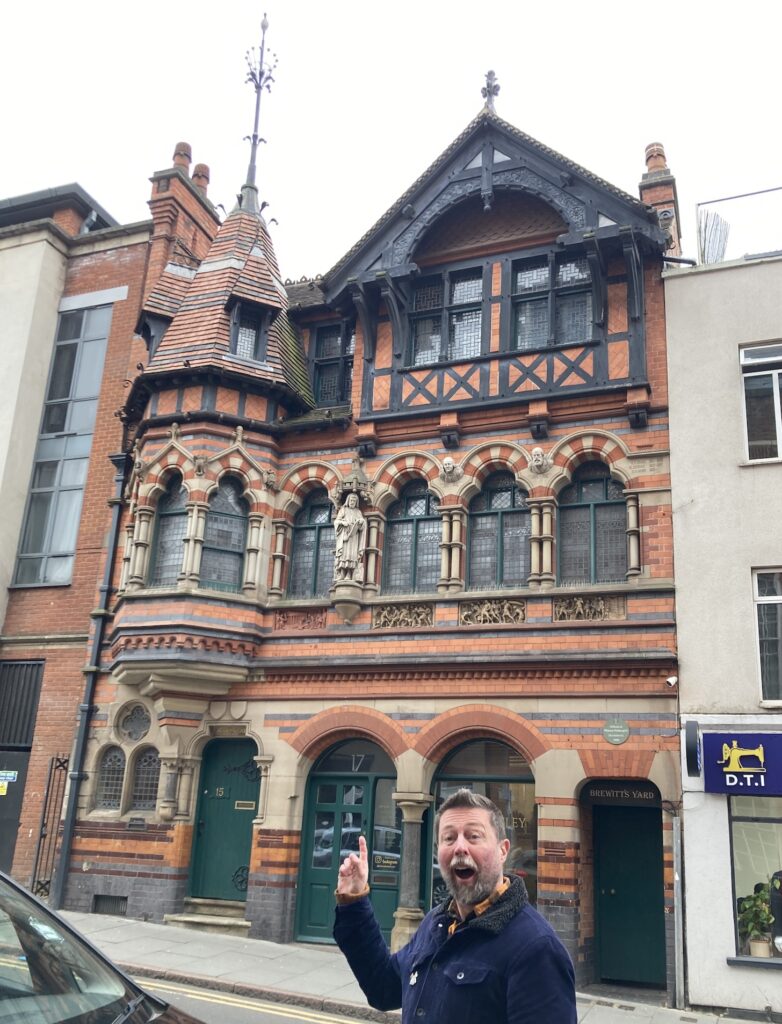
I went to a Heritage Open Day at the weekend and realised a long-held ambition to see inside the former Nottingham & Notts Bank building in Newark. This is a brilliant example of reuse and of the idiosyncrasies of Fothergill’s style.
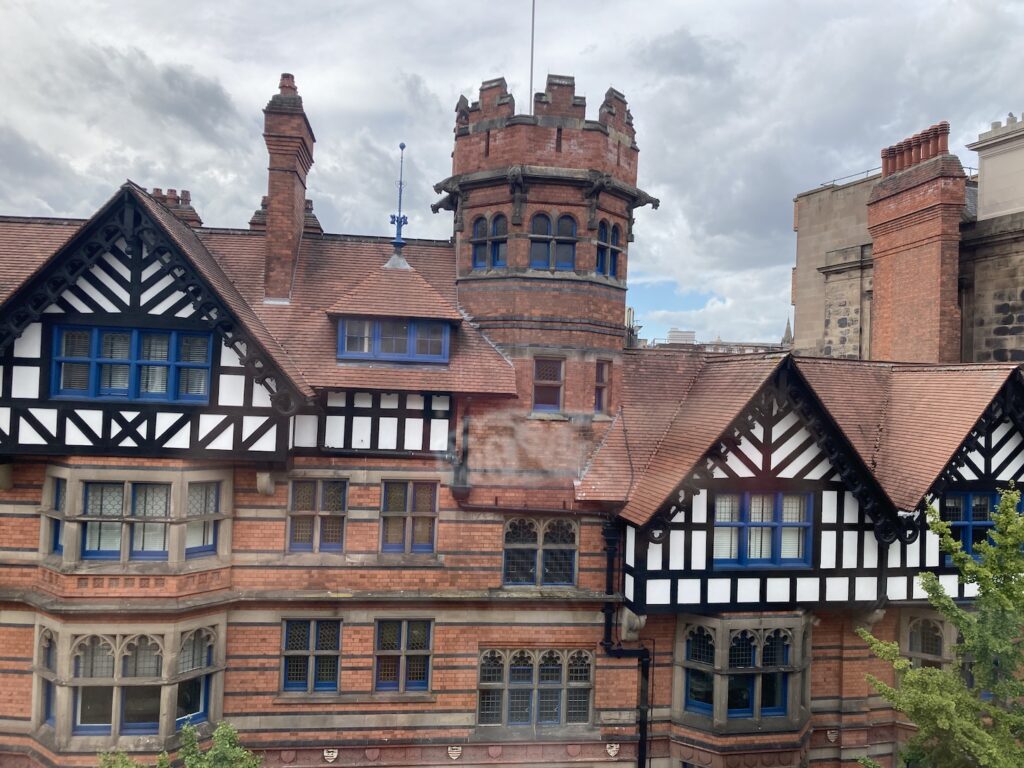
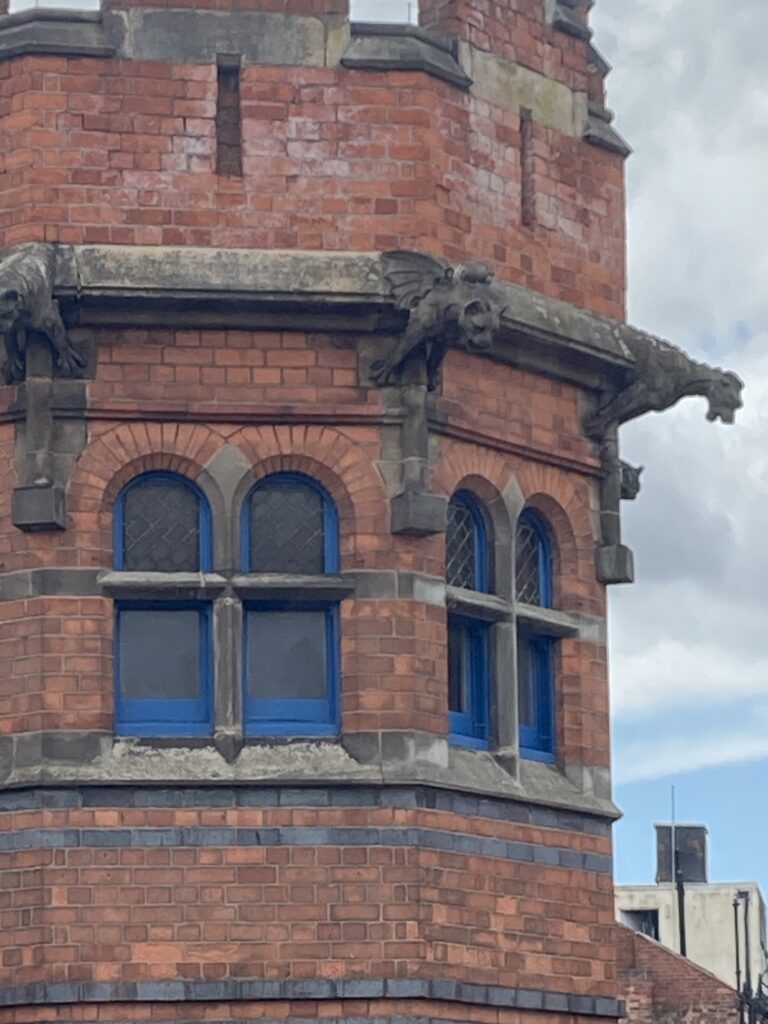
The building, completed in 1887, is made up of a large Italian Gothic-style banking hall with polychrome brick walls and large windows, plus a tower (reduced in height in 1957), and the Manager’s House with oriel windows now making up the School of Musical Instrument Crafts (or Violin Making School as it’s known).
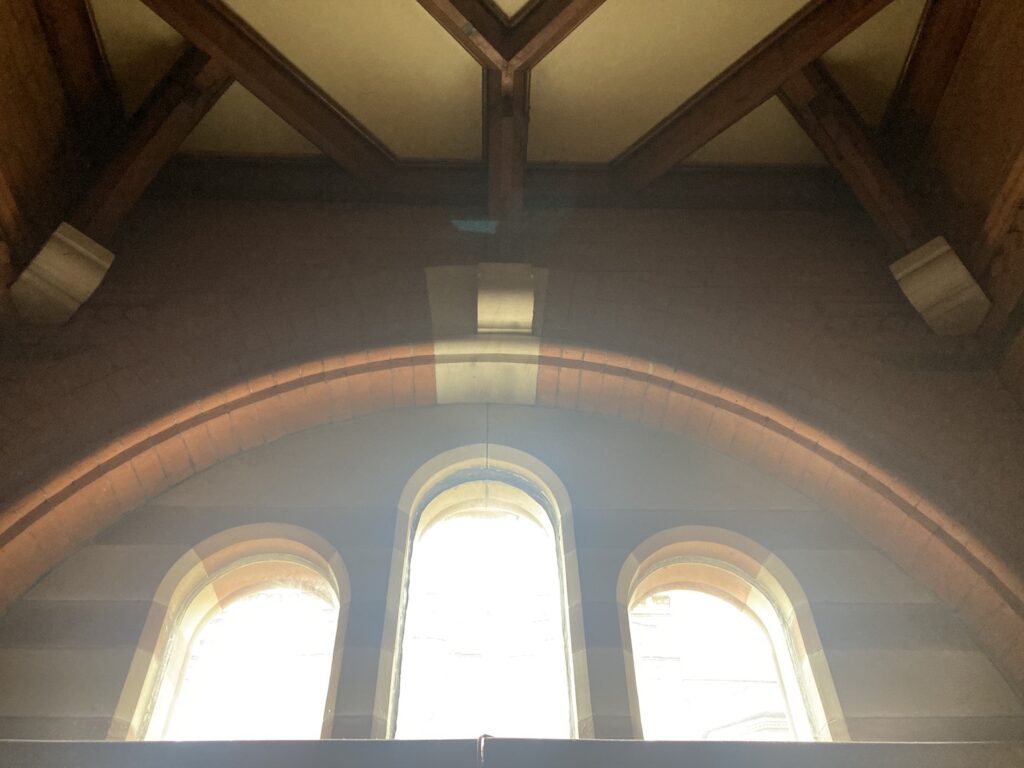
Going inside… (Photos: Lucy Brouwer)
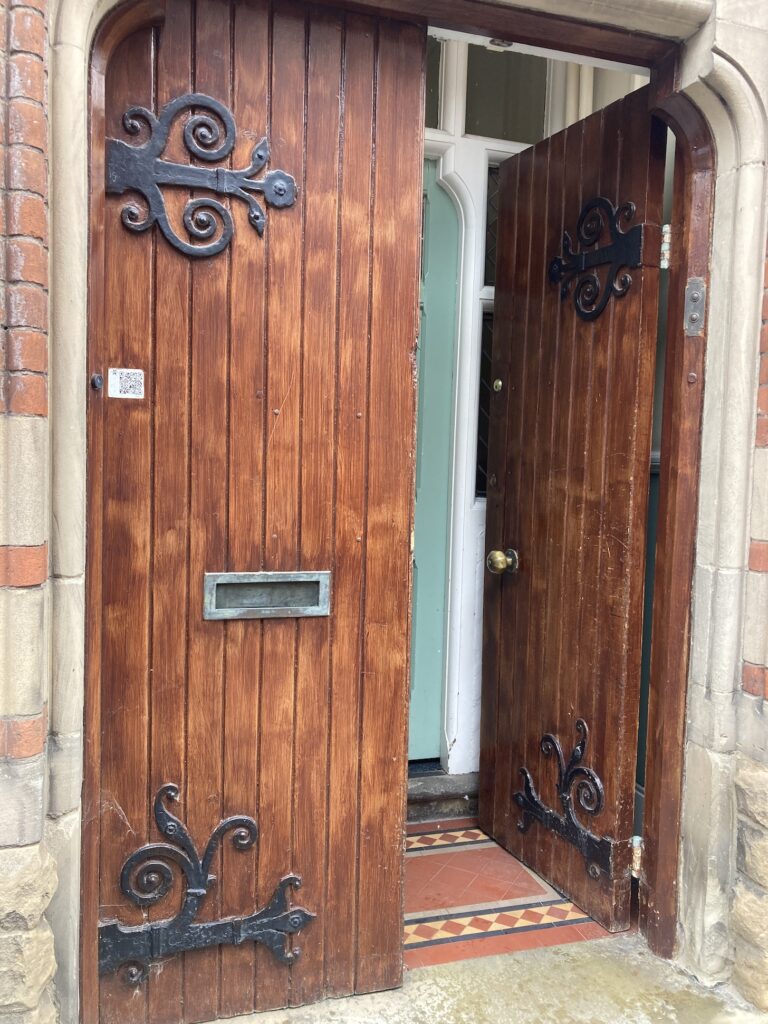
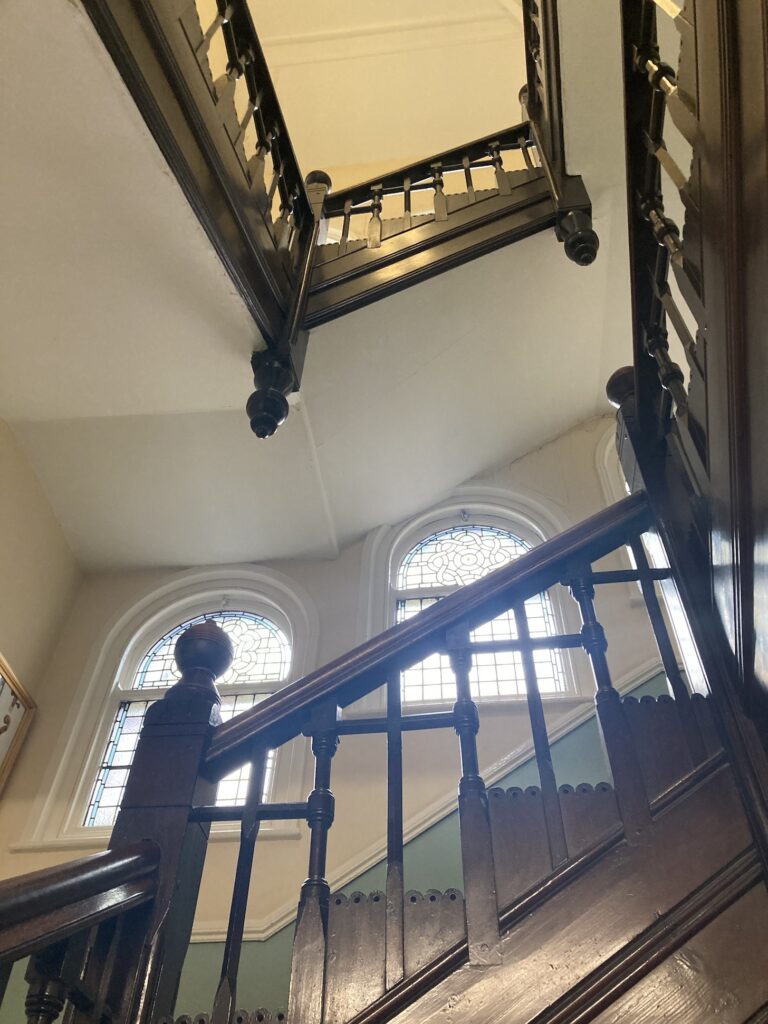
The interior has a particularly fine example of Fothergill’s timber banisters, stained, leaded glass and sturdy medieval-inspired doors. Thanks to Chris for showing us round and sharing his joinery expertise!
I learned a lot about how Fothergill’s favoured barrel vaults are not, in this case, structural (it’s all for show) and how it was likely that the woodwork was constructed off-site and installed later. The fireplaces were in some cases dummies, with gas heaters later replaced by radiators. The effect was solid medievalism with a dash of Arts & Crafts, but overall Very Fothergill!
Very much a working building, the college has been here since the 1970s, so I had to use my imagination to picture how it would have been laid out as a bank. There were loads of little signs of Fothergill’s motifs, materials and details. It was a real treat to have a good look around. The college has been under threat recently, so here’s hoping they get to stay here and look after the building for years to come. Heritage Open Days continues until 20 September, with lots to see and do around Notts.
Berni Inns
My next event is a talk about the history of Nottingham’s Berni Inns and their buildings. This once-popular restaurant chain had several branches in Nottingham and surrounding areas, with many of them opening in the 1960s and 1970s. I’ve researched the history of the buildings, the food and the adverts for these Nottingham Berni Inns – Join me for an entertaining look into how we used to “Disco Dine with steak and wine for under £1”.
The talk takes place at The Vat & Fiddle, Queensbridge Road (near Nottingham Rail Station) on Wednesday, 23 September, prompt start 7 pm. (doors open 6.30pm and the pub is open until 9 pm). Tickets are £10 here or at the bar.
Tour dates
There will be a couple of scheduled architecture tours in October:
This tour looks at the life and city-centre buildings of Watson Fothergill, Nottingham’s most eccentric architect. Featuring Queen’s Chambers, Former Nottingham & Notts Bank, Fothergill’s Office and more.
An introduction to the prolific 19th-century architect who quite literally shaped the streets of Nottingham. Featuring a look over the Park Tunnel, Hine’s Home & Office and the Lace Market.
I have very limited availability for private group walks in October and November. Prices start at £100 for up to 4 people – drop me a line to find out more.
September and October are getting busy, but read on for all the events I’ve got coming up.
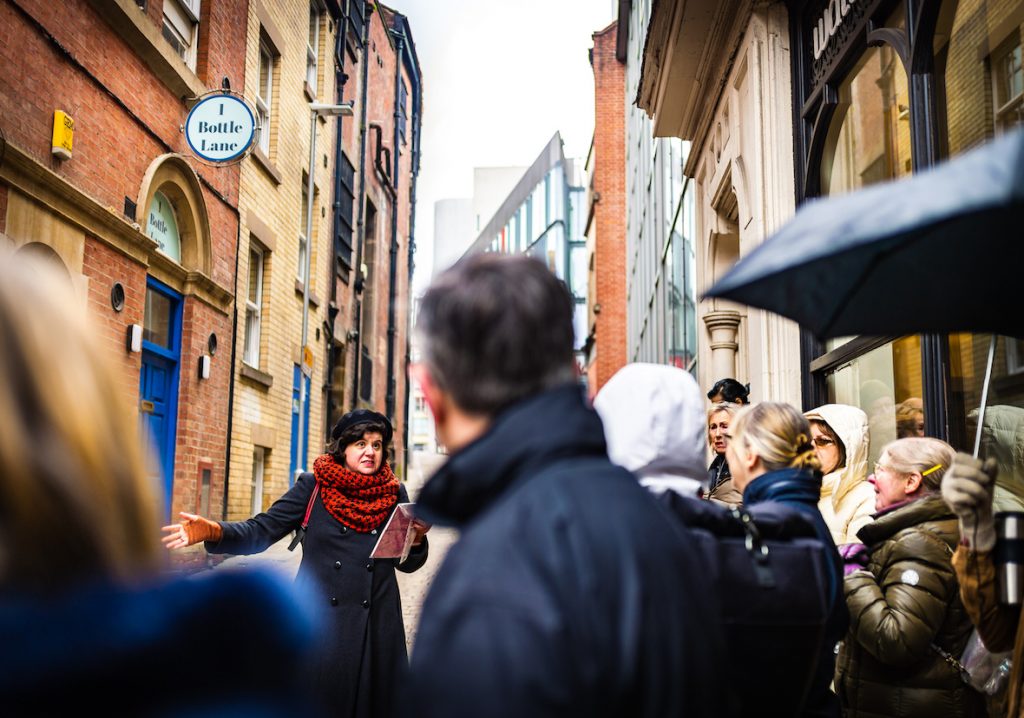
Look up and see Nottingham differently! Photo: Lucy Brouwer
Firstly, I will be giving a short introductory talk about Watson Fothergill the architect and his buildings at The People’s Hall, Heathcoat Street, Nottingham on Sunday 13 September at 11.30 am as part of the events for Heritage Open Days. My talk is aimed at people who haven’t tried my tours yet, or fancy a refresher. There will be other speakers on heritage topics over the weekend and a chance to look around the building. Heritage Open Days events are free (some require advance booking).
Join me to discover my 5 star rated architecture tour and see Nottingham’s buildings differently! Tickets are £20 each plus booking fee.
Talks in the Pub
Once again, I will be giving some of my previously sold out history talks at The Vat & Fiddle, the welcoming Art Deco pub run by Castle Rock brewery, a short walk from Nottingham Railway Station.
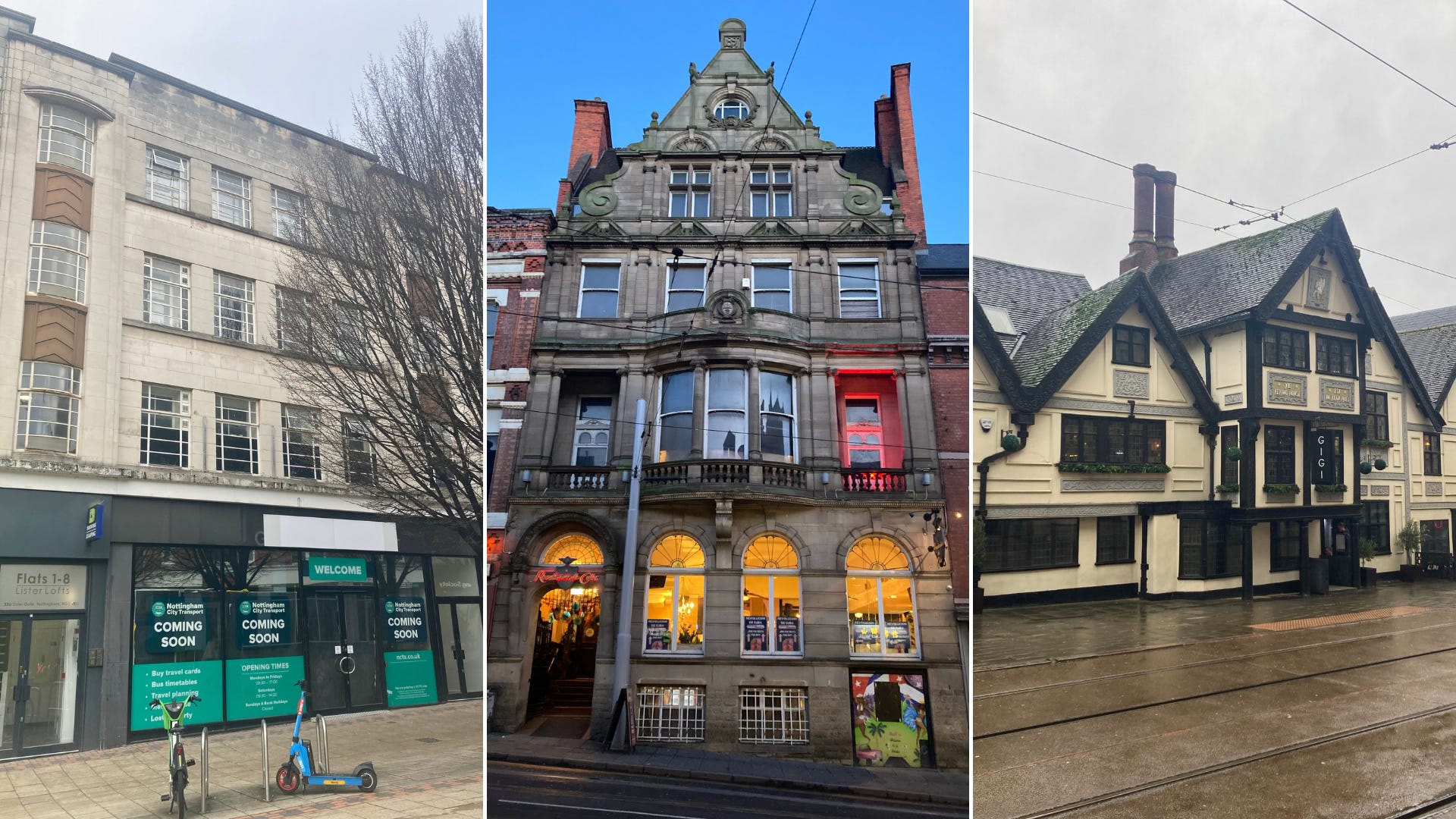
These buildings have something in common – they were all once home to a Berni Inn! Photos: Lucy Brouwer
A look at the historic buildings that were once home to the popular restaurant chain Berni Inn. If you have memories of prawn cocktails, salad bars and first dates at The Chateau, then this is for you!
On Monday 19 October, 7 pm I’ll be repeating my talk on
Nottingham and surrounding areas have several Art Deco style pubs; uncover the local architects who designed many of these buildings in the 1920s and 1930s, explore the concept of the Improved Pub, and examine trends in pub design during the inter-war years.
Unfortunately, I had to cancel the last couple of tours – because there was an “Orange Heat Warning”. But there’s one more in July and a couple of dates in August… read on!
I’m also available for bookings for any of my tours during the week, so if you’ve got a group or a few friends who’d like to explore Nottingham, please send me a message to arrange a tour. More info here.
Recommendation
When I was in London a little while ago, I had the pleasure of taking part in one of Mike The London Ambler’s tours – looking at the stations and Railway Lands behind Kings Cross and St Pancras. I really recommend Mike’s informative and entertaining architecture tours if you’re in the capital. More info: The London Ambler.
Marking the anniversary of the architect’s birth with a special event.
Hello, thanks to everyone who has joined me for an event so far this year and welcome to new subscribers. Keep reading for the latest tour dates.
2026 marks the 185th anniversary of Watson Fothergill’s birth on 12 July 1841, so I decided to mark the occasion with a special event on Sunday 12 July 2026.
I’ll be presenting an illustrated talk that looks at some of Fothergill’s buildings beyond those I’ve explored on the Watson Fothergill Walk. I will look at the stories behind the buildings built outside the centre of Nottingham. There will also be a chance to see pictures of some of the interiors of his buildings that I have been lucky enough to visit over the last few years.
Buildings to be featured include Woodborough Road Baptist Church, the Simons & Pickard Paper Warehouse, Hucknall Coffee Tavern and possibly more if there is time. Interiors are likely to include Fothergill’s George Street Office, Thurland Street Bank and Queen’s Chambers.
The talk will take place in the upstairs function room at The Castle Pub, which itself is a Fothergill building. I hope you can join me!
The room will be open at 6 pm with the talk starting at 7 pm.
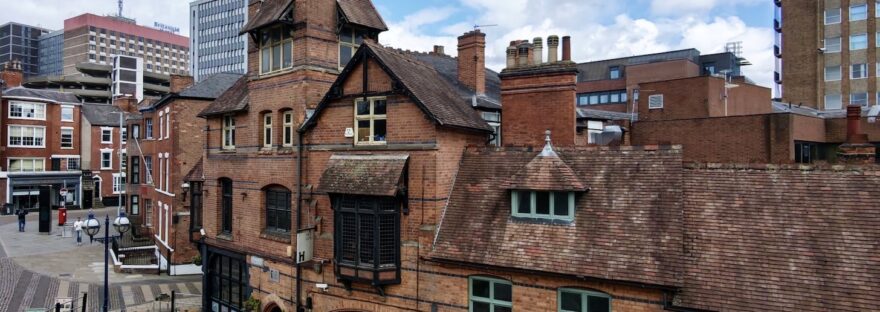
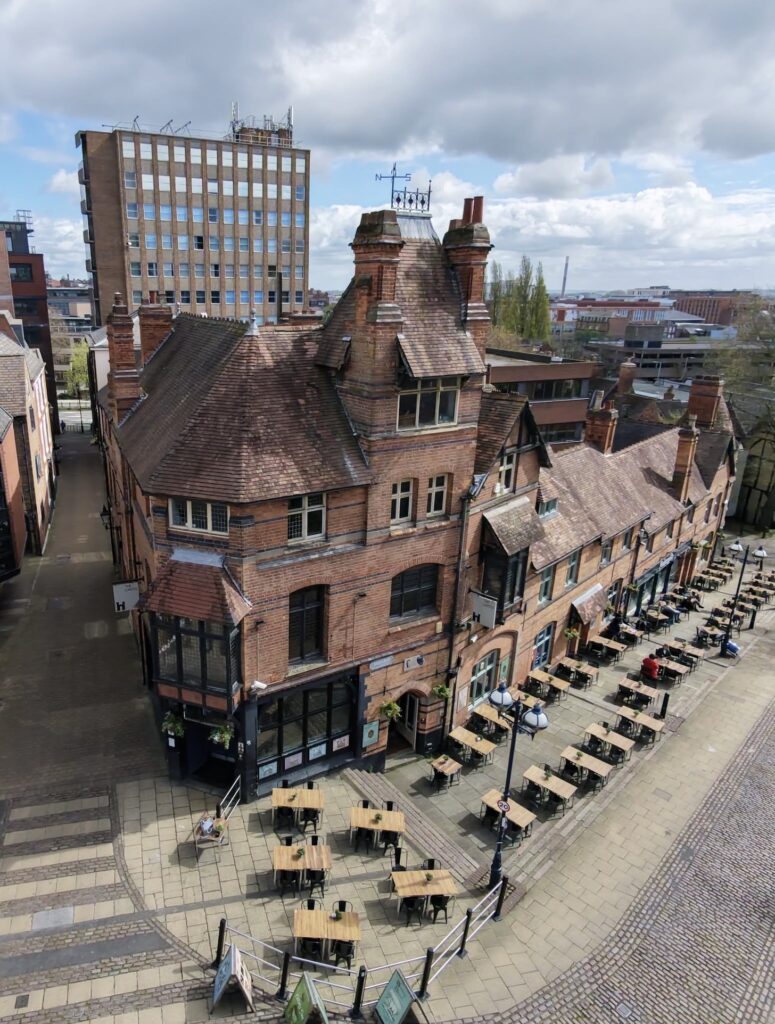
Mortimer House, The Castle Pub, Nottingham (Architect Fothergill Watson 1882-83), Drone photo: Chris Swallow (used with thanks).
There will be some evening tours to take advantage of lighter nights with a Watson Fothergill Walk on Thursday, 25 June, 6 pm and Thursday, 23 July, 6 pm. There will also be a tour on Sunday, 5 July, 10 am. Tickets are £20 each.
If you’re looking for a Father’s Day present, then my gift vouchers might be just the thing – they’re available here, or you can book a private tour for the Father figures in your life! (At time of writing I still have availability on 21 June, Father’s Day ).
I also have weekday availability for tours in Nottingham if anyone would like to put together their own group (6 or more people). Any of my architecture tours are available for private groups. (Terms and conditions apply). Please drop me a line for availability and prices. The Hine Hike will be back towards the end of the summer. Thanks for reading all the way to the end!
I hope you can join me to see Nottingham differently.
I also have some weekday availability, if you’d like to make a group booking (minimum 6 people, maximum 20 people). Drop me a line to find out more.
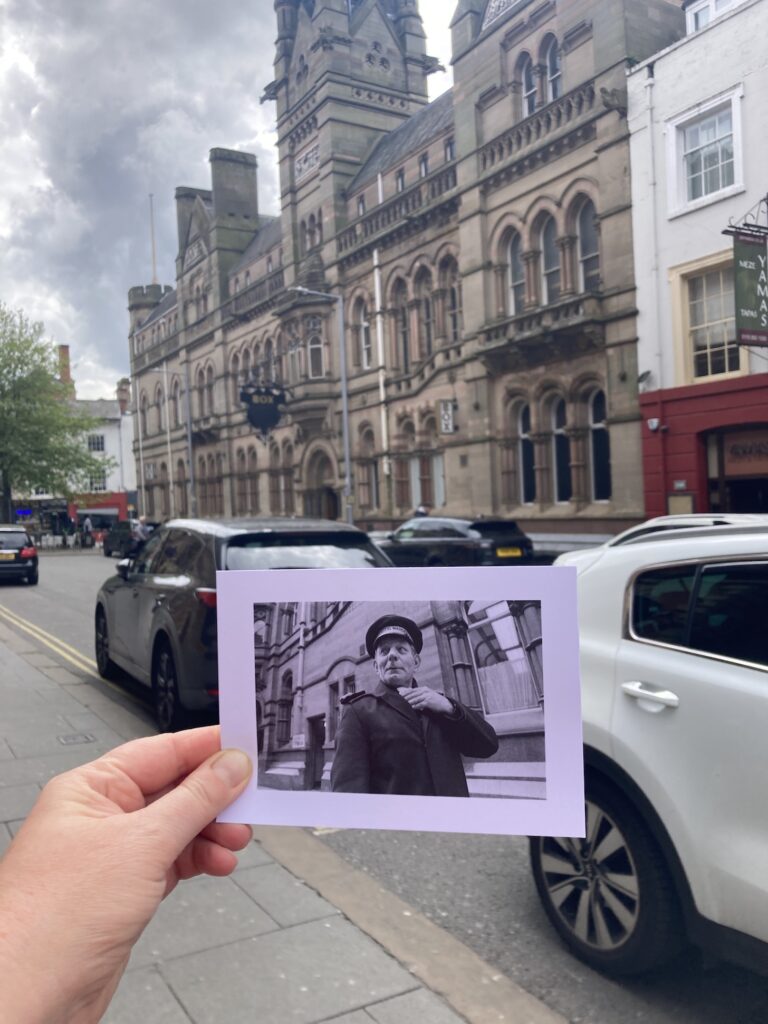
Did anyone else make it to Bonnington Gallery at NTU for John Dean, A Semester in Nottingham 1976? Some fantastic photos, including this one… I worked out where it was taken and realised that the door had been swapped for two windows. Fothergill’s Thurland St Bank is slowly revealing itself!
I’ve decided to pause the Deco in the Details tours until later in the year. These walks are still available for group bookings, so if you have a few folks who would like a tour – let me know!
Do you follow me on Instagram? For more Fothergill and Architecture-related, goings on you can find me @watsonfothergillwalk
I was a guest on my favourite architecture podcast + May tour availability.
Keep reading for exciting news of my podcast appearance… First of all, a shout-out for my upcoming tours. This is basically my job now, and I really appreciate the support and wonderful feedback that I’ve received from so many of you. Hopefully, the weather is going to start behaving itself so, it’s the perfect time to join me and discover even more of Nottingham’s architecture.
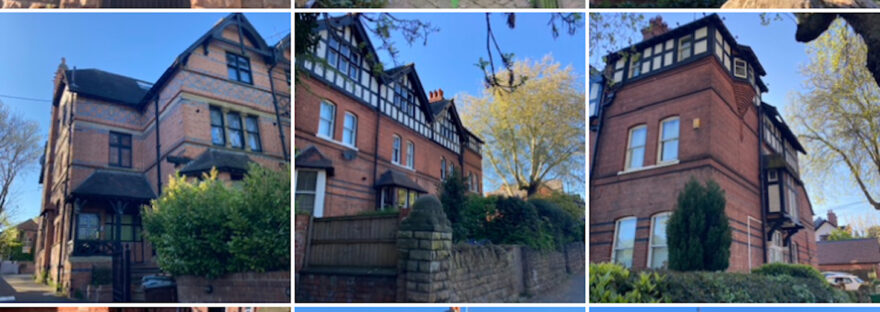
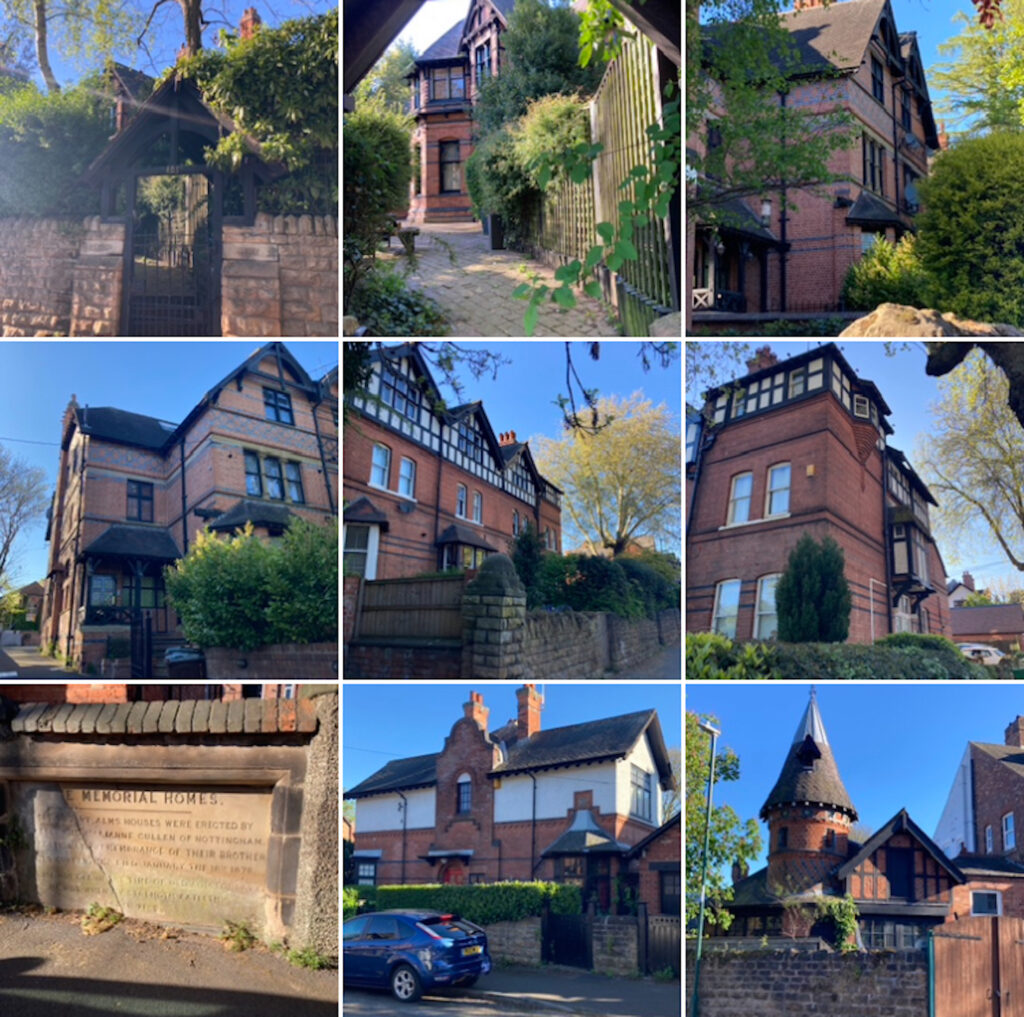
Some of the buildings you can learn more about on The Carrington Crawl. Photos: Lucy Brouwer.
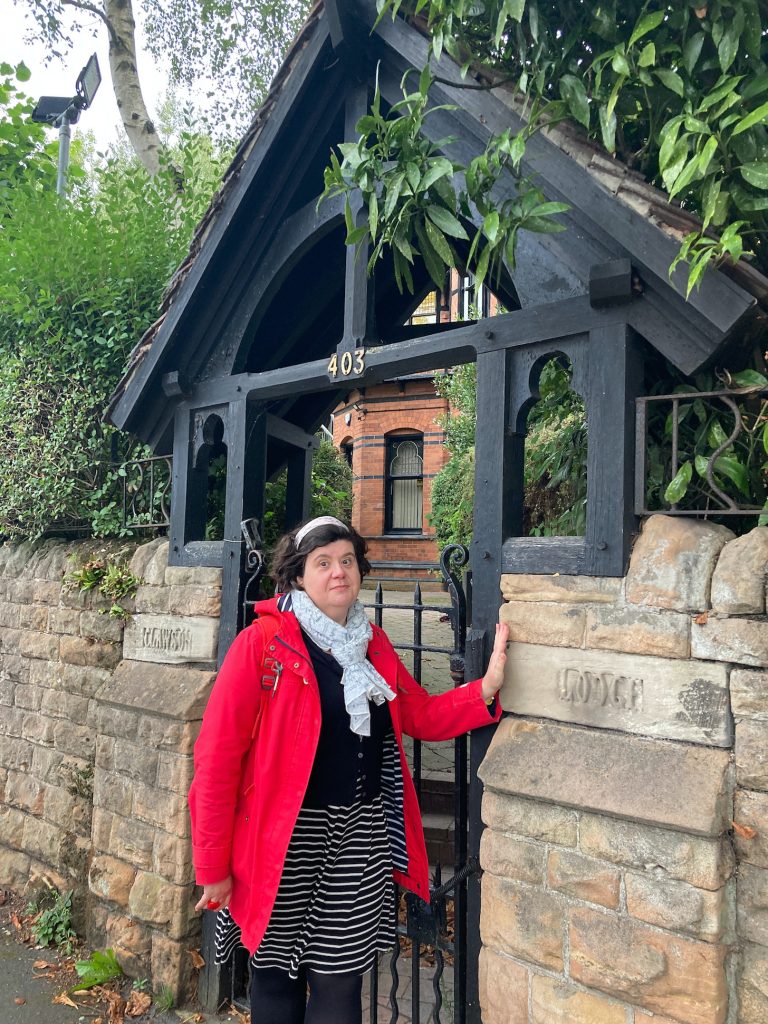
More Watson Fothergill, this time his domestic architecture and the work of his Chief Assistant, L.G. Summers, plus a few surprises. Starting at Mapperley Road, taking in Sherwood Rise and ending in Carrington, where we can explore inside the Ukrainian Cultural Centre at Clawson Lodge.
Not forgetting my original Nottingham city centre architecture tour:
If you’ve already done it, tell your friends. If not, what are you waiting for? A rare afternoon outing for this tour of buildings by Victorian architect Watson Fothergill (aka Fothergill Watson). Recently called Nottingham’s Charles Rennie Mackintosh by a visiting London tour guide…(I’d argue that you could call him Nottingham’s Gaudi!). Join me to find out what all the fuss is about!
Monstrosities Mon Amour!
If you’re interested in architecture, like me, you may have read John Grindrod’s books – particularly Concretopia (which will change your preconceptions about Modern buildings) and IconIcon, which looks at landmark buildings in contemporary Britain.
Author John Gringrod on my tour of Nottingham’s architecture. Photo: Lucy Brouwer
Recently, John came to Nottingham’s Five Leaves Books to talk about his latest book, Tales from the Suburbs, on LGBTQ+ people’s experience of suburbia. Monstrosities Mon Amour is John’s podcast where he invites writers, tour guides and experts to talk about the architecture that other people love to hate. After taking John on a personalised tour of Nottingham, he asked me to contribute and here’s the result!
A few people have asked if I can move my Deco in the Details tours to the weekend, so I’ve given my diary a shake-up and moved the two dates (previously on Wednesdays) to Sunday slots in May.
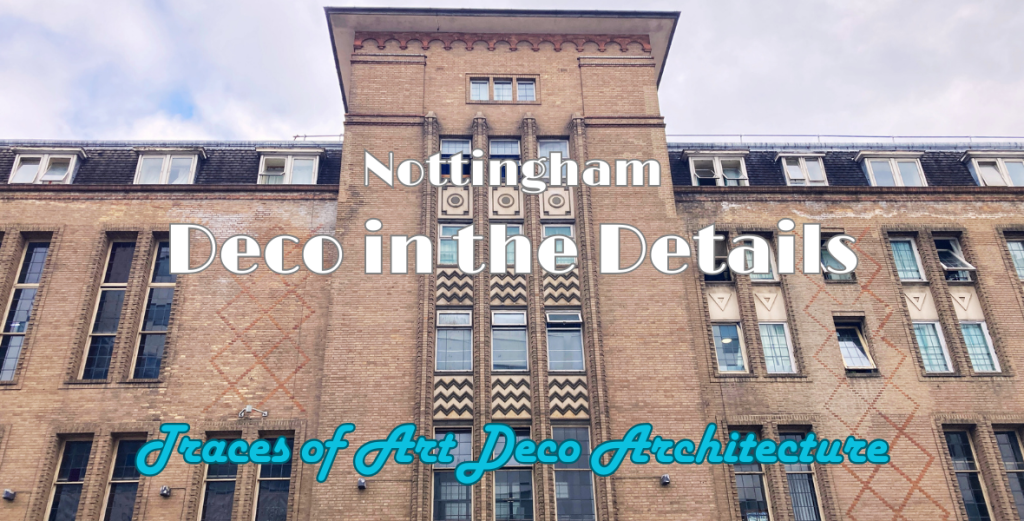
This tour looks for traces of Art Deco style in the architecture of the 1920s and 1930s. Starting with the Council House and taking in Friar Lane, Viyella, Broadmarsh and Listergate to end back at the other side of the Council House (well, it is very large!).
There was so much change in Nottingham in the 1920s and 1930s that this tour needs two parts. You can do either one or both, in any order. This one starts with the YMCA and winds down Parliament Street to Hockley and Sneinton Market.
There’s lots to discover on both these tours – you might be surprised how much. Expect my usual entertaining blend of architecture-spotting, history and anecdotes.
Other upcoming events
There are still some spaces on The Hine Hike, Sunday 19 April, 2 pm. If you’ve not done this tour yet, then please join me to explore the massive contribution the architect Thomas Chambers Hine made to the way modern Nottingham is laid out.
A rare chance to join me for theCarrington Crawl. This tour looks at houses designed by Watson Fothergill and his chief architectural assistant, Lawrence George Summers. I don’t do this one very often, so don’t miss out on a chance to find out more about Fothergill’s domestic set-up, his art collection, the house he built for himself and the buildings that helped to shape Mapperley Park, Sherwood Rise and Carrington. This walk starts at the junction of Mansfield Road and Mapperley Road and finishes at Clawson Lodge (the Ukrainian Cultural Centre) in Carrington, where you can go inside, look around, enjoy a drink and ask me questions!
All these tours can be booked for independent groups -I’m often available during the week. Please drop me a line to set up a tour for you and your friends, or for social clubs, gatherings, alternative works-dos etc.
Architecture in the Pub talks
Thank you for the fabulous response to these talks. The Berni Inns talk at the Abdication is now full, but I will hopefully be repeating the series and possibly adding new topics at the Vat & Fiddle in the Autumn. There will be some historical highlights on the Vat & Fiddle’s social media over the coming weeks.
My research into Nottingham’s Berni Inns has led down a few historical rabbit holes…
I’m busy researching and writing my forthcoming talk on Nottingham’s Berni Inns and their buildings. This is now fully sold out at The Vat & Fiddle, but I will be repeating the talk at The Abdication Micropub, Daybrook, on Tuesday 21 April, 7 pm. Please contact the pub for tickets, £10 each.
Meanwhile, I have a couple of walking tours lined up for April:
I also have some weekday availability to conduct walking tours in the next few months, if you have a group of friends, a club or organisation that would like to see Nottingham differently, drop me a line here.
I have been delving deep into the stories of some old Nottingham buildings. One of these is the Flying Horse Hotel, which, for a short time, was owned and run by Berni Inns, but has been famed in the town and beyond in the years before and since.
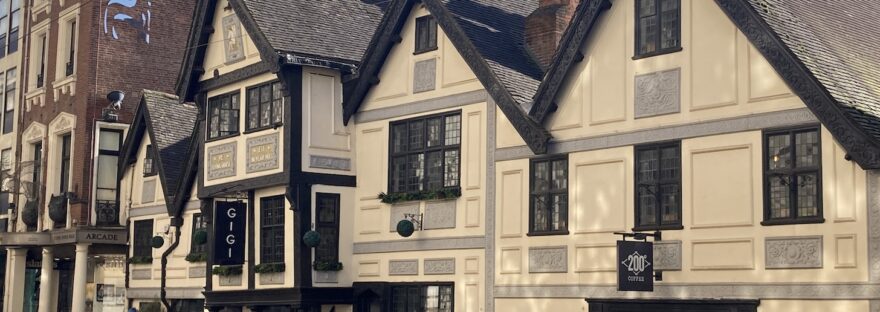
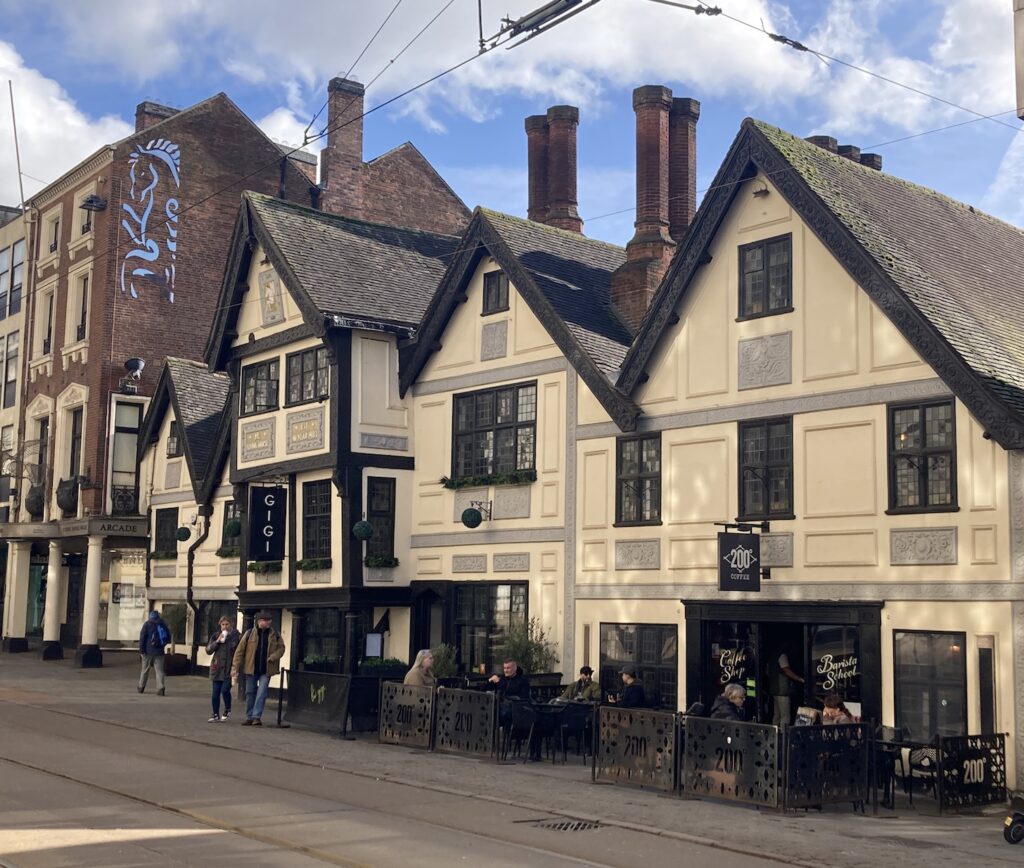
These days, it is Flying Horse Walk, a shopping arcade first planned in the mid-1980s, now home to the first cafe opened by 200 Degrees Coffee and Bar Gigi, who make use of some of the cellars beneath the building. According to J. Holland Walker’s 1928 history of Nottingham, The Flying Horse stands on the site of the house the Plumtre (sometimes Plumptre) family erected when they first came to Nottingham in the 13th century. Claims are made, not least by the date inscribed on the facade, that it was established as a hotel in 1483, but like several other dates attached to Nottingham pubs, this might not be everything it seems.
I’ve trawled the newspaper archives for evidence and found that The Flying Horse Hotel is sometimes called a “Tudor Coaching Inn”, with the name referring to the speed of the horse-drawn vehicles. It seems more likely that the flying horses were the ones on early fairground rides – perhaps inspired by the Goose Fair, which was held on the Great Market Place close by. J. Holland Walker posits that it was known as “Travellers Inn” (later writers state that he doesn’t mean this was the name of the hotel, rather this was the purpose for which the hotel had a reputation.) It was also claimed (apparently in Thomas Bailey’s Annals of Nottinghamshire) that the hotel was mentioned in letters of endowment of the Plumtre Hospital in 1392.
The Wikipedia page claims the owner was William Rowbottom from 1799. I’ve found evidence for him as licensee until 1811, when Robert Mackley, formerly of the Black Boy Inn, took over. I can find Mackley at The Flying Horse until around 1821, and then it is possible that he retired. Mrs Jane Clarke is the next licensed victualler on the premises (until circa 1844), and then the hotel is taken over by her son-in-law, William Henry Malpas. Of Malpas, a lot more seems to have been recorded, at least in the local papers.
William Henry Malpas (1803-1862), along with his wife Jane (who he’d married in 1835), and later his sister Emma Susanna Malpas plus a staff of over a dozen barmaids, waiters, chambermaids, cooks, a carman and an under ostler, boots and under boots, ran the hotel until his death in 1862. Henry Malpas, as he was known to his friends, was a character seemingly straight from the pages of The Pickwick Papers (Charles Dickens’ debut novel, published in serial form from 1836). A colourful obituary in the Nottingham Journal describes him as “20 years mine host” at The Flying Horse, known for its “quaint and cosy style of architecture… one of those establishments where ‘men on the road’ and temporary sojourners might be supposed to have ‘taken their ease at the inn.’” The Flying Horse was known throughout the country and “held lordly sway over the lesser inns in Nottingham.” Malpas was a “robust and genial host”, always ready with a sporting story, his “force of character”, patriotism, love of field sports and greyhounds and acquaintance with “stars of the ring” including Nottingham’s boxing hero William “Bendigo” Thompson, making him a popular figure. Despite bankruptcy hearings due to his “having more than one iron in the fire” with his investments in iron and tin plate, he continued at the Flying Horse after the death of his wife and after attempts to sell the lease of the Hotel.
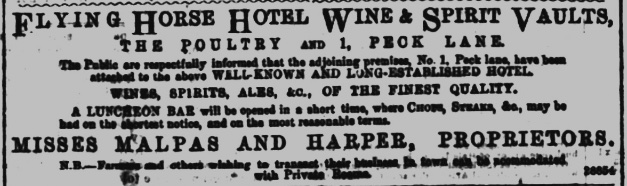
At his death in November 1862, from a “brief but severe illness” after suffering severely from “frequent and protracted attacks of gout”, his sister Emma Susanna Malpas took over the running of the hotel, going into partnership with her assistant Sarah Harper from 1868. They rebuilt substantial sections of the building in 1870 and opened a new luncheon bar and restaurant in 1871, described as “at once handsome, commodious and convenient”. In 1872, a new company was formed and it appears the hotel was at least partially rebuilt (at least this was the plan at the time).
Nottingham Journal, April 1870. (British Newspaper Archive).
Miss Malpas died in 1874, and for a while, Miss Harper continued at the helm, making more improvements to the building.
From around 1877-8, the Hotel seems to have been run by a succession of managers and manageresses, and owned by Thomas Dickinson (sometimes Dickenson), Wine and Spirit Merchant, with Martin Inett Preston (solicitor, who had been Sheriff of Nottingham 1866-7) trading as The Flying Horse Hotel Company.
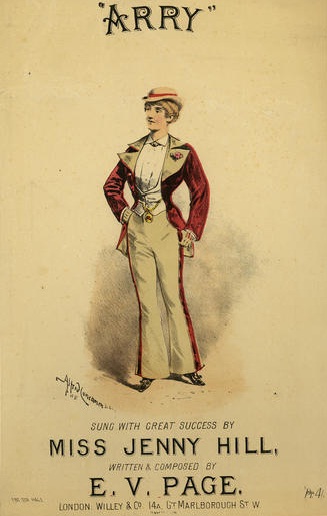
In November 1886 an altercation between the manageress Miss Emily Smeed and the Musical Hall star Jenny Hill was reported. Miss Hill was refused service, and a fight ensued, possibly ending with Miss Hill striking Miss Smeed with her umbrella (the witness accounts were conflicting to say the least).
In 1881, a new annexe to the hotel with an entrance of St Peter’s gate opened, with a new refreshment counter and billiard room.
Each successive report of the Hotel going up for auction (in 1870 and 1908) seems to end in ‘no sale’, as the reserve price was not met. It continued to trade all the same. Apart from adverts for staff and notices of meetings and dinners, the most solid mention of management is in 1908, when the license of the “ale house” transfers from Arthur Mann to Charles Symons.
In 1916, alterations are again proposed, this time to reduce the number of entrances; the magistrates object. Around 1921, Trust Houses Ltd, a company originally formed to rejuvenate coaching inns for the motor car age, took over The Flying Horse.
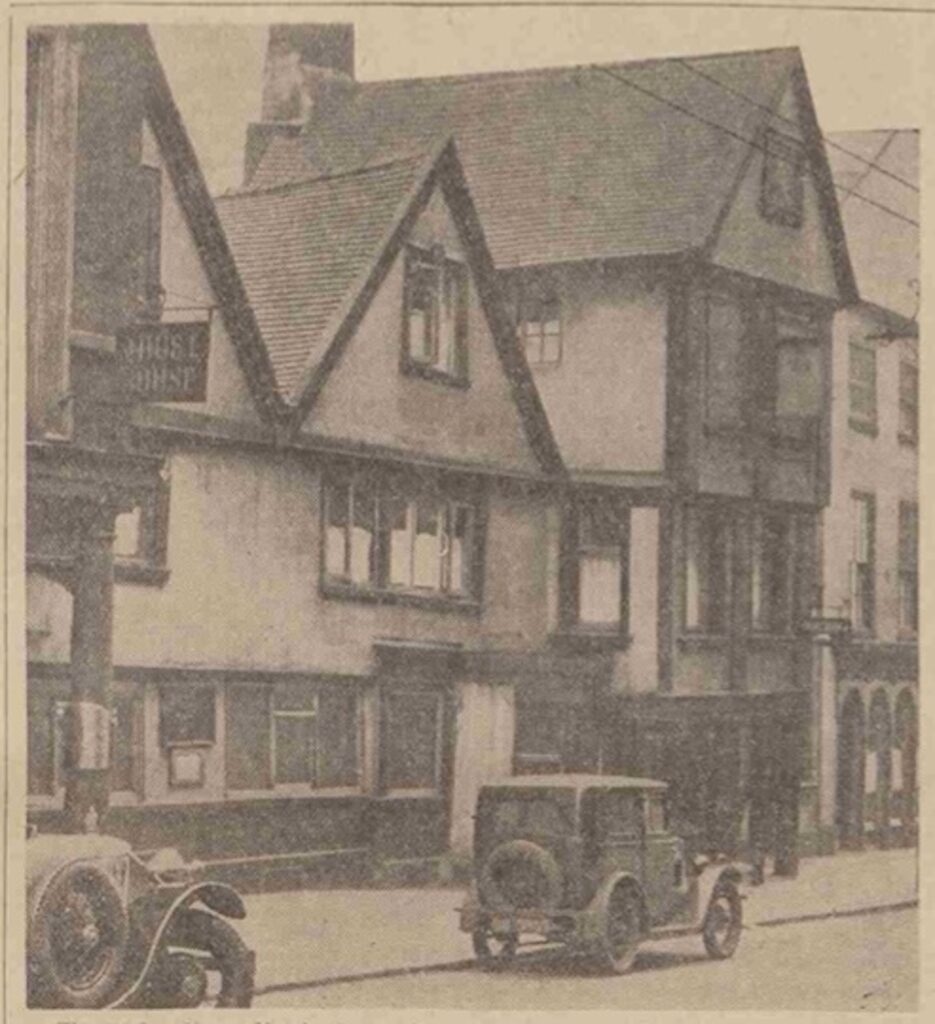
In 1931, the property was once again put up for sale, but Trust Houses still seem to be in charge, then in 1934, applications were made for more alterations to the building, it was actually suggested that the building be demolished. Douglas Gladstone Millett, Trust Houses in-house architect, planned to pull down The Punch Bowl, another inn adjacent to the Flying Horse on Peck Lane, as this was now largely disused. The licensing magistrates were in favour of pulling down the entire hotel rather than modernising the interior. They claimed the only solution was to rebuild. The Flying Horse was described as the only surviving medieval landmark in Nottingham. The date 1483 was then visible on the signboard, but the architecture was described as “from about the time of The Armada.”
The Flying Horse Hotel, before the 1935 alterations. Nottingham Evening Post, 1.12.1934 (BNA)
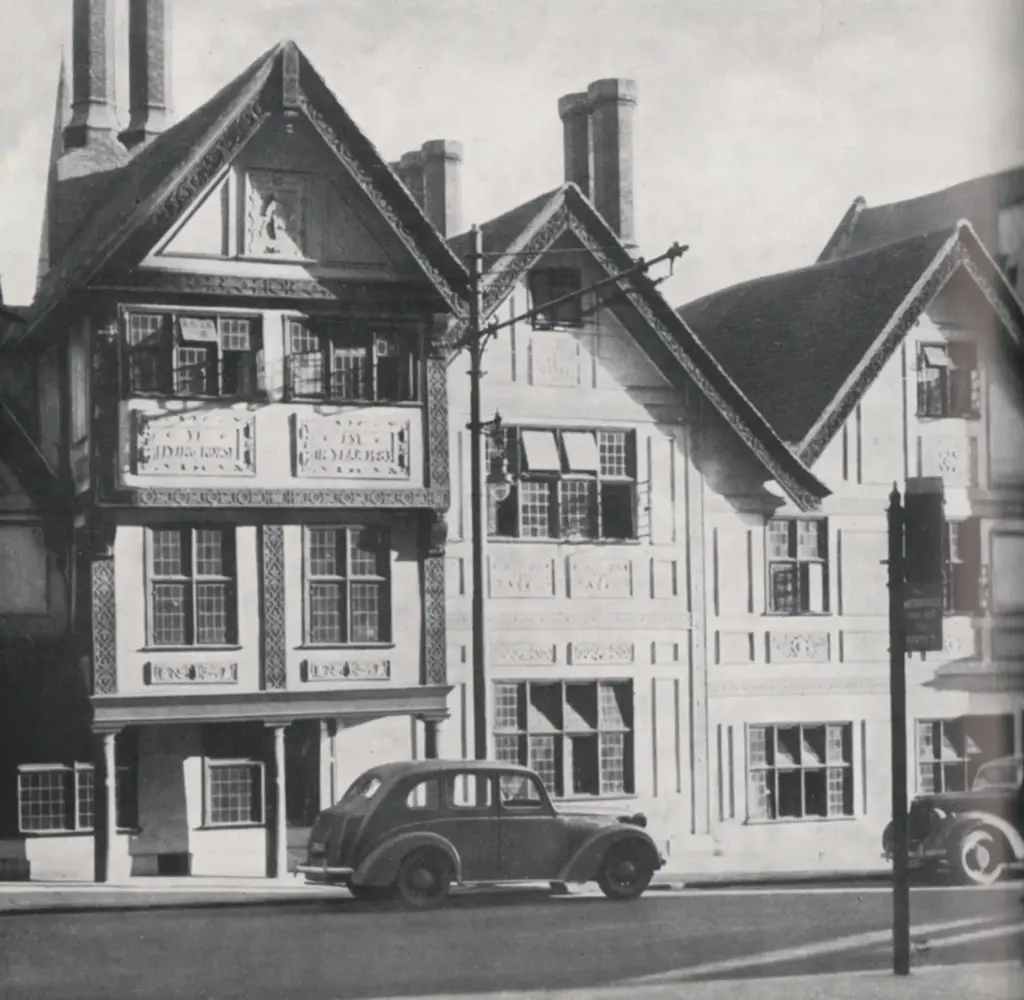
Permission for Trust Houses modernisation scheme was refused at first, but in 1935 plans for structural alterations were deemed satisfactory and went ahead, with the facade being practically rebuilt to D.G. Millett’s design (the pargetting is alleged to be based on The Rose & Crown, another coaching inn he had worked on for the company in Saffron Walden, Essex.)
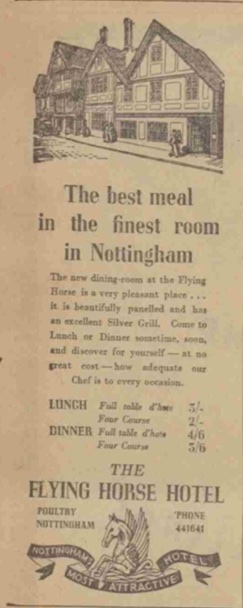
8 Oct 1936 Nottingham Evening Post (BNA)
The Flying Horse Hotel circa 1951 (Old English Inns Illustrated, source.)
The new dining room was described as “beautifully panelled”, a description you’ll recognise if you’ve ever been inside 200 Degrees Coffee Shop (and a scheme that they have replicated across their chain of cafes!).
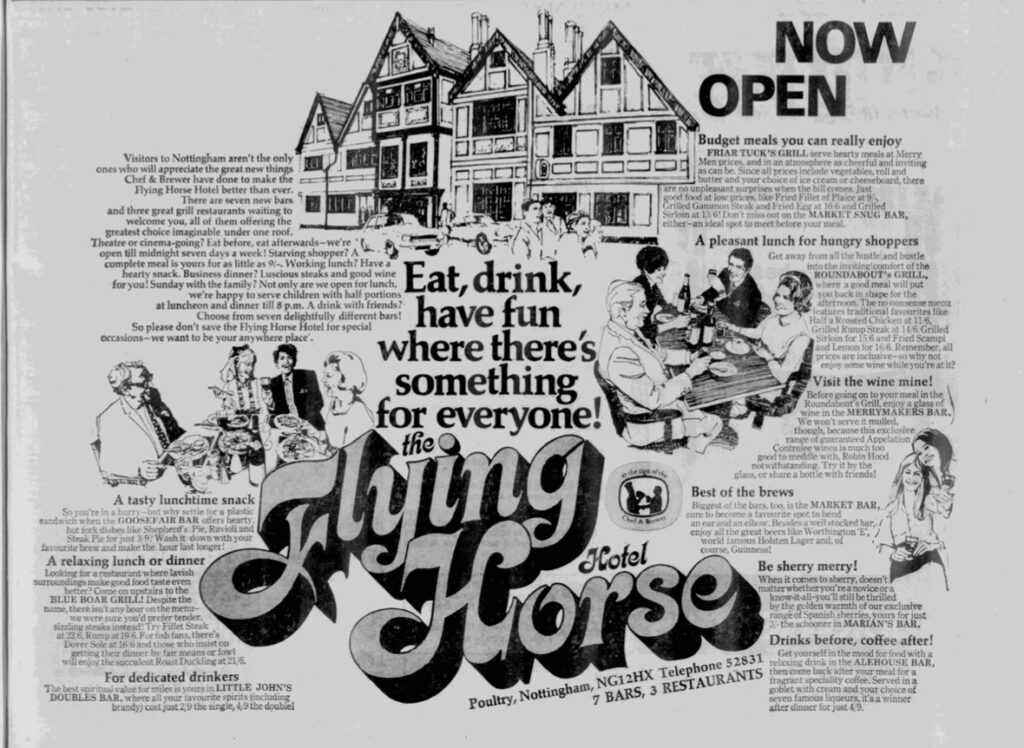
In 1968, the Hotel again came under threat of demolition but was saved and altered internally once again, this time to become part of the Chef & Brewer chain of dining pubs, opening in 1969.
1969, Nottingham Evening Post (BNA)
Into the 1970s, as Chef & Brewer were absorbed into the Grand Metropolitan hotel chain, The Flying Horse was rebranded as a Schooner Inn and by 1981 had become a Berni Inn (the 9th steak restaurant in Nottingham and the surrounding area.) In 1986, when plans for the new shopping arcade were launched, Berni had originally planned to remain on the site, but in the end, they pulled out of the deal, and the Flying Horse Hotel finally closed its doors. Flying Horse Walk shopping arcade opened in 1988, costing £8 million it was seen as a sign that Nottingham was a vital and fashionable shopping city.
Original shops included Ouiset, French Dressing Mondi, Alexon, Berketex Brides, Le Pew, Barbara Pepper Lingerie, The Costume Jewellery Shop, Optional Extras, Wires and Intermission Coffee Shop (upstairs if I remember rightly!).
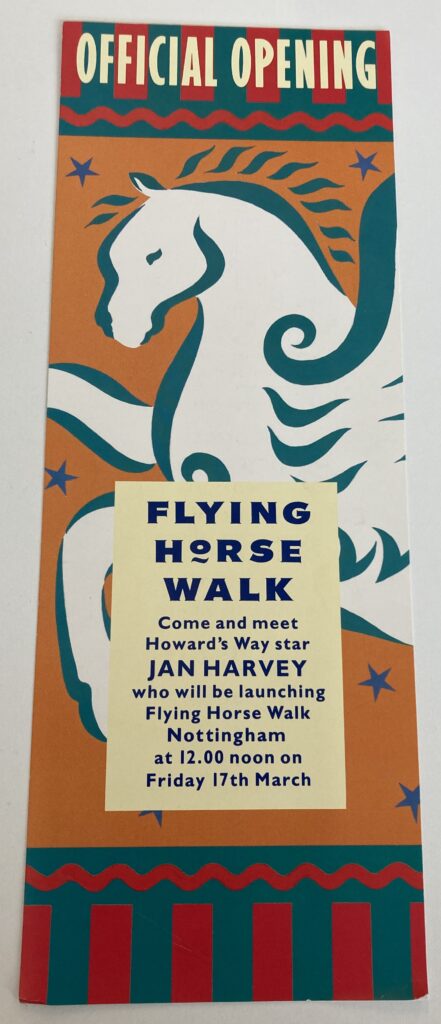
Flying Horse Walk Opening event, March 17 1988 (With thanks to Nottingham City Libraries Local Studies Dept.) (Actress Jan Harvey played a fashion tycoon in the BBC melodrama Howard’s Way, broadcast on BBC 1 at the time)
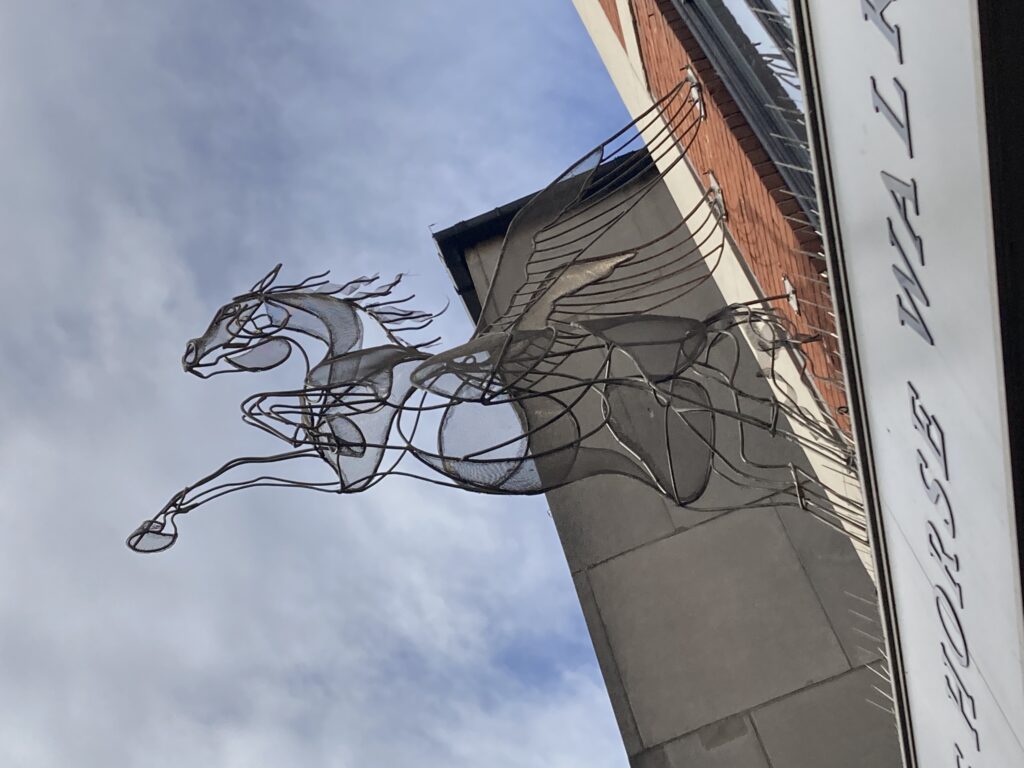
The facade remains as a listed building, but the majority of the building was modernised (and has been refurbished a couple of times since). The arcade was rebranded as FH Mall for a while, but was rebranded again as Flying Horse Walk in 2013 with the addition of Amy Goodman’s Pegasi sculptures. Currently, in 2026, the shops inside include The Cheese Shop, Vivienne Westwood, jewellery shops, hairdressers and art shops.
The Flying Horse sculpture by Amy Goodman (Photo: Lucy Brouwer)
More about Nottingham’s Berni Inns and their buildings on 21 April, 7 pm at The Abdication Micropub, Daybrook. Please contact the pub to reserve a spot. Tickets £10 each.
Building histories… an occasional series. Plus a new talk at the Vat & Fiddle in March.
Deco in the Details Part 1 is now sold out, and there are 6 tickets remaining for Deco in the Details Part 2 on 29th March, 11 am. I will also hopefully be doing these walks again later in the year.
The Watson Fothergill Walks in February and March have tickets still available, if you haven’t joined me yet for a tour of my favourite Nottingham buildings, then make sure you don’t miss out this year. Read on to the end for news of a new illustrated talk at the Vat & Fiddle in March.
Thanks to my correspondent Hazel C for suggesting I look into the history of 26-28 Market Street, Nottingham. It has just been put onto the market for sale, with the present tenants Revolucion de Cuba, staying on inside.
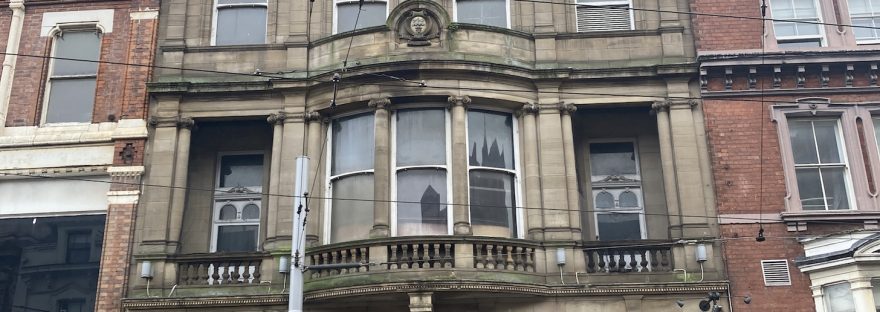
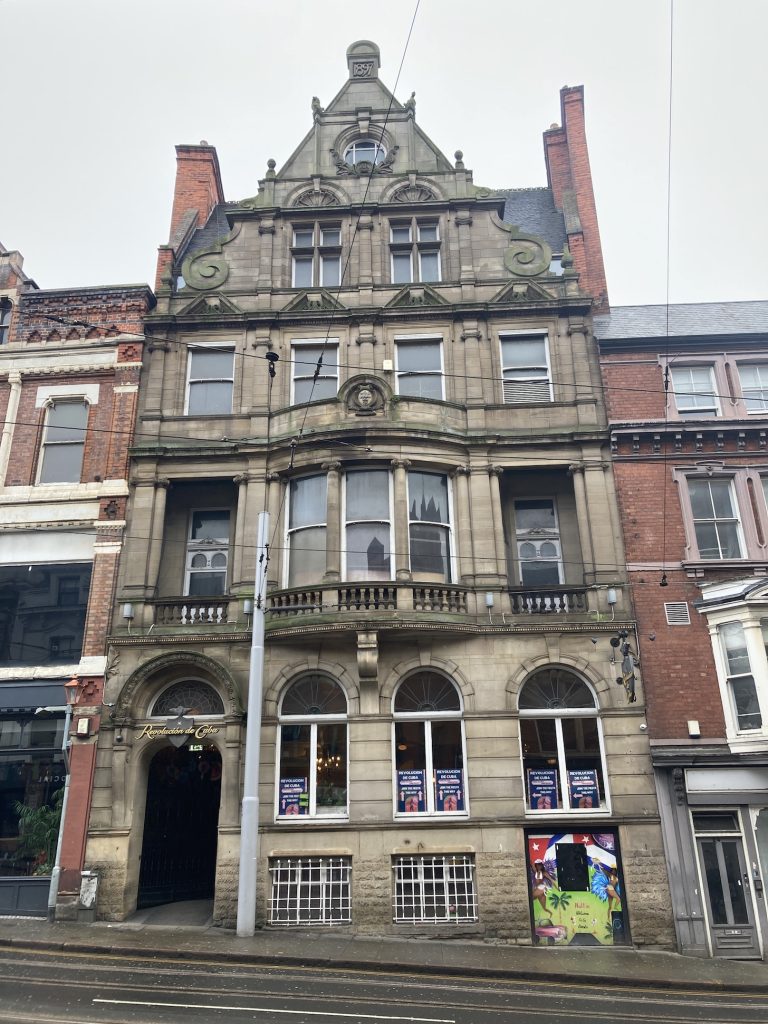
This Flemish Renaissance-style grade II listing building, which was built from 1897 and opened in 1899, was designed by architect A.R.Calvert as The Nottingham and County Constitutional Club. At the time of his death in 1922, he was still the club’s secretary.
Alexandra House, Market Street, Nottingham. Photo: Lucy Brouwer.
It was originally built as the headquarters of The Nottingham and County Constitutional Club, one of several gentlemen’s clubs in the city in the late Victorian period. It was organised as a place for supporters of the Conservative and Unionist Party to meet and discuss the political events of the day, socialise and use the facilities. Their chairman at the time was the Solicitor James McCraith (coincidentally a colleague and client of Watson Fothergill).
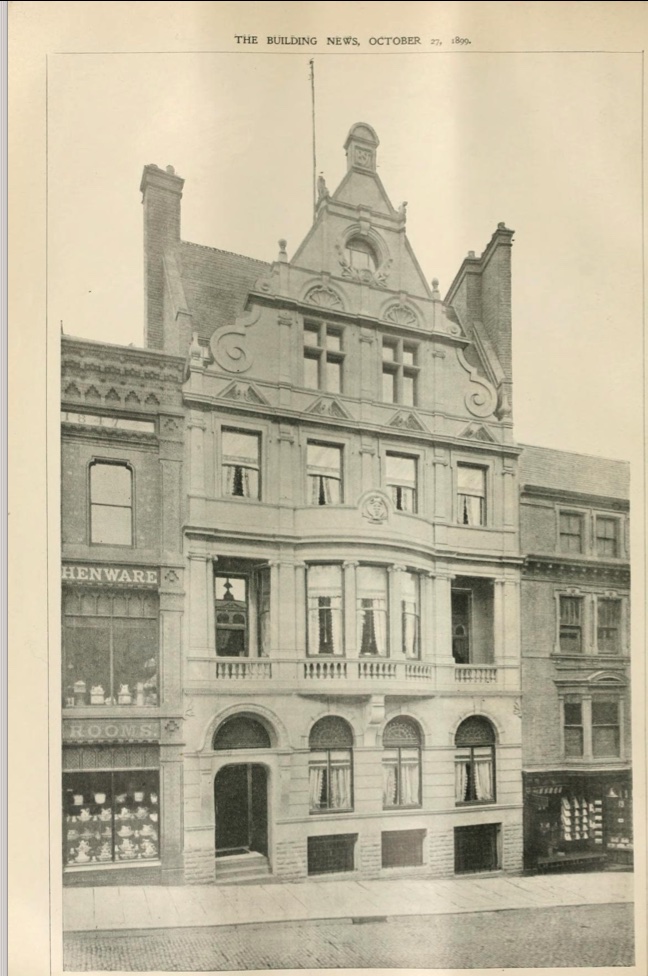
The newly completed Constitutional Club, 1899 (The Building News, Internet Archive).
When newly built, The Constitutional Club was considered “one of the most complete and well-equipped clubs outside London.” Inside were a smoking room, billiard room (three tables), and assembly hall on the ground floor. On the second floor, behind the balconies, were dining rooms, a committee room, reading, writing, and card rooms. At the top of the building were bedrooms for members, a bathroom and a steward’s room. Disconnected from these were a kitchen, scullery and servants’ bedrooms. There was a large skittle alley in the basement and a ladies’ room, decorated in peacock blues and white, “separate from the club proper”, (as not yet having the vote, the ladies were not allowed membership.)
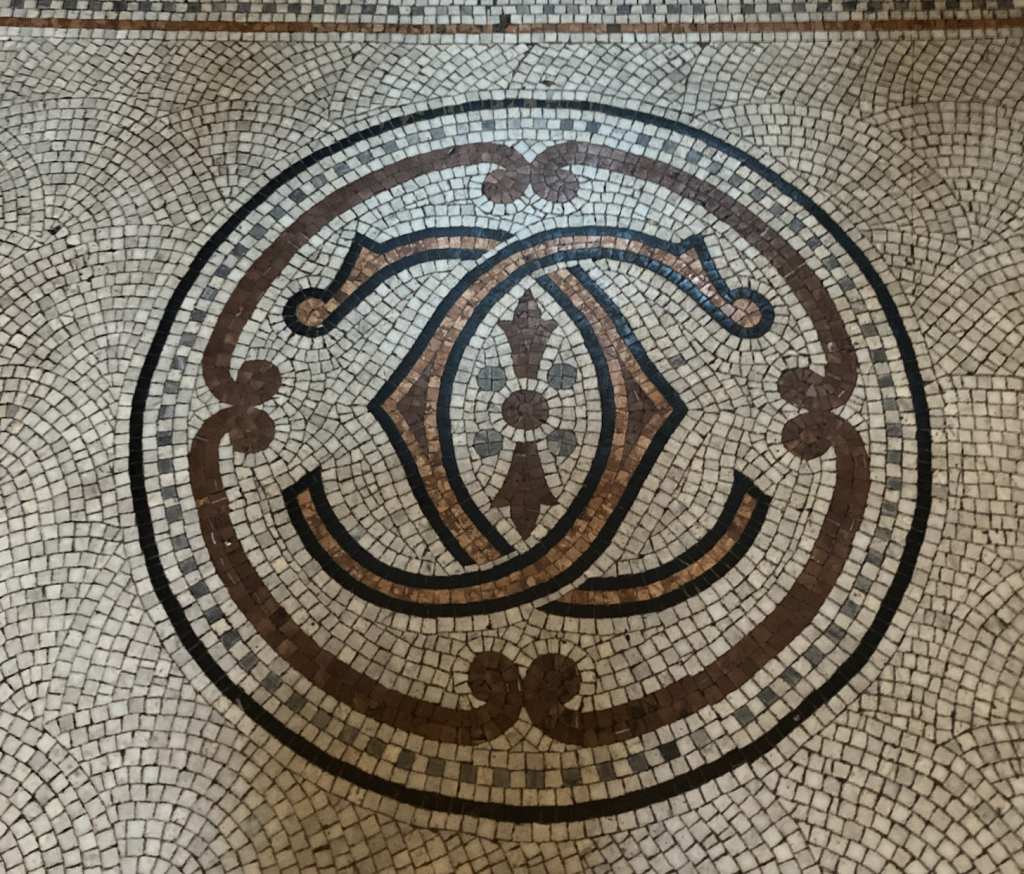
The front of the building was constructed in Derbyshire stone, the entrance porch was panelled in Kilkenny and Languedoc marble, with a mahogany screen containing antique glass. A period photograph held by Historic England shows that the terrazzo floor, which can still be found in some places inside, is likely original.
CC for the Constitutional Club, found at the entrance to the building. Photo: Lucy Brouwer.
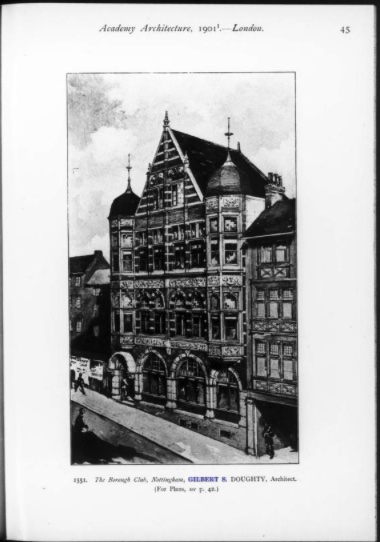
Over the years, these clubs and their lavish buildings fell out of fashion and became expensive to maintain. The Borough Club, which had a similarly decorative building on King Street, completed to designs by the architect Gilbert Smith Doughty, merged with the Constitutional Club in 1959. The building on King Street was sold to the Nottingham Corporation and subsequently demolished.
The Borough Club on King Street to a design from Academy Architect Magazine.
The Market Street Building and the organisation both took on the name “The Borough Club”. This building in turn, became too large and was sold off in 1968. The club had also merged with The Nottingham Reform Club (who themselves had sold off its Victoria Street building – Now The Cosy Club). In 1969, in an effort to bring themselves up to date, the merged clubs moved to the Midland Design & Building Centre, then a new modern building on Mansfield Road (and itself now demolished). The city’s politically-minded clubs now seem to have been absorbed by Conservative Party organisations, and the era of Gentlemen’s clubs is long gone – if you search for them now, you’re more likely to find listings for lap dancing establishments!
The next use for the Market Street building was as a Berni Inn. When The Black Boy Hotel on Long Row (whose many alterations and rebuilding works were carried out by Watson Fothergill) was demolished in 1970, the license was transferred to these premises, and it was refurbished with some of the hotel’s fixtures (including a small statue of an enslaved boy – which came up for auction a couple of years ago). It was renamed The Black Boy Inn, claims were made that the name and the history of the old hotel came from the time of King Charles II, whose nickname was apparently “Black Boy”, thanks to his dark hair. A likely story!
Berni Inns, a British restaurant chain whose accessible and straightforward Steak and Chips menu did much to democratise eating out in post-rationing Britain, had several establishments in Nottingham. In December 1971, The Black Boy Inn on Market Street opened. It eventually was home to four bars with seating for 330 people. As well as their trademark steaks, in the mid 1970s it served pizza and boasted a female DJ in its DiscoDine bar.
Berni traded here until 1988, when the building closed for refurbishment, reopening as Old Orleans, a Louisiana Jazz theme bar and restaurant, with the City Trading House bar in the basement.
In December 2015, Revolucion de Cuba took over the site from the relatively short-lived Long Island American Diner (Here from 2014. If anyone can remember the name of the nightclub on the upper floor, please let me know!)
Part of the Revolution chain of bars, it has recently been taken over by a new consortium and will be having a spruce up as the building goes on the market once again, valued at almost £2 million. (Check the listing for more pictures of the interior.)
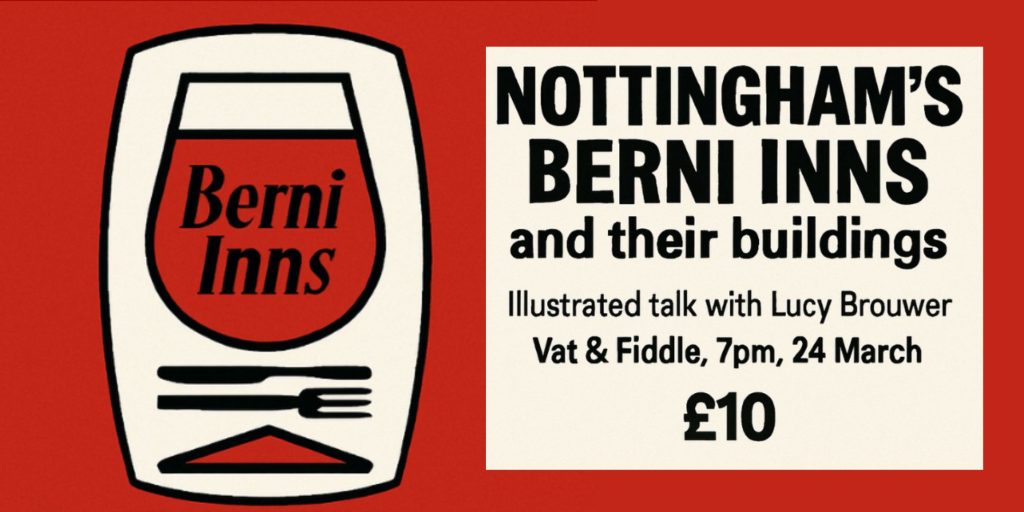
All this has inspired me to dig deeper into the history of Nottingham’s many Berni Inns and their buildings, and I will be presenting my findings at The Vat & Fiddle on Tuesday 24th March, 7pm. Tickets are £10.
If you have any Nottingham Berni Inn memories to share or photos of the interiors of any of Nottingham’s many Berni Inns, I’d love to take a look. Drop me a line here.
My next Vat & Fiddle talk, on Watson Fothergill in the Park Estate, is now sold out. However, if you’d like to book me to give a talk to your group or club, please do not hesitate to contact me.
The weather has not been particularly conducive for tours this month, so I took a day off for a wander around Beeston. (This is not a guided tour, just something I do!)
Beeston’s history is well-documented, and the Beeston Civic Society have been doing great work. If you live there or visit, you’ll know that there are loads of cafes and bars, interesting shops and charity shops. A few buildings caught my eye…
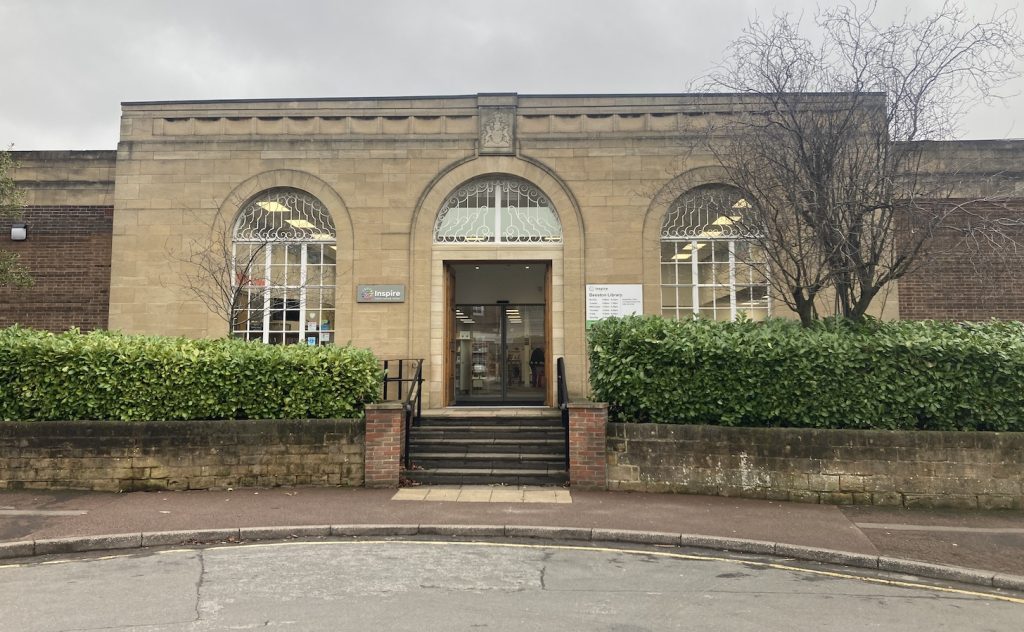
Beeston Library, Photo: Lucy Brouwer.
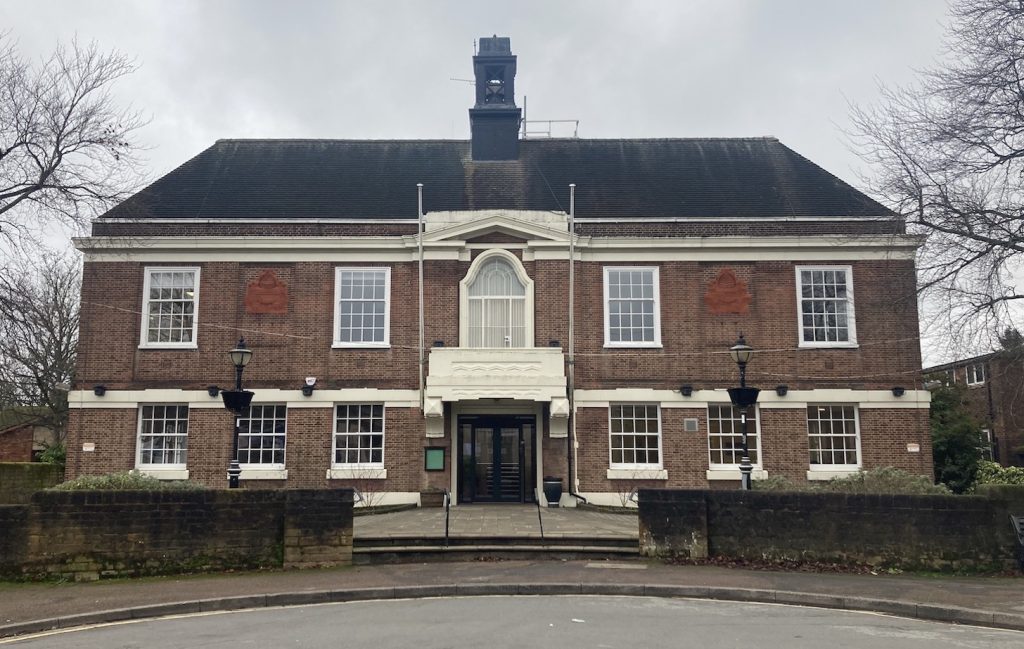
As a former Library Assistant and full-time bookworm, I made a beeline for Beeston Library. The building on Foster Avenue was designed by the County Architect E. W. Roberts in 1938. He was also responsible for West Bridgford Library. The builders of the Library, local firm Hofton & Son, also built Beeston Town Hall, which is now used as a church, and sits opposite. It opened in 1938 and was designed by the architects Evans, Clark & Wollatt with H.H. Goodall. It has a solid Neo-Georgian look with Art Deco details.
Former Town Hall, Beeston. Photo: Lucy Brouwer.
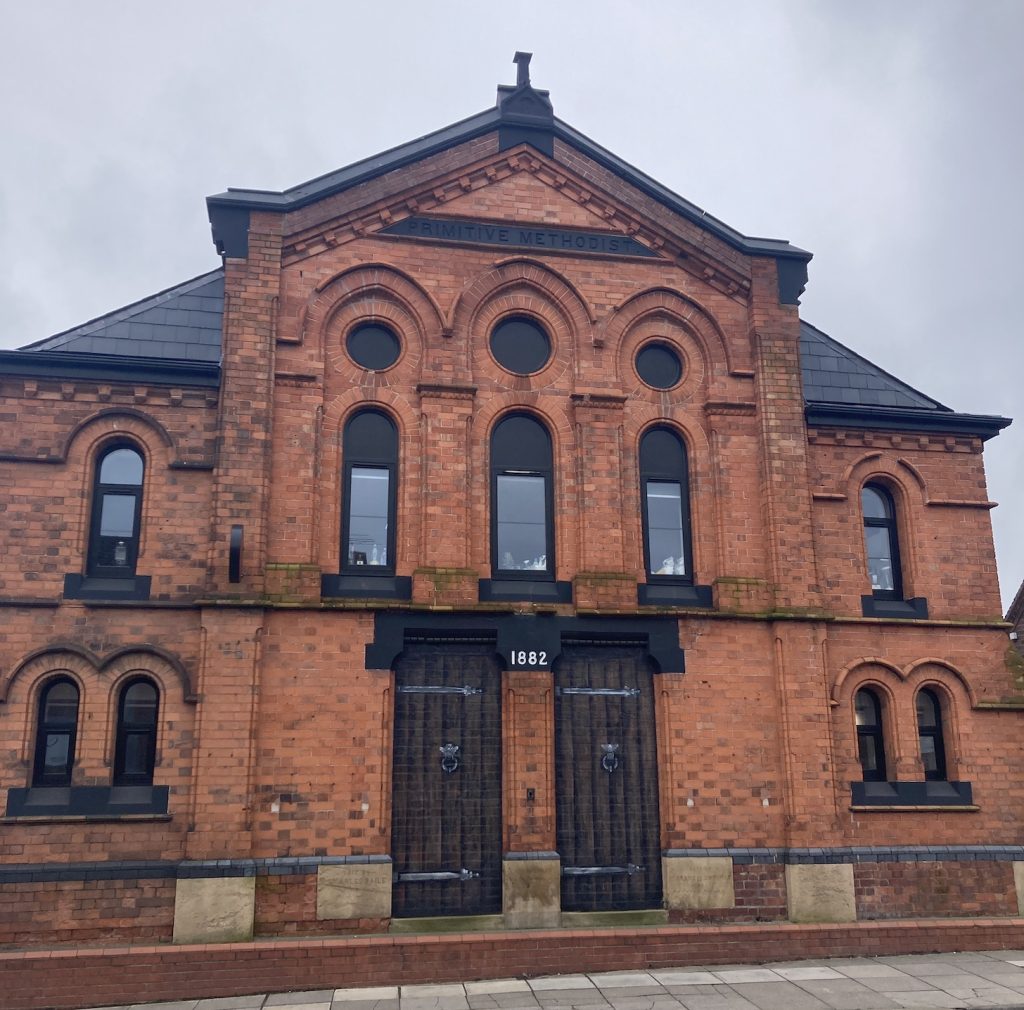
After a very nice coffee at Greenhood, itself in a former Birds the Confectioners shop on the High Road, our daunder** took us past the former Primitive Methodist Church on Wollaton Road. This 1882 building was one of many Victorian-era Methodist churches by Nottingham architect Richard Charles Sutton.
Former Primitive Methodist Church, Beeston. Photo: Lucy Brouwer.
R.C. Sutton was a very prolific architect in his day; his buildings can be found all over Nottingham and outlying areas. I’m hoping to explore his work and his connections to Bromley House Library, where he had his office, further this year.
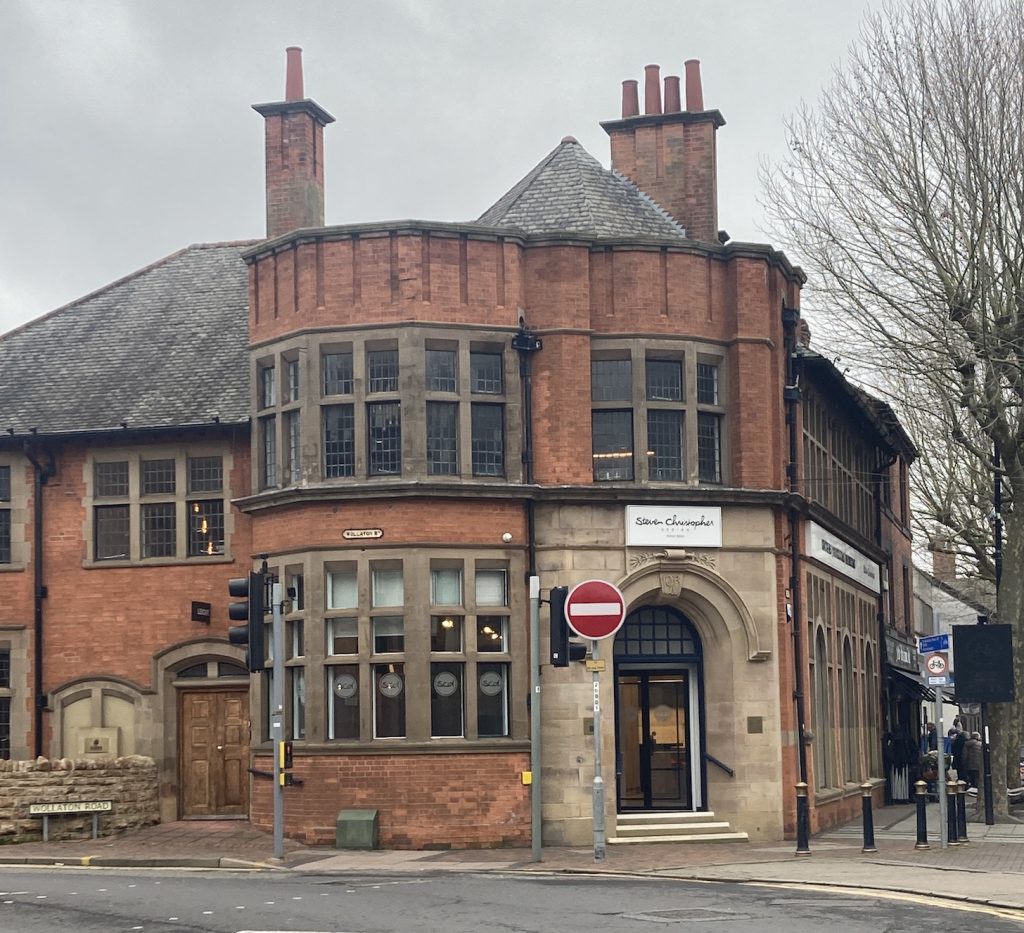
Back on the High Road, the former NatWest Bank stands out. It was originally built for the Nottingham and Notts bank, 1905-08, and was likely designed by the Coalville architect Thomas Ignatius McCarthy. The Pevsner guide describes it as “abstracted Neo-Tudor.” It ceased to be a bank in 2023 and is now a kitchen showroom.
Former Nottingham & Notts/ NatWest Bank, Beeston. Photo: Lucy Brouwer.
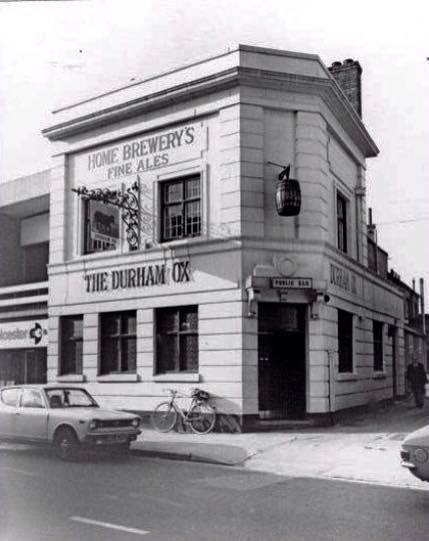
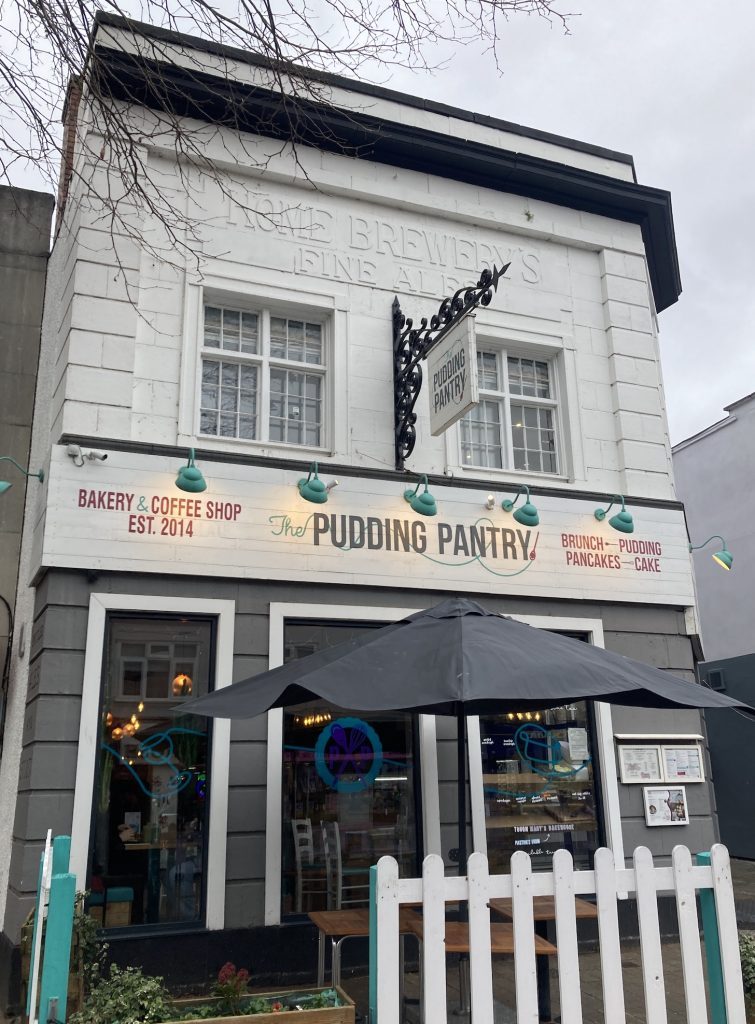
Further down the High Road, the familiar Home Brewery lettering on a white building caught my eye. The Pudding Pantry cafe was previously The Durham Ox pub.
A very detailed history of the pub can be found on David Hallam’s Beeston History website. The present building was built in 1925, and was one of many pubs rebuilt by the Nottingham architect Albert Edgar Eberlin, as mentioned in my Art Deco Pubs talk. Eberlin also worked on The Fox, The Royal Children, The Beechdale and many more pub buildings around Nottingham.
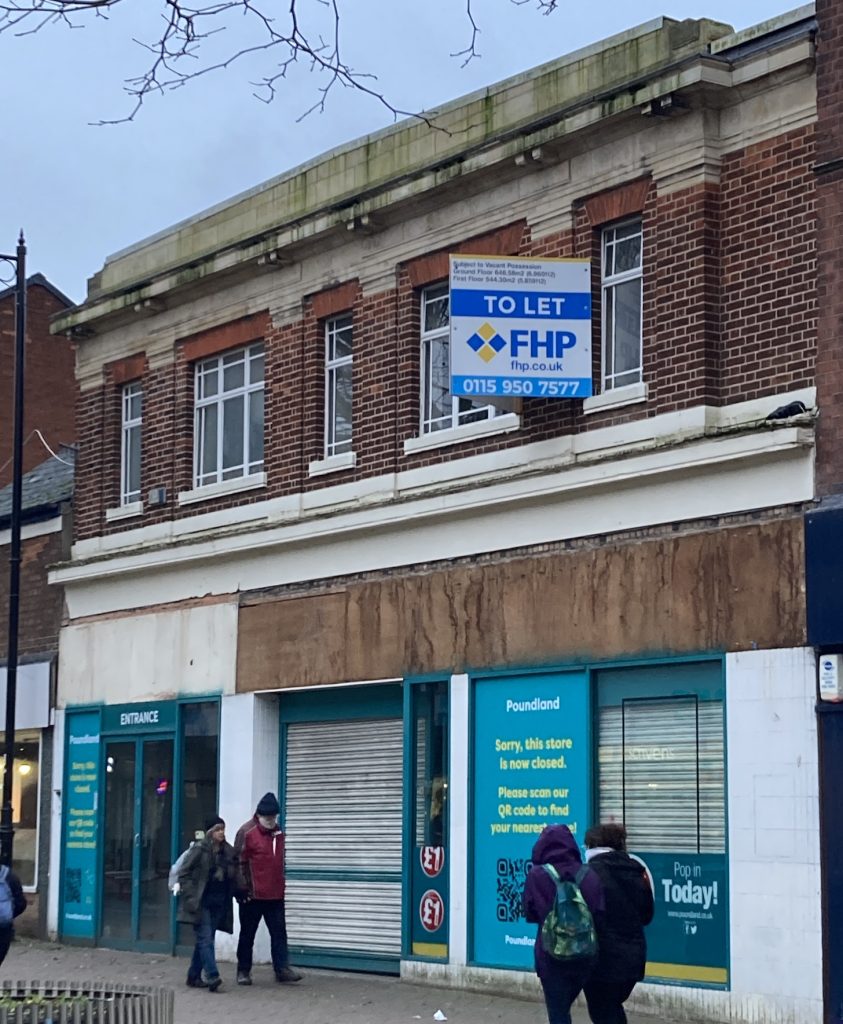
Another Deco-era building I noticed, the recently closed Poundland, was in fact a former Woolworths.
This was Woolworth’s store 578 and was completed in 1934 by their in-house architect, Harold Winbourne. I noticed the parapet and margin glazing in the metal-framed windows. Head over to the Woolies Buildings website for archive pictures of this one in its former glory and to Building Our Past for shop architecture historian Kathryn A. Morrison’s in-depth look at Woolworths and their architects.
Does your neighbourhood have any buildings that catch your eye? Look up and see what you can see next time you’re out. Or if you have a building you’d like me to research – get in touch.
* Bimble; English, informal: a leisurely walk or journey.
** Daunder; Scots: to stroll, saunter or wander aimlessly.
Thanks for reading Watson Fothergill Walk – Lucy Brouwer! Subscribe for free to receive new posts and support my work.
Book the newly renovated function room in a Fothergill building
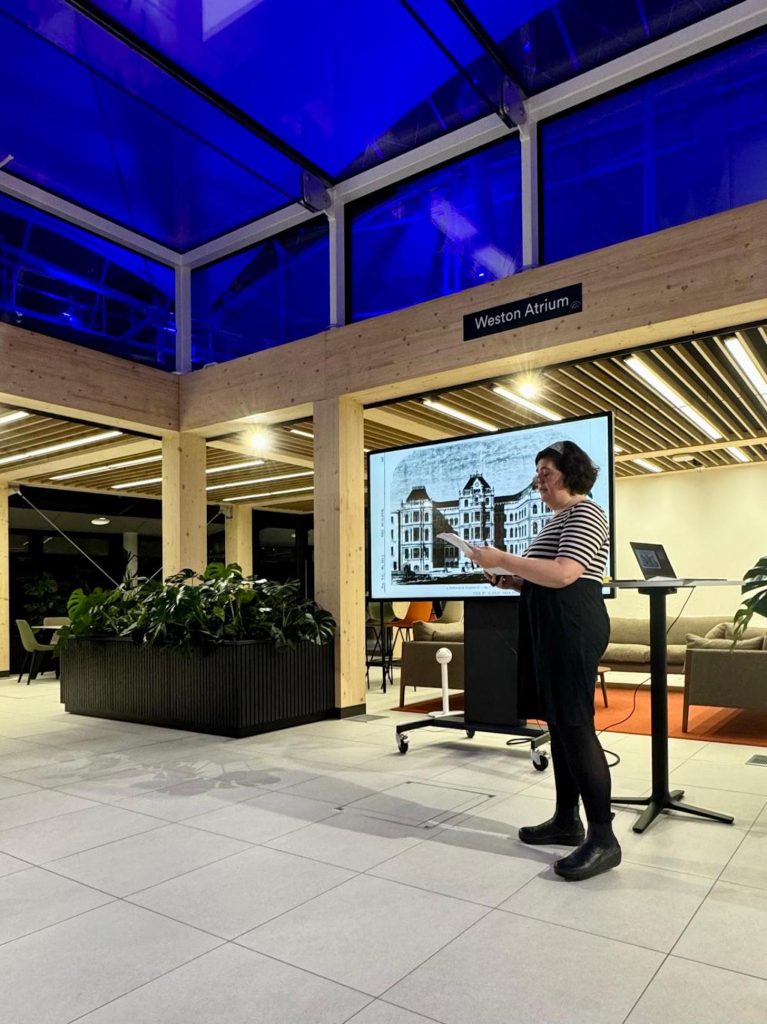
Thanks to everyone who came to the Introducing TC Hine event at the University of Nottingham. It was great to see some familiar faces and to explore the City as Lab project.
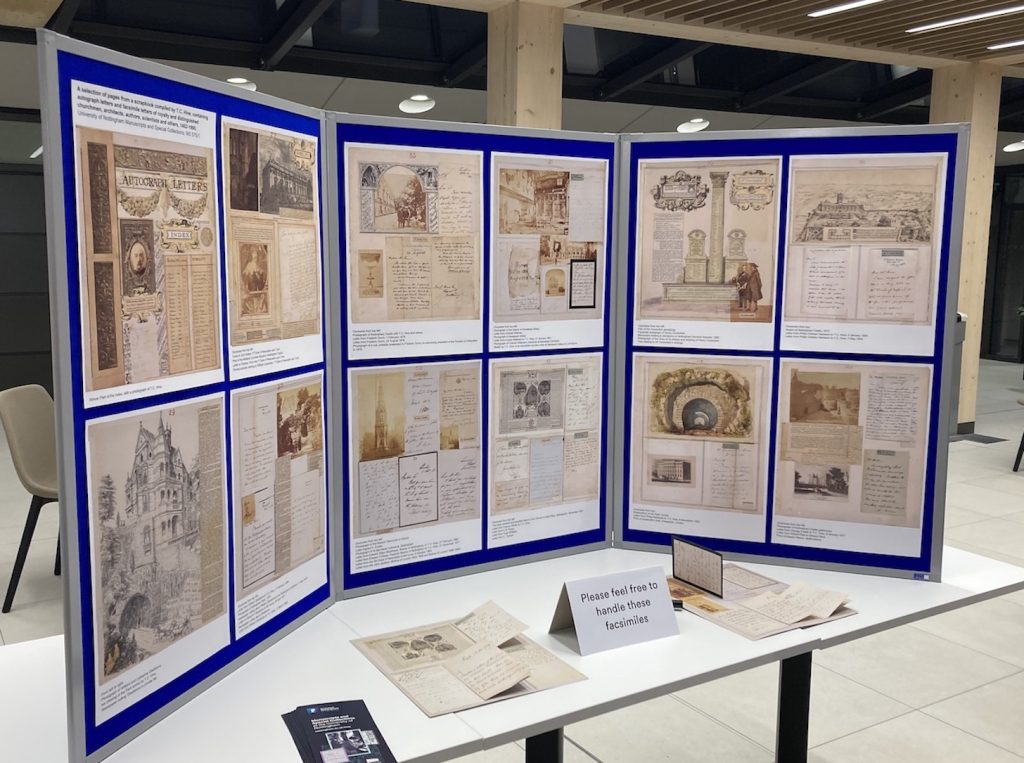
Some pages from the digitisation of TC Hine’s scrapbook. (Photo: Lucy Brouwer)
To continue the TC Hine theme, I’m offering my Hine Hike tour on Sunday 14 December, 11 am. This tour surveys the Nottingham city centre buildings of the Victorian architect Thomas Chambers Hine, from The Park Tunnel to The Lace Market and gives an introduction to his life and work.
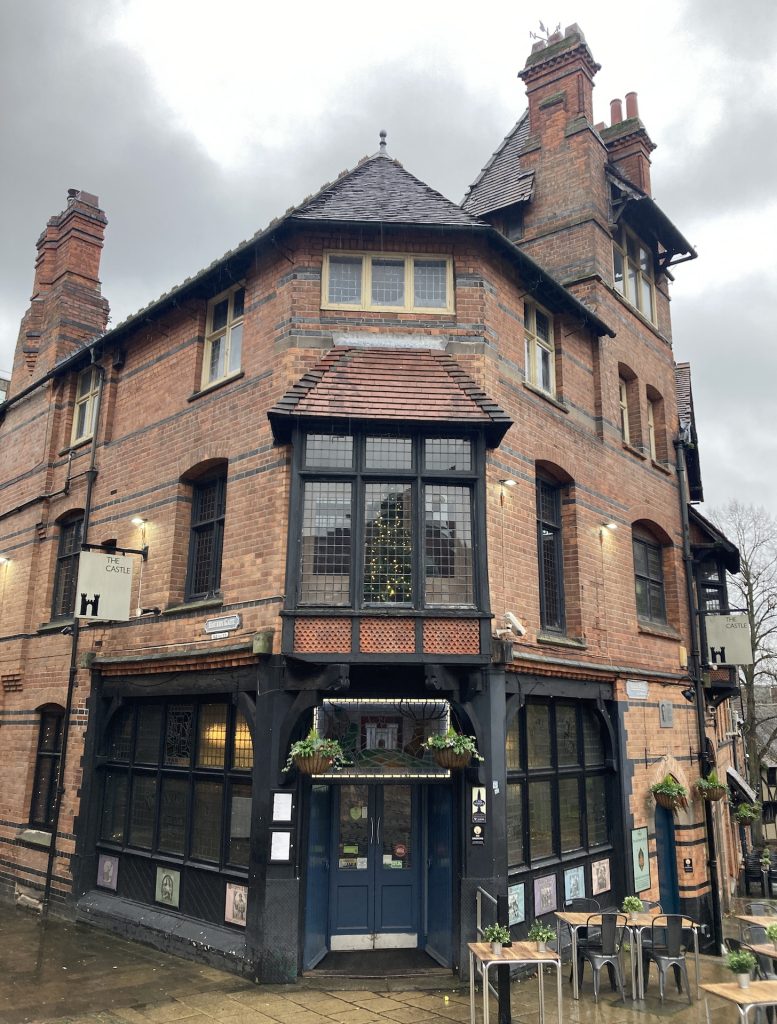
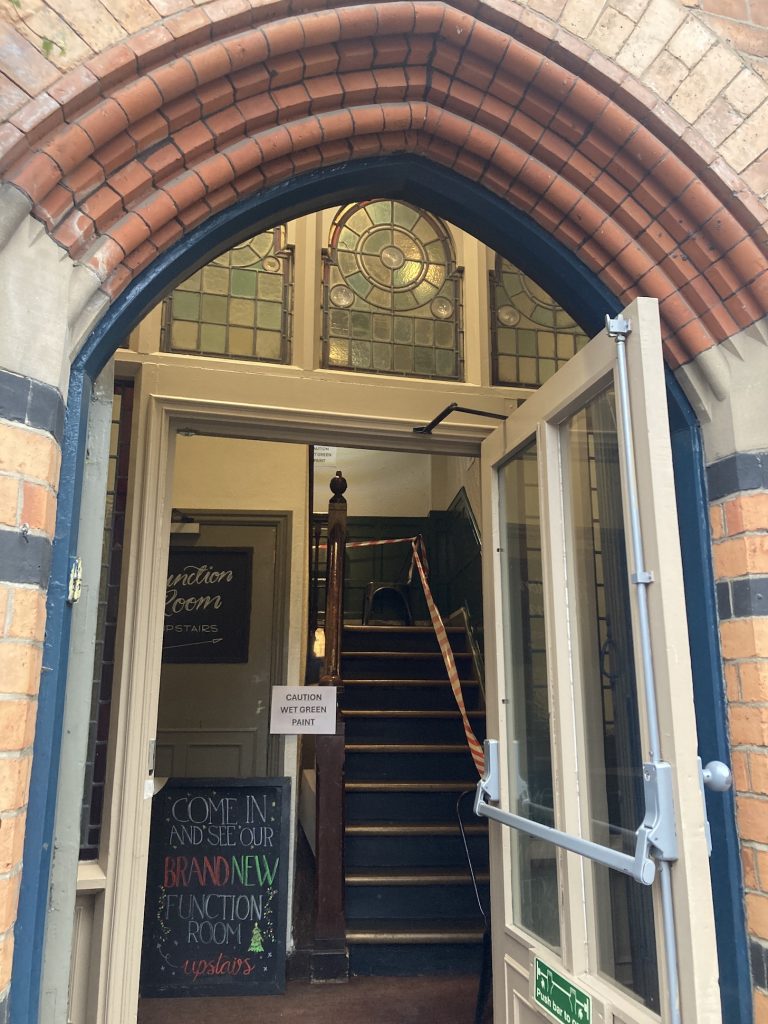
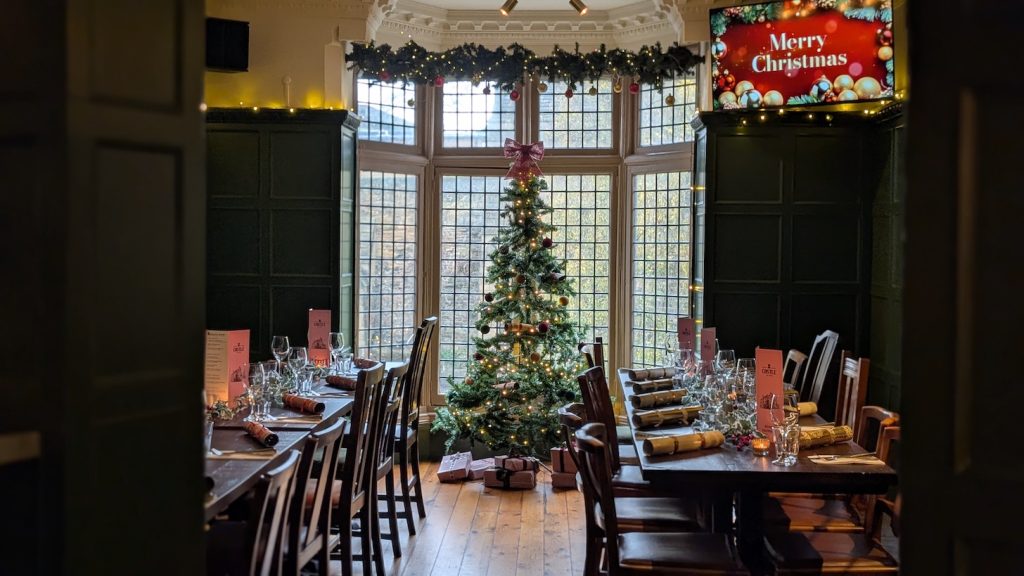
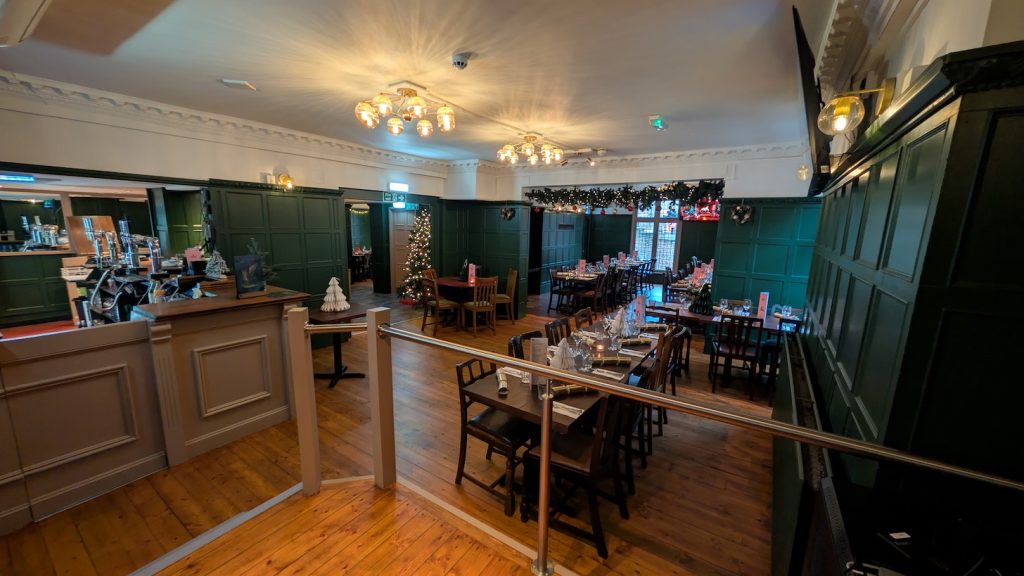
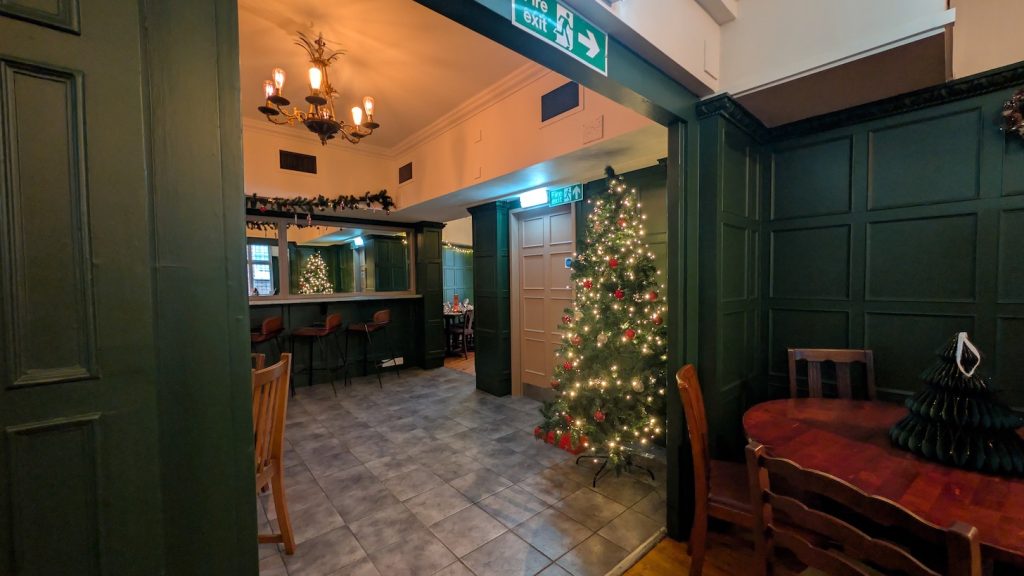
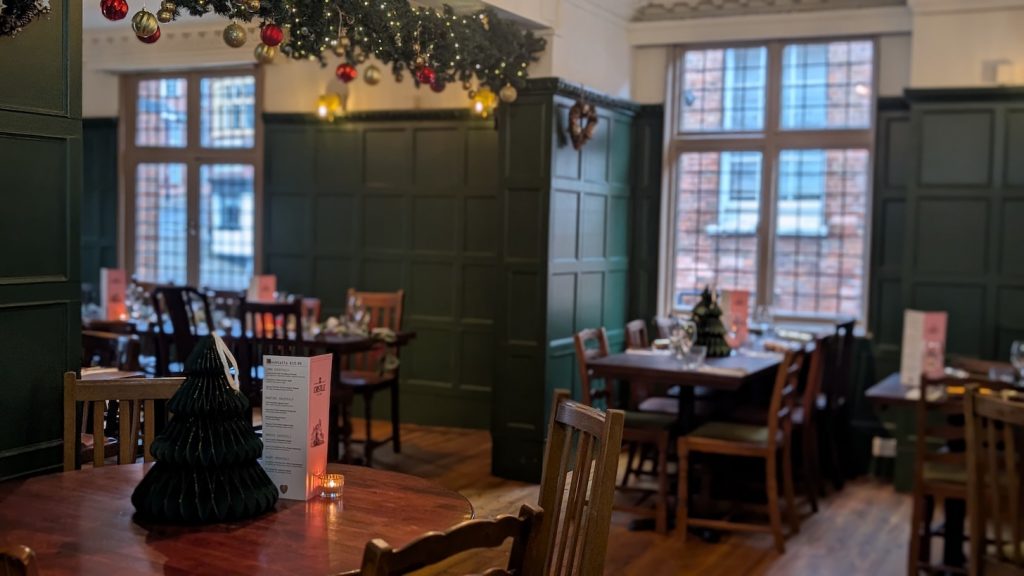
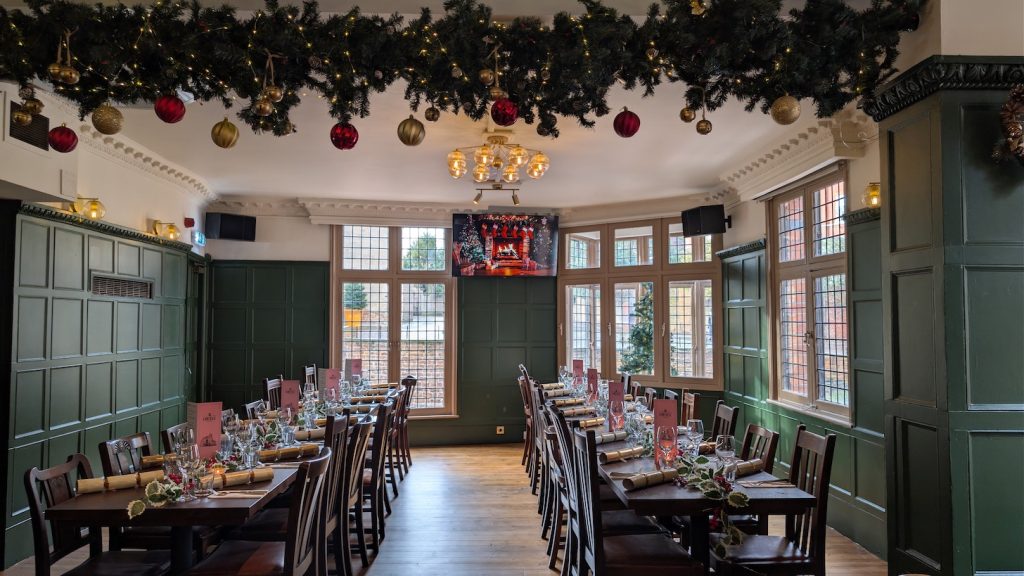
The upstairs function room of The Castle has been renovated and is ready for pre-Christmas bookings. I took a look around inside.
(Photos of the interior courtesy of Eversosensible/ The Castle Pub).
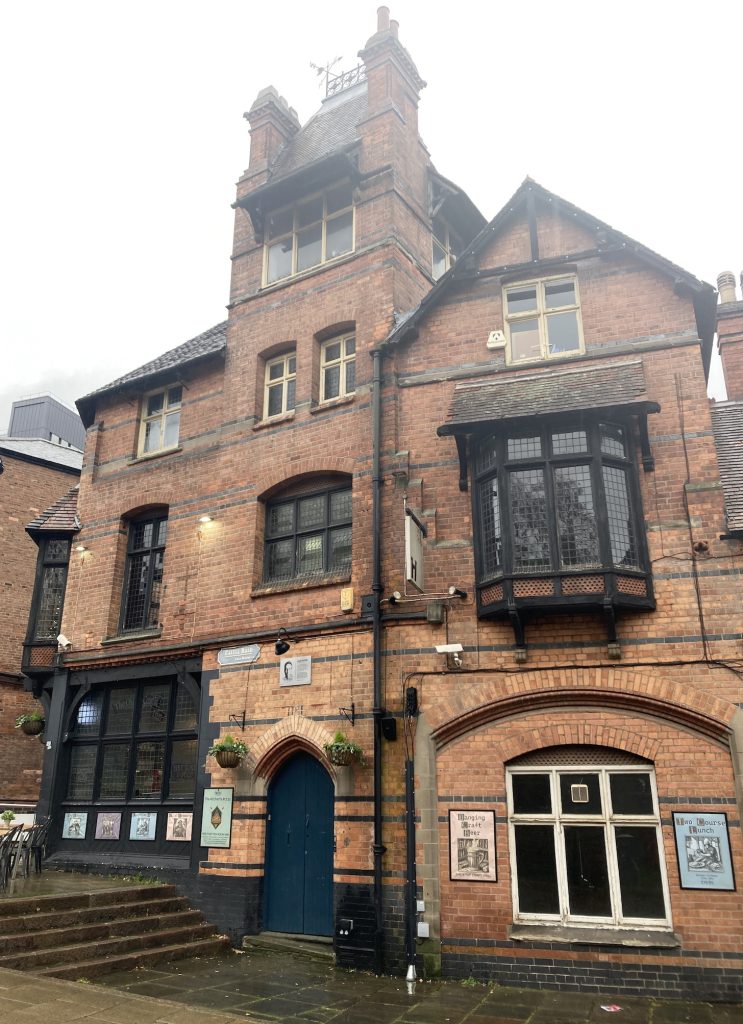
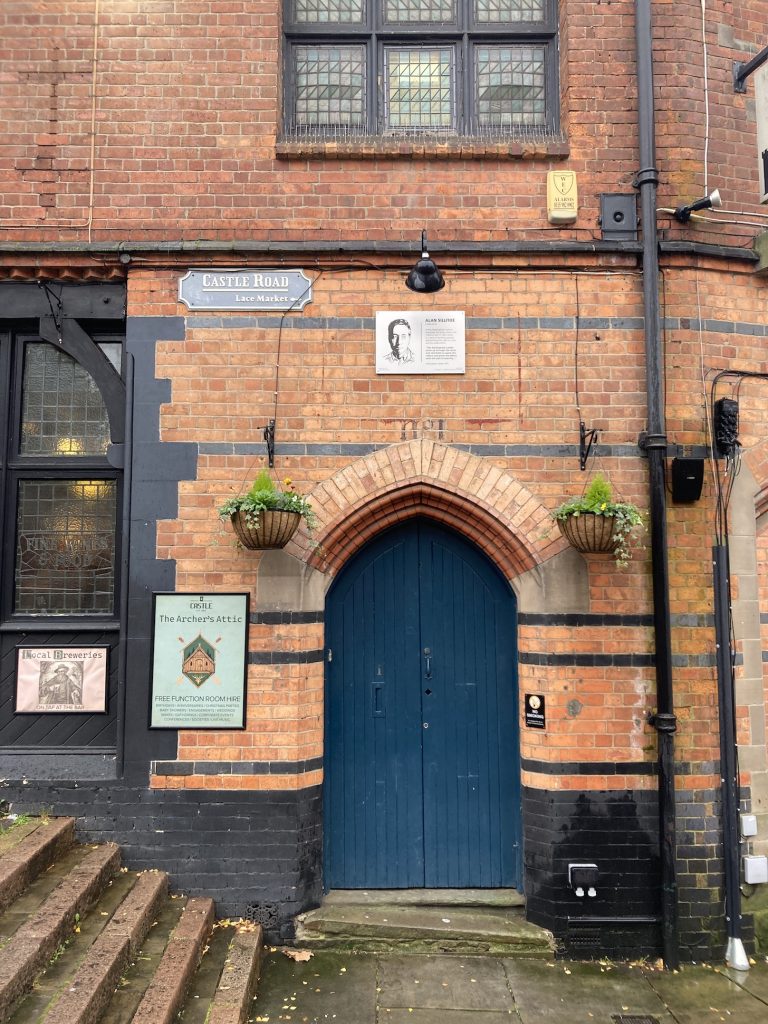
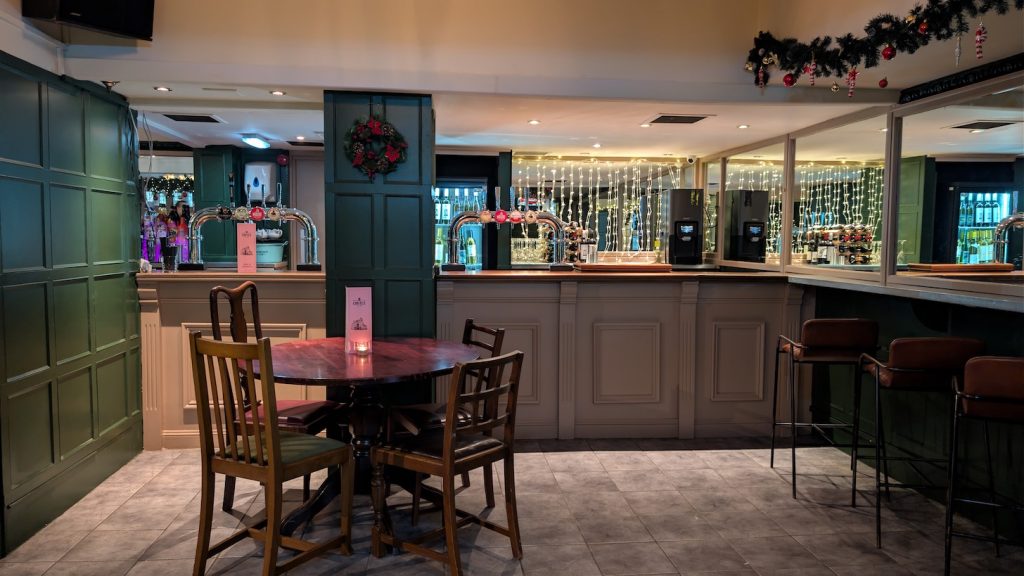
Upstairs in The Archer’s Attic (so called because there’s a great view of the Robin Hood statue), there is a bar, two dining areas with plenty of room for parties or group events, and even space for your own DJ. There’s info on capacity and more photos on the pub’s website. It’s free to hire the room, and they have some pre-Christmas availability so drop them a line if you’re interested in booking.
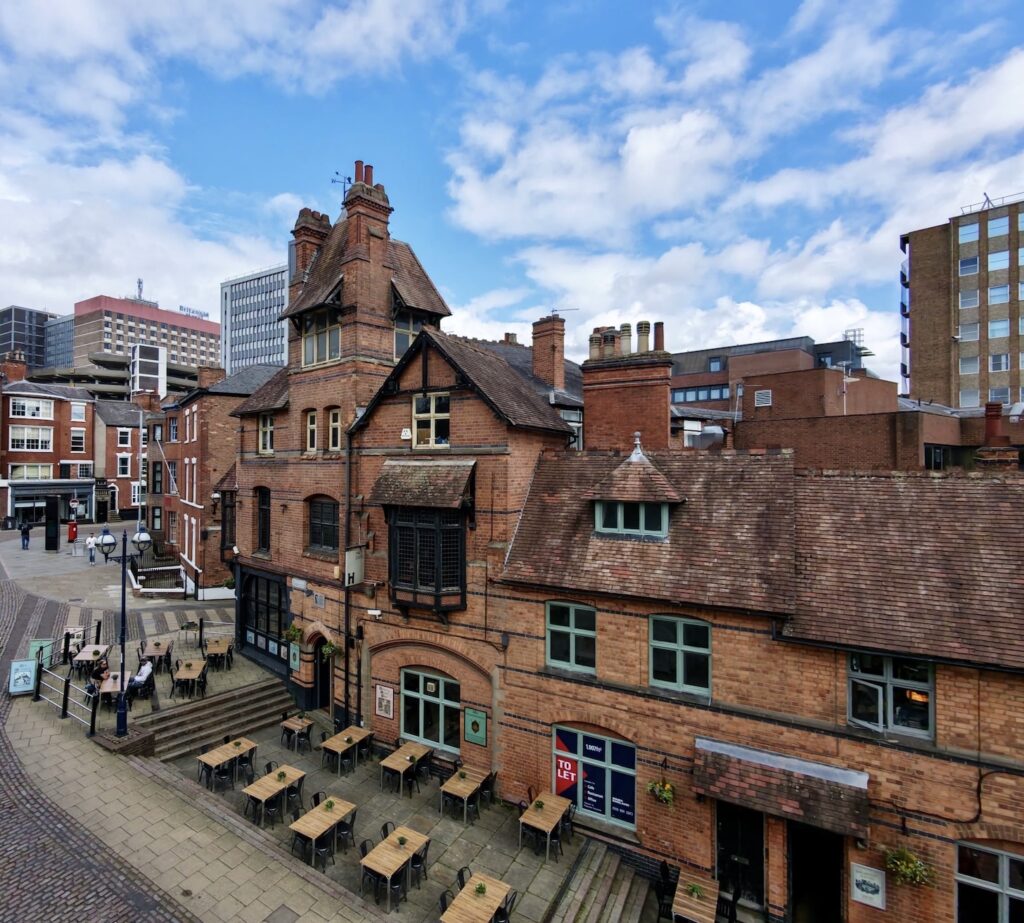
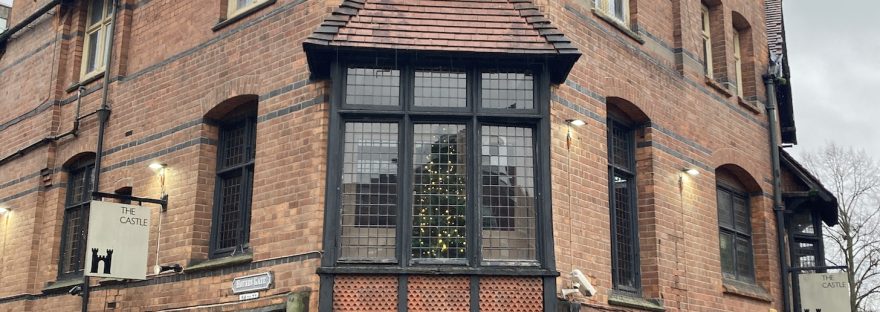
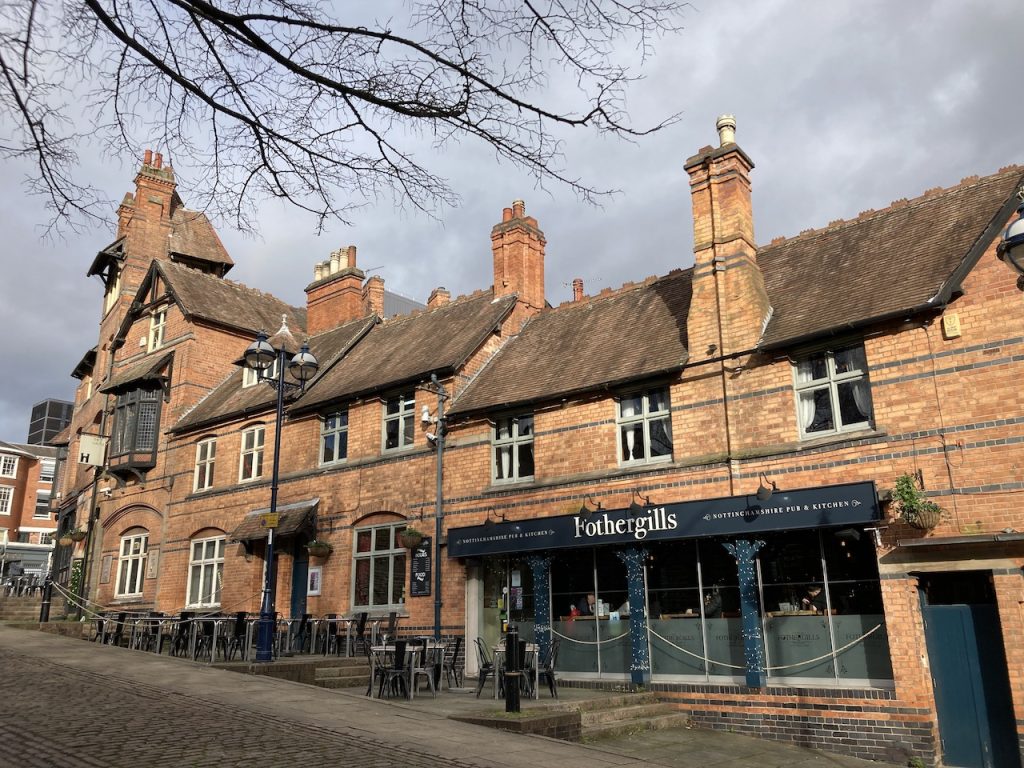
Mortimer House, which is also home to Fothergill’s Pub & Bistro, was built in 1882-83, and represents the Old English elements of Fothergill’s architectural style. Built for Clement Tate, a business man and surveyor, who was based in Nottingham at the time, the building was originally six houses with shops at either end. The Old Castle Inn, as it was then known, has been a public house since 1980, with a brief stint as The Fletcher and Firkin in the 1990s (look for the old Firkin doormat!) It had previously been a tea room, an antique shop and the office of a bankruptcy accountant! These days, it is a listed building and the final stop on my Watson Fothergill Walk guided tour.
Mortimer House, now The Castle and Fothergill’s (Photo: Lucy Brouwer)
The Watson Fothergill Walk will be back in 2026, so make sure you are subscribed to receive dates as they are announced. Gift Vouchers for my tours are available from Gift Up, or you can book a private walk for small groups by contacting me via my website.
Thanks for reading Watson Fothergill Walk – Lucy Brouwer! Subscribe for free to receive new posts and support my work.
I’m working with U of N Manuscripts & Special Collections on something special
If you’ve been on my Hine Hike walking tour, you’ll know that architect Thomas Chambers Hine’s buildings are very important to Nottingham.
In researching the tour, I visited the University of Nottingham’s Manuscripts & Special Collections archives to look at Hine’s scrapbooks. Since then, the archivists have painstakingly digitised these documents, so it’s now possible to view them without handling the fragile pages.
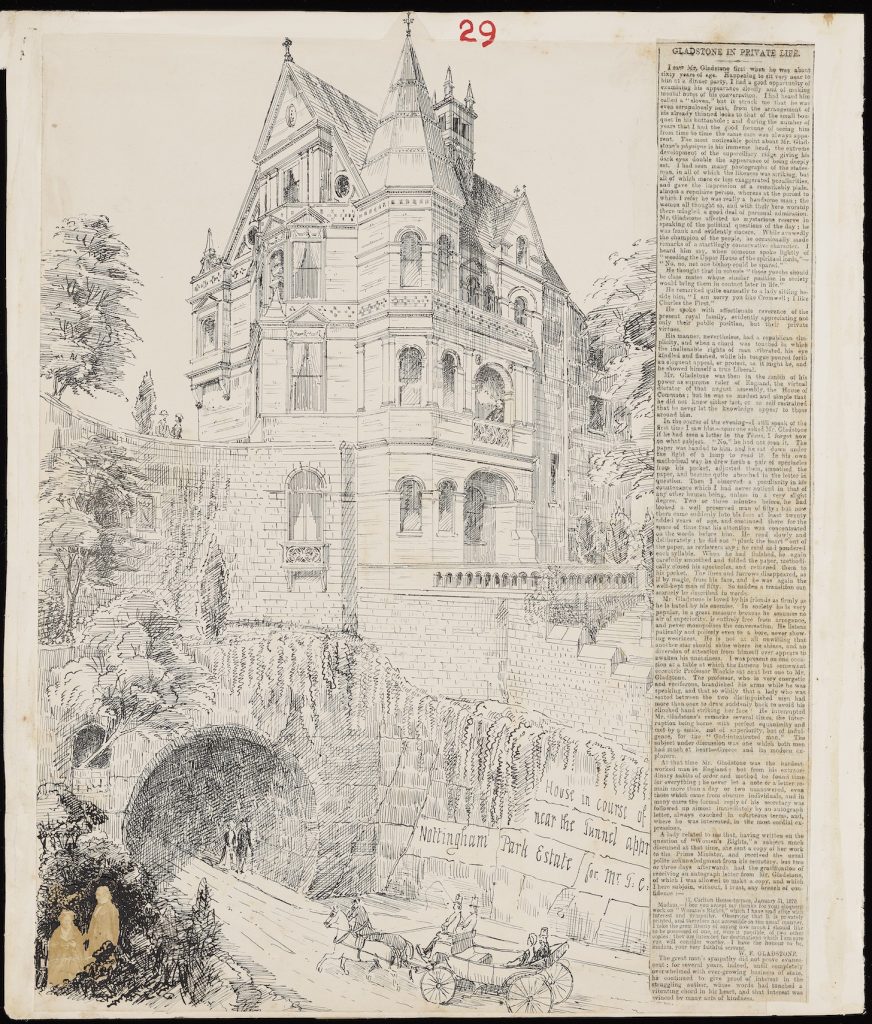
Article and image of The Park Tunnel from the Scrapbook of T. C. Hine, Manuscripts and Special Collections, MS 575/1/164. Please do not reproduce without permission.
To celebrate, a special event will take place on Thursday, 4th December, 5 pm at the newly developed Weston Atrium, Castle Meadow Campus, NG2 1AB (formerly the HMRC building) – The event is free, but places are limited, so please email or phone Manuscripts & Special Collections to book. Keep reading for the contact details :
Introducing T. C. Hine – Manuscripts and Special Collections event at Castle Meadow Campus
Weston Atrium, Castle Meadow Campus, NG2 1AB
Thursday 4th December, 17.00 to 19.00
Manuscripts and Special Collections have recently completed a conservation and digitisation project on a beautifully unique item, the scrapbook of architect Thomas Chambers Hine (1813-1899). Hine designed some of the most iconic buildings in Nottingham including the current Nottingham Castle, Nottingham General Hospital, and The Park Estate. The scrapbook is an extraordinary item personally crafted by Hine himself and includes letters and signatures of royalty, churchmen, architects, authors and many others. As a keen autograph hunter, T.C. Hine collected letters which were signed by famous people and pasted them into a scrapbook, often accompanied by relevant illustrations and manuscript notes, photographs, cuttings from printed works, and engravings of architectural features and buildings that T.C. Hine perhaps admired.
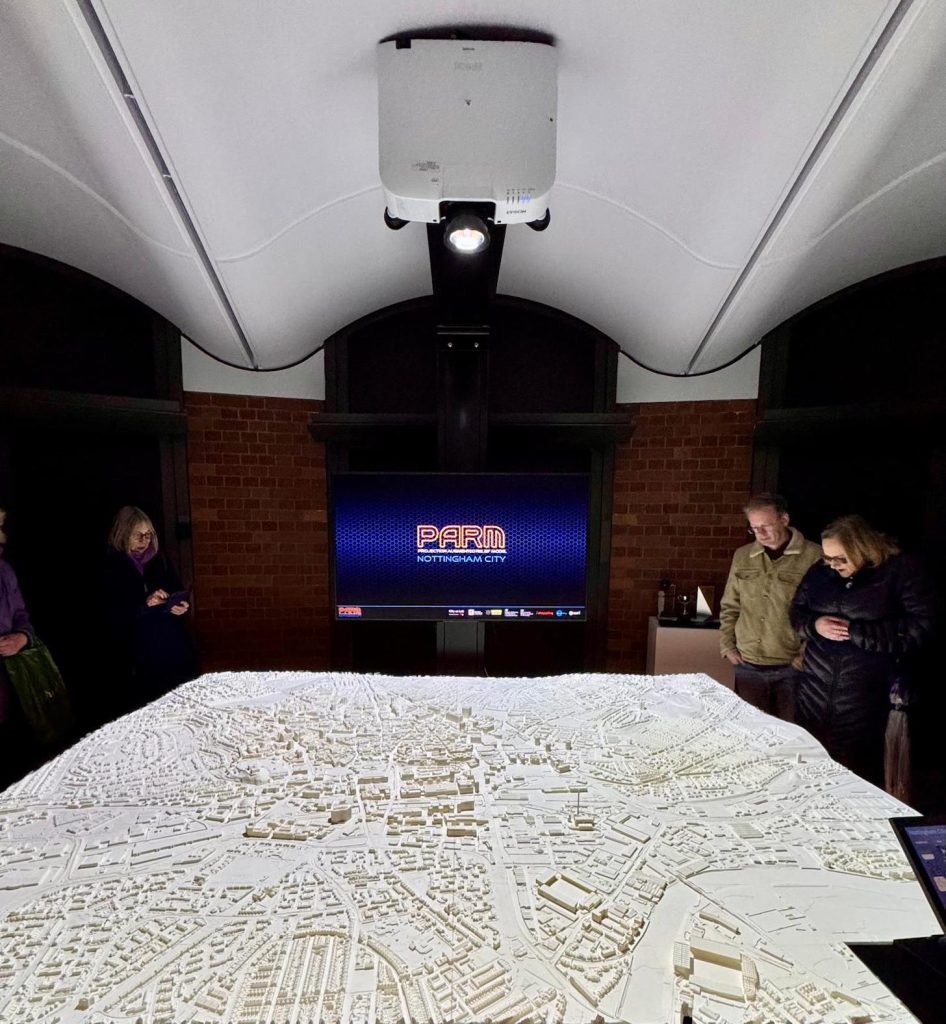
This event will include short talks from Lucy Brouwer, the historian and tour guide who has developed the Watson Fothergill Walk and Hine Hike in the city centre, and Gavin Kinsley (York Archaeology) who will discuss aspects of Hine’s work in Nottingham. After this, attendees will be invited to view an innovative three-dimensional model of the centre of Nottingham onto which is projected locations of Hine’s most notable architectural designs, facilitated by Dr Gary Priestnall (University of Nottingham) and hosted in the ‘City as Lab’ facility adjacent to the event space. Digital images of the scrapbook will also be available for attendees to explore in their own time with refreshments.
The event is free to attend but due to a limited number of places you will need to register in advance. We will also be operating a waiting list. To register, please email Manuscripts and Special Collections on mss-library@nottingham.ac.uk or call us on 0115 95 14565.
Places are limited, so please book in advance. Hope to see you there to talk about Why Hine Matters!
I will also be staging a Hine Hike on Sunday 14 December, 11 am, so wrap up warm and join me to discover the work of Thomas Chambers Hine in Nottingham.